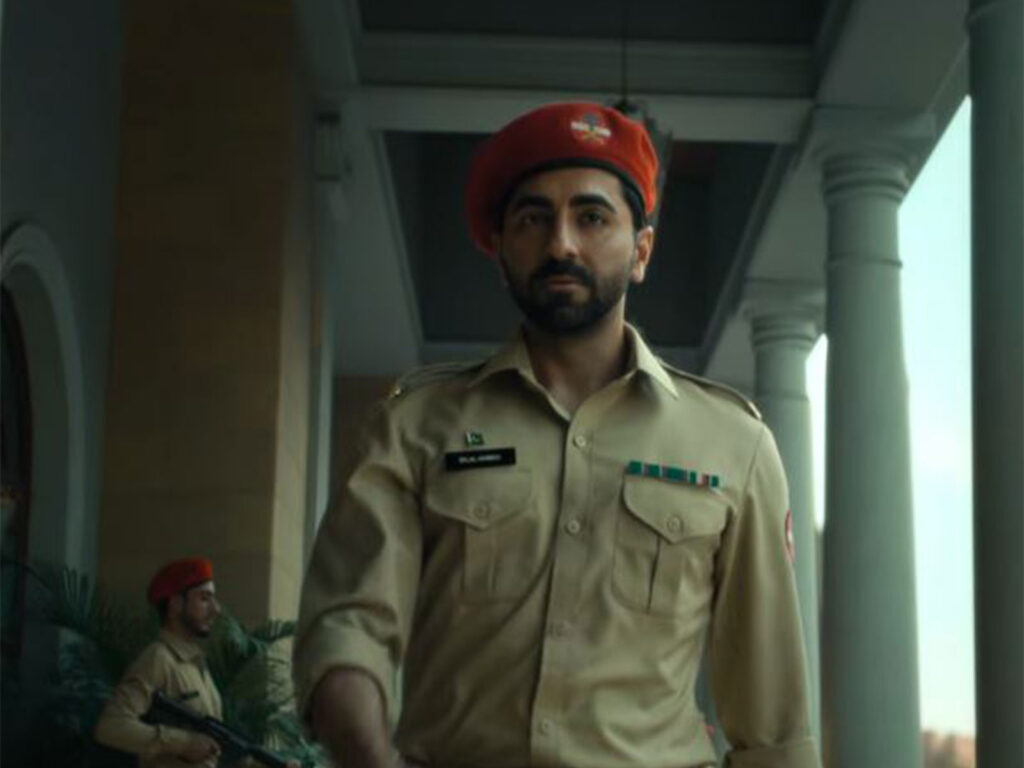
Movie: Udta Teer
Director: Aakash A. Kaushik
Cast: Ayushmann Khurrana, Sara Ali Khan, Rahul Bose, Ram Kapoor, Mukul Dev, Gulshan Grover, Suhail Nayyar
Genre: Spy Comedy, Action, Satire
Release Date: October 23, 2026
What happens when a Pakistani spy working undercover in India loses his memory and starts believing he is a fiercely patriotic Indian officer? That wonderfully absurd question forms the foundation of Udta Teer, an action-comedy starring Ayushmann Khurrana and Sara Ali Khan.
Directed by Aakash A. Kaushik, the film turns the familiar India-Pakistan espionage formula upside down. Instead of celebrating an Indian agent infiltrating enemy territory, it follows a Pakistani operative whose carefully constructed identity becomes his biggest problem.
The concept has considerable comic potential, and there are moments when Udta Teer makes good use of it. Unfortunately, an imaginative premise does not automatically produce a consistently entertaining film.
The central problem is that Udta Teer cannot always decide whether it wants to be a clever spy spoof, a broad patriotic comedy or a conventional action entertainer. That uncertainty becomes increasingly noticeable as the story progresses.
Udta Teer Story: A Spy Who Forgets Which Country He Serves
Ayushmann Khurrana plays Vikrant, an apparently dedicated Indian intelligence officer involved in dangerous counterterrorism operations.
But Vikrant is hiding an extraordinary secret.
His real name is Bilal Ahmed, a Pakistani operative who has successfully infiltrated India’s intelligence establishment. He secretly passes information to handlers across the border while maintaining the appearance of a committed Indian patriot.
His elaborate deception extends into his personal life. Bilal is married to Yamini (Sara Ali Khan), who works in India’s Defence Ministry, making their relationship another complicated part of his undercover existence.
Trouble begins when a mission involving terrorist Azhar Maqsood (Mukul Dev) exposes cracks in the intelligence network. As suspicions grow and competing agendas collide, Bilal becomes involved in an accident that leaves him suffering from amnesia.
When he regains consciousness, he remembers his Indian identity but forgets his original loyalties.
The Pakistani spy suddenly believes he is exactly the patriotic Indian officer he has been pretending to be.
Naturally, this creates chaos for his handlers, colleagues and fellow undercover agents, who struggle to control someone whose allegiance has changed without his knowledge.
The resulting confusion drives much of the comedy while raising an intriguing question about how identity shapes a person’s beliefs.
Ayushmann Khurrana Has an Unusual Role, but the Writing Limits Him
Ayushmann Khurrana has built much of his career around characters caught in uncomfortable circumstances. Films such as Vicky Donor, Badhaai Ho and Dream Girl demonstrated his ability to combine awkward situations with relatable emotions.
Udta Teer offers another unusual challenge, asking him to portray a character whose personality is effectively divided between two identities.
The contrast between Bilal’s calculated deception and Vikrant’s newly discovered patriotism provides the film’s most promising comic material.
The character’s sincerity becomes amusing precisely because the audience knows something he does not.
However, the screenplay doesn’t consistently exploit that contradiction.
Instead of building more inventive situations around Bilal’s uncertain identity, it frequently returns to familiar exaggerations, nationalist punchlines and recognizable Bollywood comedy devices.
Khurrana remains an engaging presence, but the role could have benefited from more psychological complexity.
A man who forgets his loyalties while retaining his professional abilities presents fascinating possibilities. The film seems more interested in generating immediate laughs than exploring what makes this character so strange.
That may satisfy viewers seeking uncomplicated entertainment, but it also leaves the lead performance feeling less distinctive than the premise suggests.
Mukul Dev and the Supporting Cast Provide Much of the Entertainment
The ensemble brings together several accomplished performers, although their opportunities are uneven.
Mukul Dev plays Azhar Maqsood, the terrorist whose activities become central to the unfolding confusion.
His character is presented with exaggerated comic flourishes, including an obsession with a fictional dating application called Hinder.
The absurdity makes Maqsood an unusual antagonist, and Dev’s comic timing has been singled out as one of the film’s more successful elements.
The performance carries additional significance because Udta Teer is among his final screen appearances following his death in 2025.
Ram Kapoor plays Niazi, one of Bilal’s Pakistani handlers, while Gulshan Grover portrays General Mir. Their characters contribute to the film’s increasingly chaotic portrayal of the opposing intelligence establishment.
Rahul Bose appears as Indian intelligence official Burman, whose predicament becomes another source of situational comedy.
Suhail Nayyar also benefits from the complicated network of undercover identities, bringing energy to scenes involving the increasingly unpredictable Vikrant.
Sara Ali Khan, unfortunately, receives less substantial material.
As Yamini, she is connected directly to the protagonist’s double life, yet the film does not fully develop the emotional consequences of that deception.
Her presence contributes to the domestic storyline, but the relationship has the potential to provide considerably more than romantic interruptions between elaborate spy-related jokes.
The Comedy Works Best When Confusion Drives the Humour
The strongest aspect of Udta Teer is its central reversal of the traditional spy thriller.
Most espionage films depend on an undercover operative maintaining a false identity. Here, the operative becomes trapped inside that identity, turning the usual dramatic tension into comedy.
That inversion is naturally entertaining.
It allows the story to create situations where the apparent hero unknowingly sabotages the very people who once controlled him.
The film also uses references to popular Hindi cinema, familiar songs and exaggerated political figures to generate additional laughs.
However, not all these choices are equally effective.
Several jokes rely heavily on caricatures of Pakistan’s political and military establishment. Others draw humour from religious practices and cultural stereotypes.
Political satire can be effective when it exposes hypocrisy or absurdity. It becomes less interesting when an entire group is reduced to predictable comic characteristics.
Udta Teer sometimes struggles with that distinction.
The film’s broader comedy may appeal to audiences who enjoy loud, deliberately unrealistic entertainers, but viewers expecting sharper writing could find its approach repetitive.
Aakash Kaushik’s Direction Struggles With Tonal Balance
Making a successful spy comedy requires more than combining espionage with jokes.
The suspense needs enough credibility to make the danger meaningful, while the humour must feel connected to the characters rather than interrupting the story.
Kaushik, making his feature directorial debut, shows confidence in embracing a deliberately exaggerated world.
The film moves through action sequences, undercover operations, political mockery and domestic complications with considerable ambition.
But ambition occasionally overwhelms coherence.
The first half benefits from the novelty of the premise, particularly as Bilal’s changed personality begins disrupting existing plans.
The later portions reportedly become more complicated, introducing twists and patriotic drama that do not always blend comfortably with the lighter material.
Some critics have praised the escalating surprises, while others have found the screenplay increasingly exhausting.
That division reflects the film’s fundamental creative gamble: it prioritizes entertainment over plausibility, but does not always provide enough inventive humour to justify the shortcuts.
Music and Patriotic Elements Add Energy but Create Distractions
Sachin-Jigar’s songs contribute to the film’s commercial entertainment ambitions, while Ketan Sodha’s background score supports its mixture of suspense and comedy.
The soundtrack includes energetic tracks such as Bhootni Ke and Jai Hind, alongside familiar musical references woven into comedic situations.
These choices reinforce the film’s playful relationship with popular Bollywood conventions.
However, the musical and patriotic elements also reveal its biggest weakness.
Whenever the film leans heavily into sentimental nationalism, the distinctive identity-confusion premise risks becoming secondary.
There is nothing inherently incompatible about patriotism and comedy. The problem arises when the screenplay replaces its cleverest ideas with familiar emotional shortcuts.
The story could have explored how national identity becomes part of someone’s personality, especially when the protagonist’s understanding of himself is so easily disrupted.
Instead, it often settles for broader, more immediate entertainment.
Udta Teer Review Verdict: An Entertaining Idea With Uneven Execution
Udta Teer is an unconventional addition to Bollywood’s increasingly crowded espionage genre.
Its greatest strength lies in an amusing central contradiction: a trained spy becomes unexpectedly dangerous to his own handlers because he genuinely believes his cover story.
Ayushmann Khurrana brings credibility to the unusual protagonist, while Mukul Dev and several supporting performers contribute memorable comic moments.
Unfortunately, the film’s inconsistent writing, uneven characterization and dependence on broad stereotypes limit its potential.
Published reviews have been sharply divided, with some praising its energetic comedy and surprises while others criticize its lack of tonal control.
The verdict: Udta Teer offers an amusing premise and occasional bursts of effective comedy, but its reliance on familiar patriotic formulas prevents it from becoming the consistently clever spy satire it could have been.
Viewers who enjoy exaggerated Bollywood entertainers may appreciate the chaos. Those looking for disciplined storytelling, subtle satire or convincing espionage will probably find it less satisfying.