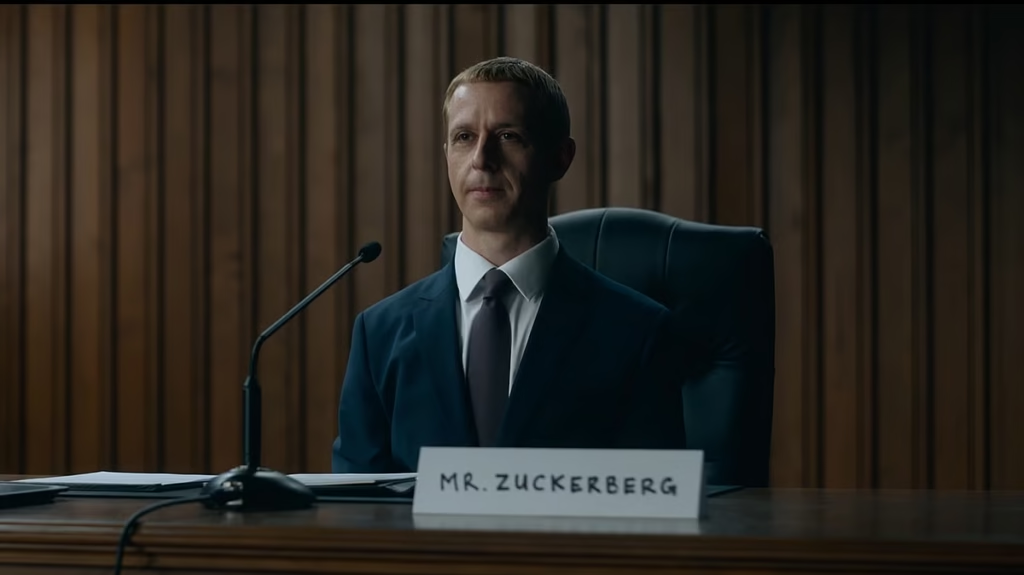
Aaron Sorkin’s The Social Reckoning returns to the world of Facebook 16 years after The Social Network, but the question has changed considerably. David Fincher’s 2010 film explored how a socially awkward Harvard student built a digital empire. This time, the story examines what happened after that empire became powerful enough to influence public opinion, political conversations and the way millions of people consume information. The result is an ambitious investigative drama with compelling performances and a fascinating real-life foundation, although its determination to make a point sometimes gets in the way of telling a more complicated story.
Written and directed by Sorkin, the film stars Mikey Madison as former Facebook employee Frances Haugen, Jeremy Allen White as The Wall Street Journal reporter Jeff Horwitz and Jeremy Strong as Mark Zuckerberg. Rather than continuing the original film’s story of ambition, friendship and betrayal, The Social Reckoning focuses on the 2021 Facebook Files investigation, which exposed troubling internal research and raised serious questions about the company’s approach to user safety.
It is a worthwhile subject for a film, especially when social media has become such an ordinary part of everyday life. Yet the challenge for Sorkin is that audiences are no longer discovering Facebook’s darker side for the first time. The damage associated with misinformation, online extremism and engagement-driven algorithms has been discussed for years. Turning those familiar concerns into a genuinely surprising dramatic experience proves more difficult.
Mikey Madison gives the film its strongest emotional centre
The most effective creative decision is shifting attention away from Zuckerberg and placing Frances Haugen at the centre of the story. Madison portrays her as an intelligent, determined employee who initially believes Facebook can become a better company. Her growing frustration comes from recognising problems within the organisation while struggling to convince the people around her that those problems deserve urgent attention.
That approach gives the film something more personal than another argument about corporate responsibility. Haugen is not presented simply as someone determined to expose her employer. She is a professional whose belief in the company’s original purpose gradually conflicts with what she discovers about its internal priorities. The tension between loyalty and responsibility makes her a more interesting protagonist than a conventional whistleblower hero.
Madison’s restrained performance appears particularly well suited to that conflict. After the emotional intensity of her Oscar-winning work in Anora, she takes on a character whose strength emerges through persistence rather than dramatic confrontation. Her quieter approach provides a necessary counterweight to Sorkin’s dialogue-heavy screenplay.
Jeremy Allen White is equally important as Jeff Horwitz, the journalist who helps bring Haugen’s findings into public view. Their working relationship creates the film’s most engaging dramatic thread. Horwitz understands reporting and verification, while Haugen understands the complicated systems the investigation seeks to expose. Neither can accomplish much without the other’s expertise.
The exchanges between them offer a practical explanation of investigative journalism without turning every conversation into a technical lecture. Their disagreements also matter because the process of turning confidential information into a responsible news story involves professional judgement, patience and trust.
The difficulty is that Sorkin’s dialogue can sometimes make characters sound more like participants in an expertly rehearsed debate than individuals struggling through uncertain circumstances. His ability to turn complicated ideas into entertaining conversations remains impressive, but the constant verbal precision can reduce the sense of spontaneity.
Jeremy Strong’s Zuckerberg is striking but less complicated
Jeremy Strong faces a particularly difficult task in taking over the role of Mark Zuckerberg from Jesse Eisenberg. In The Social Network, Eisenberg portrayed a young entrepreneur whose insecurity, intelligence and ambition were tangled together. Strong’s interpretation is noticeably different. His Zuckerberg is older, wealthier and accustomed to operating from a position of extraordinary authority.
The performance emphasises emotional distance. Strong presents Zuckerberg as a corporate figure who appears more comfortable discussing business consequences than acknowledging the human implications of his decisions. His measured delivery and carefully controlled physical presence make him unsettling, particularly when contrasted with the urgency displayed by Haugen and Horwitz.
However, the character is also one of the film’s weaknesses. While Eisenberg’s Zuckerberg remained difficult to understand, he was rarely predictable. Strong’s version is presented through a narrower set of motivations, with the screenplay repeatedly drawing attention to the conflict between financial success and social responsibility.
Bill Burr brings some welcome energy as Charlie, a fictionalised former Facebook insider who challenges Zuckerberg’s thinking. His confrontations provide opportunities for Sorkin’s sharpest exchanges, although they also underline the filmmaker’s tendency to let characters deliver arguments that sound suspiciously like the conclusions he wants viewers to reach.
The supporting cast, including Betty Gilpin and Wunmi Mosaku, adds professional tension to the corporate and journalistic environments. Still, the central performances do much of the work in keeping the material engaging.
Aaron Sorkin’s biggest problem is living up to The Social Network
Comparisons with The Social Network are unavoidable, even if The Social Reckoning is better understood as a companion film than a conventional sequel.
Fincher’s original worked because its filmmaking created tension beyond the dialogue. The cold visual compositions, controlled editing and electronic score by Trent Reznor and Atticus Ross gave Facebook’s origin story an atmosphere of ambition, paranoia and emotional isolation. It made ordinary conversations about websites, contracts and ownership feel consequential.
Sorkin’s direction takes a more conventional approach. The new film reunites him with cinematographer Jeff Cronenweth, but the visual storytelling is less distinctive. Corporate meetings, investigative conversations and congressional preparations are presented with the efficiency of a polished political drama rather than the uncomfortable precision that made Fincher’s film memorable.
Alexandre Desplat’s music also represents a different creative direction. Where the original score contributed to the feeling that technology was transforming human relationships in unsettling ways, this film leans more heavily on the emotional traditions of investigative and institutional dramas.
That difference is not automatically a failure. Sorkin has repeatedly demonstrated his ability to create absorbing entertainment from conversations, competing priorities and characters trying to accomplish something difficult. His work on The West Wing, The Newsroom and The Trial of the Chicago 7 reflects that particular strength.
However, The Social Reckoning seems most convincing when it concentrates on how Haugen and Horwitz work together, and less effective when its characters become vehicles for explaining what audiences should think about Facebook.
One especially important example involves the film’s treatment of social media algorithms. Rather than merely presenting technology as harmful, the investigation explores how recommendation systems can amplify inflammatory material and how internal research raised concerns about those consequences. The story becomes more interesting when it examines the decisions behind those systems instead of simply repeating that online misinformation is dangerous.
There is also a limitation to the film’s treatment of actual events. Sorkin compresses and rearranges parts of the historical timeline for dramatic purposes, bringing developments surrounding the Facebook Files and Zuckerberg’s congressional appearances closer together. These changes help the narrative maintain momentum, but viewers should not mistake every depicted sequence for an exact account of what happened.
The verdict: An important story that needed more complexity
Perhaps the film’s most difficult challenge is its ending. The real Facebook Files investigation helped bring important information into public view, and Haugen’s decision to speak openly about her experiences was significant. But exposing a problem and solving it are very different achievements.
That distinction is especially relevant in 2026, when debates surrounding algorithmic influence, platform accountability and online safety remain active. A story celebrating the exposure of corporate wrongdoing can feel incomplete when the broader issues have not disappeared.
The Social Reckoning benefits from committed performances, a strong investigative premise and Sorkin’s ability to make complicated professional conversations accessible. Madison and White provide the emotional foundation, while Strong gives Zuckerberg a deliberately uncomfortable presence. Yet the film appears too eager to identify its heroes and villains, leaving less room for the ambiguity that made its predecessor so compelling.
It is a thoughtful companion to The Social Network, even if it lacks that film’s distinctive atmosphere and dramatic complexity. Its strongest material is not about proving that Facebook became too powerful. It is about the difficult process of challenging an organisation that has already become indispensable to much of the world.
For audiences interested in journalism, technology and corporate accountability, there is considerable value in revisiting that story. Those expecting another cinematic achievement on the level of Fincher’s original may find the experience more conventional than anticipated.