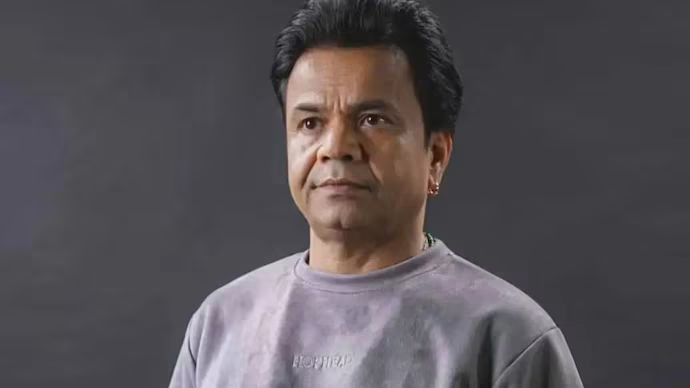
Rajpal Yadav has received a crucial—but sharply conditional—window from the Supreme Court in his long-running cheque-bounce dispute. On October 7, the court accepted a proposal under which the actor plans to sell ancestral property to clear outstanding dues linked to financing for his 2012 film Ata Pata Laapata. At the same hearing, however, the bench made clear that its patience with the actor’s payment record is running thin and warned that his existing three-month imprisonment could potentially be enhanced to two years.
A bench comprising Chief Justice of India Surya Kant and Justices Joymalya Bagchi and V Mohana took note of arrangements for an immediate ₹2 crore payment. Yadav produced demand drafts worth ₹1.15 crore, while a prospective buyer of his property agreed to contribute another ₹85 lakh. According to the proceedings, that second payment is expected by October 12.
The ₹2 crore, importantly, does not settle the entire dispute. The court indicated that once these payments are made, it will lay down a schedule governing how the remaining amount must be cleared.
The property sale could become the key to clearing the balance
Yadav’s lawyer told the Supreme Court that a buyer for the ancestral property was present in court and willing to pay ₹85 lakh in advance. Asked about the property’s value, his counsel said: “The property value is worth more than ₹30 crore.”
The complainant’s lawyer also indicated willingness to give Yadav three months to clear the remaining amount once the initial ₹2 crore was paid. That is what makes Wednesday’s development significant: rather than simply extending another payment deadline, the court now has a specific asset-sale proposal before it that could provide a practical route toward recovering the outstanding money.
Still, the bench did not treat the proposal as proof that Yadav had satisfactorily complied with his earlier commitments.
Justice Bagchi said, “We are not satisfied with this. This conduct does not satisfy us.” The court indicated that its accommodation was being given primarily so the complainant could recover the money owed. Justice Bagchi also warned that the bench was inclined to consider increasing Yadav’s imprisonment from three months to as much as two years.
That warning is especially important because the present proceedings are not simply about whether Yadav can arrange money now. His conduct during years of litigation and repeated payment assurances has become a major issue before the courts.
How Ata Pata Laapata led to the dispute
The case dates back to financial arrangements surrounding Yadav’s Ata Pata Laapata. Delhi High Court records state that Murli Projects Pvt Ltd provided ₹5 crore in connection with the film in 2010. Subsequent agreements revised the amount payable as deadlines were extended, eventually taking it to approximately ₹11.10 crore under an August 2012 agreement.
Seven cheques later became the subject of complaints under Section 138 of the Negotiable Instruments Act after they were dishonoured. Yadav and his wife, Radha Rajpal Yadav, challenged the proceedings on multiple grounds, including their contention that a later consent agreement affected the validity of the earlier cheques. The Delhi High Court rejected the request to quash the complaints.
In its July 10, 2026 judgment, the Delhi High Court affirmed Yadav’s conviction and sentenced him to three months’ simple imprisonment in each of the seven cheque-bounce cases, with the substantive sentences running concurrently. It also imposed a fine of ₹1.05 crore in each case after accounting for payments already made.
The High Court was particularly critical of repeated assurances that did not translate into payment. Its judgment records multiple occasions on which undertakings were given and later remained unfulfilled. It also noted that ₹2.25 crore had been deposited during the proceedings and released to the complainant.
Why the Supreme Court has not simply sent Yadav back to jail
The latest hearing shows the tension at the centre of the case. On one side is Yadav’s existing conviction and what the courts have described as a history of unmet undertakings. On the other is the practical question of how the complainant can recover the money.
The Supreme Court appears, for now, to be prioritising recovery. That explains why the bench has entertained the ancestral-property proposal even while openly questioning Yadav’s conduct.
The next crucial step is therefore financial rather than cinematic: the promised ₹2 crore must actually reach the court or complainant as directed, after which a timetable for clearing the remaining liability can be fixed.
For Yadav, the difference between another opportunity and a substantially tougher sentence may now depend less on assurances and more on whether the money arrives when promised.