Adapting East of Eden is the kind of assignment that can make prestige television feel terrified of its own source material. John Steinbeck’s 1952 novel spans generations, wrestles openly with good and evil, moves from intimate family resentments to enormous questions about whether people can escape the sins handed down to them, and contains enough story for several separate dramas.
Zoe Kazan’s seven-episode Netflix adaptation does not capture every piece of it. It could not.
What it does remarkably well is find two very different human centers inside all that literary weight.
Florence Pugh’s Cathy Ames brings danger into the story. Hoon Lee’s Lee gives it hope.
Between them sits a rich, sometimes unwieldy family saga involving brothers Adam and Charles Trask, the next generation of Trask sons, jealousy, inherited pain and the possibility that being shaped by your past does not necessarily mean being sentenced by it.
The series is occasionally too solemn and inevitably loses some of the novel’s breadth, but when it stops trying to carry Steinbeck’s entire philosophical universe on its shoulders and concentrates on people making terrible or compassionate choices, East of Eden becomes genuinely absorbing television.
PopcornRealm Rating: 4/5
Netflix’s East of Eden is created by Kazan, who serves as co-showrunner with Jeb Stuart. Garth Davis directs Episodes 1-4, with Laure de Clermont-Tonnerre handling the final three. The cast includes Pugh, Christopher Abbott, Mike Faist, Hoon Lee, Ciarán Hinds, Martha Plimpton, Joseph Zada and Joe Anders.
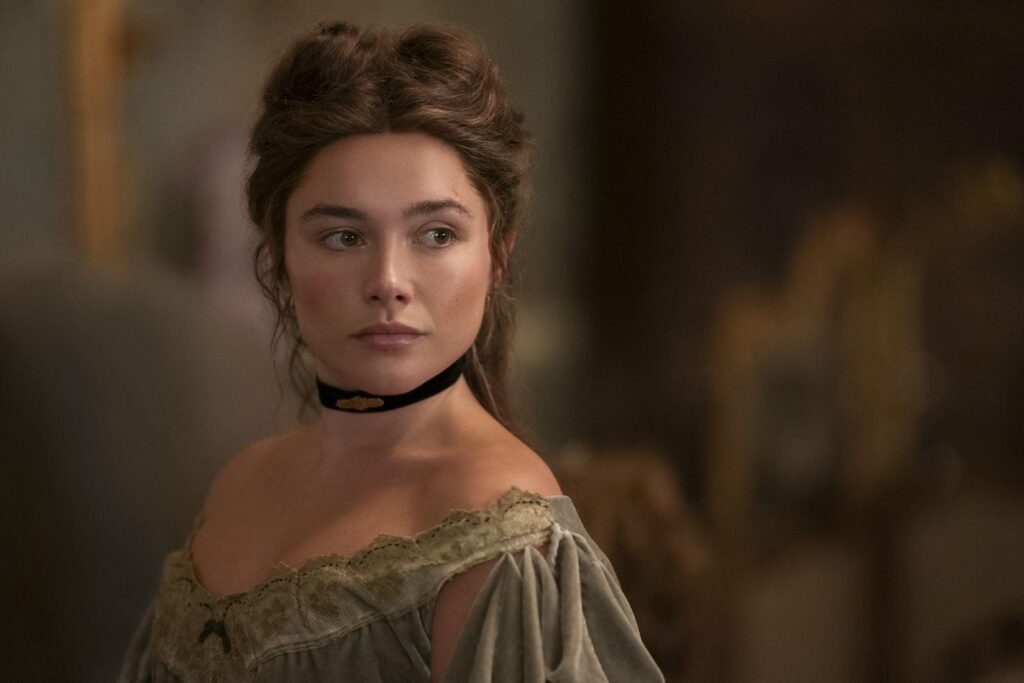
Florence Pugh refuses to make Cathy easy to understand
Cathy Ames is one of the biggest traps in East of Eden.
Treat her as straightforward evil and she becomes dramatically flat. Explain every awful thing she does through trauma and the adaptation risks softening a character Steinbeck deliberately made deeply disturbing.
Pugh finds a more interesting space between those extremes.
Her Cathy can be frighteningly calculating without looking like an actor announcing that she is playing a villain. She observes people, works out what they want and understands how desire can be turned against them. When kindness is offered to her, she does not automatically interpret it as kindness. She seems to examine it for leverage.
That makes Cathy’s relationship with Adam Trask particularly uncomfortable.
Christopher Abbott plays Adam as a man capable of projecting an ideal onto another person so completely that he often fails to see the person standing in front of him. Cathy tells him, through words and behaviour, that the future he imagines is not necessarily hers. Adam keeps trying to fit her into that future anyway.
Pugh exploits that disconnect beautifully.
Cathy is not sympathetic simply because the adaptation gives her more interiority. Some of her decisions are brutal. What changes is that the series becomes interested in the difference between understanding someone and absolving them.
That distinction gives Pugh much more to play than simple wickedness.
The Los Angeles Times similarly identifies Cathy as the adaptation’s most dynamic character, while noting that Pugh brings nuance to a role whose basic nature does not traditionally invite a conventional redemption arc.
Pugh’s best scenes frequently involve silence.
She can allow Cathy’s face to become almost unreadable while another character tells her what he believes she feels. Then a tiny shift reminds us that Cathy is listening, calculating and frequently several emotional steps away from everyone else.
It is a performance that keeps the series dangerous.
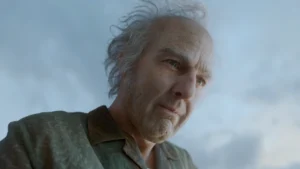
Hoon Lee quietly becomes the show’s emotional center
And then there is Lee.
Hoon Lee does almost the opposite of Pugh.
His performance is not built around volatility. It grows through patience, humour, intelligence and the gradual sense that Lee sees this family more clearly than many of its actual members do.
In Steinbeck’s story, Lee is a Chinese American servant in the Trask household, but reducing him to that job description misses almost everything important about the character. He becomes confidant, intellectual partner, caretaker and eventually one of the people most capable of articulating the story’s central belief in human choice.
Netflix’s own trailer gives him a line that essentially summarizes the adaptation’s thesis: the future does not have to be determined by the past.
Hoon Lee makes that philosophy feel lived rather than quoted from an important novel.
His performance also explores the compromises Lee makes to navigate the assumptions white Americans place upon him. The character can alter the way he speaks and presents himself depending on who is listening, while maintaining an interior life considerably richer than many people around him bother to imagine.
There is wit in that performance, but also accumulated exhaustion.
Most importantly, he brings tenderness without sentimentality.
As the Trask story moves into another generation, Lee increasingly becomes part of the emotional architecture holding the family together. He understands how destructive secrets can be, but he also understands that truth delivered without compassion can become its own kind of weapon.
Esquire called Hoon Lee a revelation, praising the way the actor expands the character into the human expression of the story’s belief in the possibility of change. That is difficult to argue with.
Without Florence Pugh, East of Eden loses much of its electricity.
Without Hoon Lee, it loses its heart.
Christopher Abbott and Mike Faist make the first brotherhood hurt
Before the story can examine another generation, it establishes its first Cain-and-Abel relationship through Adam and Charles Trask.
Christopher Abbott and Mike Faist are very well matched.
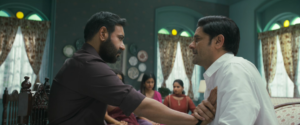
Abbott gives Adam an almost painful openness. His goodness is genuine, but the series is smart enough to show that goodness does not automatically make someone perceptive. Adam can be generous while completely misunderstanding another person. He can love an idea so intensely that he ignores reality.
Faist’s Charles is rougher and easier to distrust at first glance, but his resentment grows from an emotional wound the show establishes efficiently: he believes their father prefers Adam.
That rivalry could have become broad biblical symbolism.
Instead, Abbott and Faist keep it personal.
Charles’ anger is not interesting because viewers are supposed to decide whether he represents evil. It works because he desperately wants affection and has learned to experience its absence as humiliation.
Tracy Letts, as their father Cyrus, helps establish how easily parents can create competition between children without understanding how long the damage may survive them.
The series later repeats and transforms those ideas through the next generation, reinforcing one of East of Eden‘s fundamental questions: are children destined to become variations of the people who came before them?
Netflix describes the series itself as a story unfolding across two generations in which characters ultimately confront the reality that they are what they choose.
That theme is hardly subtle.
But subtlety was never really Steinbeck’s objective here.
Zoe Kazan understands that seven episodes cannot contain the whole novel
One of the smartest decisions the adaptation makes is accepting defeat early.
It cannot preserve everything.
Steinbeck’s novel contains two enormous family histories, lengthy philosophical conversations, social commentary and characters who could support entire episodes on their own. Compressing that faithfully into seven hours would be impossible.
Kazan instead preserves the overall generational structure while shifting emphasis.
Her connection to the material is unusual: her grandfather Elia Kazan directed the 1955 film adaptation starring James Dean, a movie that concentrated primarily on the later Cal-and-Aron section of Steinbeck’s story. Zoe Kazan has said her aim was to make this version both “epic and intimate,” taking inspiration from Steinbeck’s own description of the novel as both the story of his country and the story of himself.
The Netflix series has far more room than the 1955 film, but seven episodes still create sacrifices.
The Hamilton family is greatly reduced. Certain philosophical ideas become dialogue that can occasionally sound more written than spoken. Time moves quickly when the series shifts between generations, and some characters inevitably feel as though they deserve another episode that does not exist.
Yet the compression usually has purpose.
The adaptation understands that television needs emotional continuity more than completeness.
Rather than treating faithfulness as the number of scenes copied from a novel, Kazan concentrates on Steinbeck’s repeating ideas: brothers competing for love, parents passing damage downward, people mistaking destiny for choice and the possibility of refusing to repeat what came before.
That is a more useful form of loyalty.
‘East of Eden’ sometimes looks more restrained than epic
Visually, the series is handsome without always being overwhelming.
The landscape matters because Salinas Valley is almost a character in Steinbeck’s novel. Netflix’s production recreates the setting in New Zealand, giving directors Garth Davis and Laure de Clermont-Tonnerre plenty of wide fields, dusty roads, farms and changing light to work with.
At its best, the scenery creates the contradiction at the heart of the title.
This can look like Eden.
The people living inside it are perfectly capable of destroying one another.
The production design and costumes are similarly careful without screaming for attention. Esquire praised the period detail and the way the landscapes evoke classic paintings, while the Los Angeles Times was less convinced, finding the visual approach comparatively muted and earthbound.
Both reactions make sense.
There are beautiful frames here, but this is not a series constantly attempting to create wallpaper-ready prestige images. Its visual language often remains controlled, sometimes to a fault.
The same is true of the music.
Certain scenes would benefit from less insistence about their emotional importance. When Abbott, Pugh or Hoon Lee already has command of a moment, the series does not always need to remind us that something profound is occurring.
The story becomes richer when it stops dividing people into good and evil
The biblical architecture is obvious.
Adam.
Eden.
Two brothers.
Another pair of brothers.
Parents whose choices echo through their children.
But what makes this adaptation compelling is the gradual erosion of simple moral categories.
The show initially appears to give viewers obvious assignments. Cathy is dangerous. Adam is good. Charles is angry. The children inherit some combination of those characteristics.
Then those definitions begin failing.
Adam’s goodness can become blindness.
Charles can see truths his gentler brother refuses to accept.
Cathy can be cruel while still revealing how violence, gender and power shaped her understanding of the world.
And Lee, a man treated as socially peripheral by many characters, becomes one of the people who most clearly understands what everyone else is doing to themselves.
The important word eventually becomes “timshel.”
Without turning this review into a literature lesson, the idea is essentially about possibility: a person may choose.
That gives the story its counterargument to inherited sin.
The point is not that people inevitably overcome their upbringing. Many do not. The point is that inheritance is not necessarily command.
Hoon Lee carries that idea more naturally than any speech could.
That is why his performance becomes so essential.
Pugh shows what happens when a person believes the world is fundamentally hostile and responds accordingly. Hoon Lee shows what it means to understand cruelty without accepting that cruelty is inevitable.
They occupy opposite emotional poles of the same series.
The second generation inevitably feels like a different show
There is a structural problem East of Eden cannot completely solve.
Once audiences become invested in one generation, the story eventually asks them to redirect much of that investment toward another.
Joseph Zada and Joe Anders arrive as the older Cal and Aron Trask, carrying the Cain-and-Abel structure forward. The echoes are intentional, but repetition is part of the design: old emotional patterns reappear in younger people who do not fully understand their origins.
The later episodes are still strong, but the transition inevitably changes the series’ energy.
Pugh’s gravitational pull is so strong that any stretch moving away from Cathy can initially feel like the show has misplaced its most interesting character.
That is where Hoon Lee becomes even more valuable.
Lee provides continuity between generations. He is not merely present for the family’s history; he carries memory of it. When younger characters struggle to understand the adults around them, he knows enough to recognize the patterns repeating themselves.
The New Yorker similarly found the series somewhat uneven as it moves through its enormous story while praising both Pugh’s reinterpretation of Cathy and Hoon Lee’s expanded emotional importance.
The adaptation therefore survives its generational shift not because the second half duplicates the first, but because the characters left standing have accumulated enough history to make repetition feel tragic rather than mechanical.
Florence Pugh may attract viewers, but Hoon Lee is the reason the ending lands
It would be easy to market East of Eden entirely around Florence Pugh.
Netflix largely has.
And she deserves it.
Pugh gives Cathy the kind of dangerous charisma that can reorganize an entire show whenever she enters a room. She makes the character disturbing without reducing her to a monster and wounded without turning that pain into an excuse.
But East of Eden needs more than Cathy.
A story this concerned with cruelty cannot survive emotionally without someone demonstrating why compassion remains worth choosing.
That is what Hoon Lee provides.
His Lee does not feel morally important because the screenplay announces that he is wise. He becomes important because he repeatedly chooses care despite having ample reason to become cynical.
That distinction is the series.
East of Eden is not flawless television. Seven episodes cannot fully contain Steinbeck’s enormous novel, the pacing inevitably shifts as generations change, and the series occasionally becomes too reverential toward its own themes.
But Zoe Kazan has made something considerably more valuable than a beautifully dressed literary summary.
She has made the ideas feel attached to people.
Florence Pugh gives those ideas teeth.
Hoon Lee gives them a pulse.
And somewhere between Cathy’s refusal to trust the world and Lee’s insistence that people can still choose who they become, Netflix’s East of Eden finds the beating heart of Steinbeck’s story.
PopcornRealm Rating: 4/5