For more than a decade and a half, James Cameron has kept Avatar alive not just as a franchise, but as an event. Each new chapter doesn’t feel like a regular movie release — it feels like stepping back into a controlled sensory overload. The big question heading into Avatar: Fire and Ash was simple: can Cameron still surprise us the third time around?
The answer is… not visually revolutionary — but emotionally, this might be the franchise’s most focused chapter yet.
A familiar world, but a sharper story
By now, Pandora is no longer new. The shimmering jungles that wowed audiences in 2009 and the liquid dreamscapes of The Way of Water have already reset cinematic expectations. Fire and Ash doesn’t try to outdo those films with pure novelty. Instead, it tightens its grip on character, conflict, and consequence.
Set a year after the events of The Way of Water, the story finds Jake Sully in a darker place. Grief has hardened him. The death of his eldest son still hangs heavy, pushing Jake toward revenge — even when it clashes with Na’vi values. That internal conflict gives the film a stronger emotional spine than its predecessors.
Action that still belongs to Cameron alone
Visually, Fire and Ash is less showy with its 3D, but when it unleashes action, it’s unmistakably Cameron. One standout sequence sees Jake and his allies weaving through an industrial military complex on flying beasts — a dizzying mix of scale, speed, and precision.
It feels like mythical fantasy crashing into dystopian sci-fi, and not for a second does it feel artificial. Cameron’s greatest strength remains his ability to make chaos feel spatially real — every explosion, fall, and aerial turn lands with physical weight.
New threats, new shades of danger
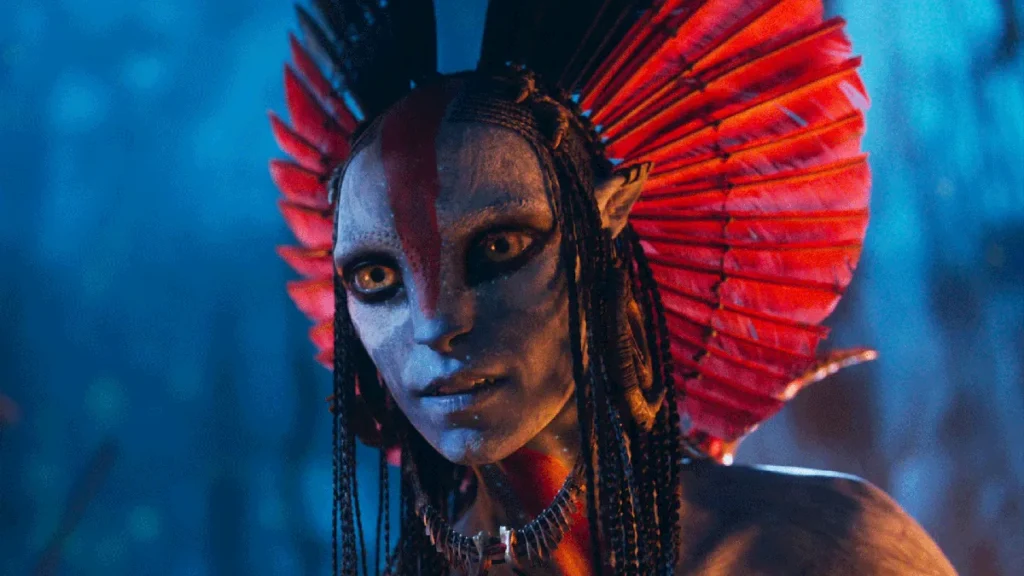
The film introduces a chilling new Na’vi faction — the ash-skinned Mangkwan, volcanic, ruthless, and led by Varang (played with eerie confidence by Oona Chaplin). She’s theatrical, dangerous, and strangely magnetic, forming an uneasy alliance with Quaritch, who remains as menacing and relentless as ever.
Their presence adds a moral grey zone that the franchise previously lacked. Not all threats come from humans anymore — and that shift matters.
Spider becomes the emotional key
While Jake’s rage fuels the plot, the emotional heart of Fire and Ash lies with Spider, the adopted human son caught between worlds. Neytiri’s mistrust of him creates internal family tension, and when Spider undergoes a mysterious biological change that allows him to breathe Pandora’s air, the stakes escalate fast.
That single development turns Spider into the ultimate prize — not just for Quaritch, but for humanity’s long-term plans to overrun Pandora. It’s a clever pivot that grounds the film’s spectacle in personal stakes.
Performances and themes
Sam Worthington delivers his most layered Jake yet — angrier, quieter, more conflicted. Zoe Saldaña brings raw volatility to Neytiri, while Stephen Lang continues to chew through the screen with militaristic menace.
Cameron also makes a pointed statement before the film even begins, declaring that Fire and Ash contains zero generative AI, emphasizing human performance and craft. Ironically, the film itself still represents a future where human acting and digital creation are inseparable — but the emotional truth of the performances remains intact.
What works, what doesn’t
What works:
- Exceptionally staged action sequences
- Stronger emotional focus than previous films
- New Na’vi culture adds tension and unpredictability
- Cameron’s unmatched control over scale and movement
What doesn’t:
- The overarching mythology is starting to feel familiar
- Some world-building stretches feel overlong
- The franchise risks repetition if future films don’t pivot further
Final Verdict
Avatar: Fire and Ash may not redefine cinema the way the first Avatar did — but it doesn’t need to. Instead, it sharpens the franchise, adds emotional weight, and delivers action that few filmmakers on the planet can match.
The psychedelic rush may be less shocking this time, but Cameron proves he still knows how to guide the trip — and keep us watching.
Not the most groundbreaking Avatar…
But arguably the most confident.