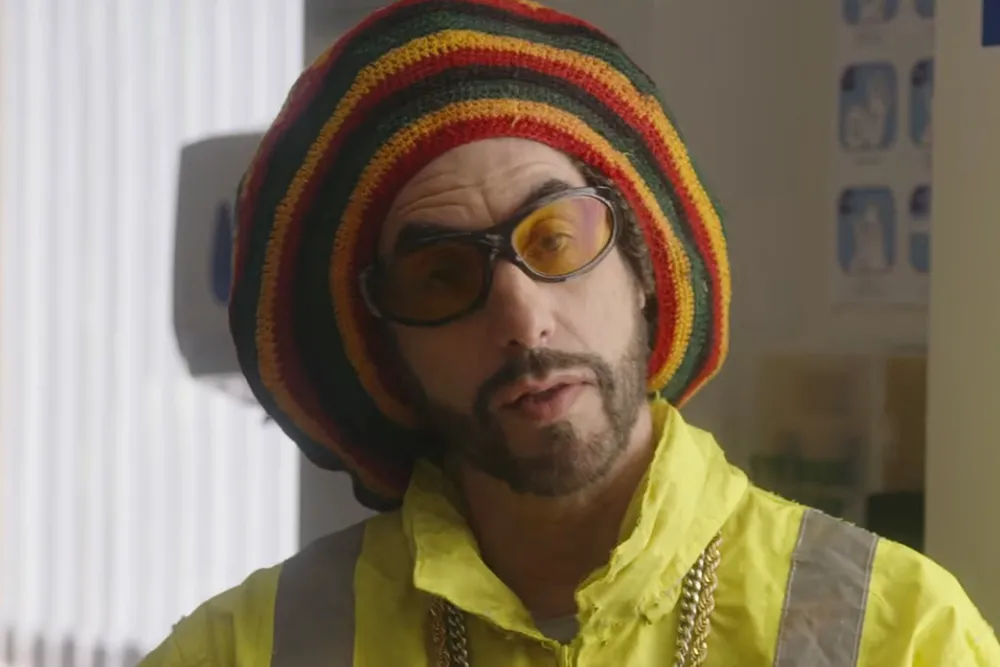
Sacha Baron Cohen’s return as Ali G is turning into a surprisingly heated conversation in the U.K. The character, who became one of British comedy’s most recognisable creations more than two decades ago, is back on the big screen in Ali G: Who Iz I?, but not everyone is welcoming the comeback. A campaign calling on cinemas to refuse the film has gathered tens of thousands of emails following the release of its trailer.
The new mockumentary from Amazon MGM is scheduled to arrive in cinemas on October 23. The trailer brings back Ali G’s exaggerated mannerisms, clothing and deliberately provocative approach to subjects including race, relationships and fatherhood. While longtime fans have reacted enthusiastically to the return, critics have argued that the character’s comedy no longer works in the same cultural environment and have accused the film of reviving stereotypes they consider offensive.
The controversy has grown quickly since the trailer appeared earlier this week. NewsCord, a news comparison and media monitoring platform, launched a campaign on Wednesday asking cinemas around the world not to screen the film. By Friday, the organisation claimed that more than 36,000 emails had been requested by campaign participants and sent to major cinema chains.
Why Ali G Is Facing Backlash Again
Much of the criticism centres on the character’s original premise. Ali G was created by Cohen as a white British man who imitates elements of urban British hip-hop and Jamaican culture while displaying an intentionally limited understanding of the world around him. The joke originally depended on the character’s ignorance, cultural appropriation and exaggerated confidence, with the comedy aimed at exposing the absurdity of his behaviour.
That approach made Ali G a major cultural phenomenon when he first appeared on British television. However, critics of the new film argue that the same material can look very different more than 20 years later. They point to the character’s use of fake dreadlocks and a Rastafarian hat in the new footage, as well as jokes surrounding his attitude towards women and fatherhood, as examples of humour that they believe has become outdated.
The NewsCord campaign has revived criticism that surrounded Ali G during his original rise. It cites a 2000 newspaper report in which Black British comedians questioned whether the character gave audiences an opportunity to laugh at Black street culture while maintaining the appearance of political correctness.
Comedian Felix Dexter was quoted at the time as arguing that the character “allows the liberal middle classes to laugh at Black street culture in a context where they can retain their sense of political correctness.” Writer Jeanette Winterson also compared the character’s presentation with the controversial Black and White Minstrels tradition.
British writer and broadcaster Afua Hirsch has now offered a similar criticism in a recent Substack post. Reflecting on her reaction to Ali G when she was younger, Hirsch wrote, “I just knew he was mocking us,” before arguing that the character no longer fits comfortably into the present cultural landscape.
Hirsch wrote, “Black people don’t dress like that anymore. Even white people imitating Black people don’t talk like that anymore. Sexualizing black women and casually mocking working class women is not accepted anymore,” describing Baron Cohen’s comedy as “a crude compound of all these things.”
The debate therefore goes beyond whether the new film is funny. At its centre is a larger question about whether a character deliberately designed around offensive stereotypes can still function as satire when audiences have become more sensitive to the real-world implications of those stereotypes.
Cinema Campaign Creates A New Question
The campaign against Ali G: Who Iz I? received another burst of attention after NewsCord shared a response from Picturehouse Cinemas. The message stated, “We currently do not have any plans to screen this film on its release,” which the campaign interpreted as confirmation that the cinema chain would not show the movie.
However, that interpretation appears to have gone further than the actual response warranted. Variety understands that the Picturehouse message was a standard response to a customer asking about a film that had not yet been booked by the company and was not currently listed on its schedule. It was not a final decision confirming that Picturehouse had chosen to reject the film.
That distinction matters because a cinema not having a movie on its schedule before bookings are finalised is not the same as refusing to screen it. The film’s eventual availability will depend on individual exhibitors and their assessment of audience demand, commercial prospects and programming decisions.
Phil Clapp, head of the U.K. Cinema Association, also pushed back against the idea that cinemas should function as cultural gatekeepers. Speaking to Variety about the campaign, he said, “Cinemas are there to engage and entertain the widest possible audience. They are not there to act as censors or arbiters of public taste. So where a film has been given a certificate by the BBFC, they will decide whether or not to play it solely with the likely response of their audience in mind.”
The film’s October 23 release date could also affect its presence at individual cinemas. It falls during the London Film Festival period and around the beginning of awards season, when some exhibitors may have other priorities for their screens. That does not mean the film will be rejected, but it could influence how prominently it is programmed.
For now, there is no indication from the information provided that the campaign has secured a confirmed major cinema victory. What it has achieved is considerably more straightforward: it has put the cultural debate surrounding Ali G back into the spotlight before the movie has even reached theatres.
Sacha Baron Cohen Expected Some Backlash
The return of Ali G was never likely to be completely controversy-free. The character was built around pushing boundaries, deliberately saying inappropriate things and creating uncomfortable situations, so bringing him back in a modern media environment was always going to invite questions about whether the original joke still works.
Baron Cohen himself appears to have anticipated at least some criticism. Sharing the trailer for Ali G: Who Iz I?, he wrote, “In an age when a single comedian’s career can be ended by a single un-PC joke, I thought I’d play it safe and bring this guy back.”
The line makes the controversy part of the film’s marketing conversation almost by design. It signals that Baron Cohen is aware of how differently provocative comedy can be received today while also suggesting that Ali G’s deliberately politically incorrect personality is central to the new project.
Ali G first appeared in 1998 as part of Channel 4’s The 11 O’Clock Show. Cohen’s character quickly became popular enough to receive his own television series, Da Ali G Show, and eventually moved into feature films with Ali G Indahouse. The character also helped establish Cohen as a performer willing to use fictional personas to satirise social attitudes, politics and celebrity culture.
That history is important to understanding the current argument. Supporters can point to the fact that Ali G was always intended as a satirical character whose ignorance and cultural imitation were part of the joke. Critics, meanwhile, argue that the character’s original satirical purpose does not automatically prevent the material from reproducing the stereotypes it was designed to mock.
The new film will ultimately have to answer that argument with its comedy rather than its trailer. Audiences who already understand Ali G’s particular brand of humour may see the comeback as a welcome return to a character they grew up with. Others may find that the same jokes feel uncomfortable or dated in 2026.
There is also a notable split in the online response. Alongside criticism of the trailer, Ali G: Who Iz I? has attracted plenty of excitement from people looking forward to seeing Baron Cohen revive the character after such a long absence. NBA star Kevin Durant and rapper A$AP Rocky are among the public figures who have expressed enthusiasm for the return.
That divided response may ultimately be more important than the current campaign. A cinema boycott effort can generate headlines, but the film’s real reception will be determined by audiences once they have the opportunity to see the entire mockumentary rather than a short trailer.
For now, Ali G: Who Iz I? has become a conversation about much more than one comedy character. It raises questions about satire, cultural representation, changing standards of humour and whether characters created to provoke audiences can survive when the social context around them changes. Whatever happens when the film arrives on October 23, Ali G’s comeback has already succeeded in doing one thing the character has always been good at: getting people talking.
Ali G: Who Iz I? FAQs
When will Ali G: Who Iz I? be released?
Ali G: Who Iz I? is scheduled to be released in cinemas on October 23. The new mockumentary marks Sacha Baron Cohen’s return to the character more than two decades after Ali G first became a major television phenomenon.
Why is Ali G: Who Iz I? facing backlash?
Critics have accused the new film of bringing back an outdated and racist caricature, particularly because of Ali G’s use of fake dreadlocks, a Rastafarian hat and his imitation of Black and Jamaican culture.
Who created Ali G?
Ali G was created and performed by Sacha Baron Cohen. The character first appeared in 1998 as part of Channel 4’s The 11 O’Clock Show before receiving his own series and eventually appearing in a feature film.
What is the campaign against Ali G: Who Iz I?
NewsCord launched a campaign urging cinemas not to screen the movie. The organisation claimed that more than 36,000 emails had been sent to major cinema chains by Friday following requests from campaign participants.
Has Picturehouse confirmed that it will not show Ali G: Who Iz I?
Not based on the information currently available. A Picturehouse response saying it had no plans to screen the film was reportedly a standard response concerning a movie that had not yet been booked, rather than a final decision to reject the film.
Is everyone against the new Ali G movie?
No. Despite the backlash, the trailer has also generated considerable enthusiasm online from people excited about Baron Cohen bringing the character back. Kevin Durant and A$AP Rocky are among those who have expressed support for the return.