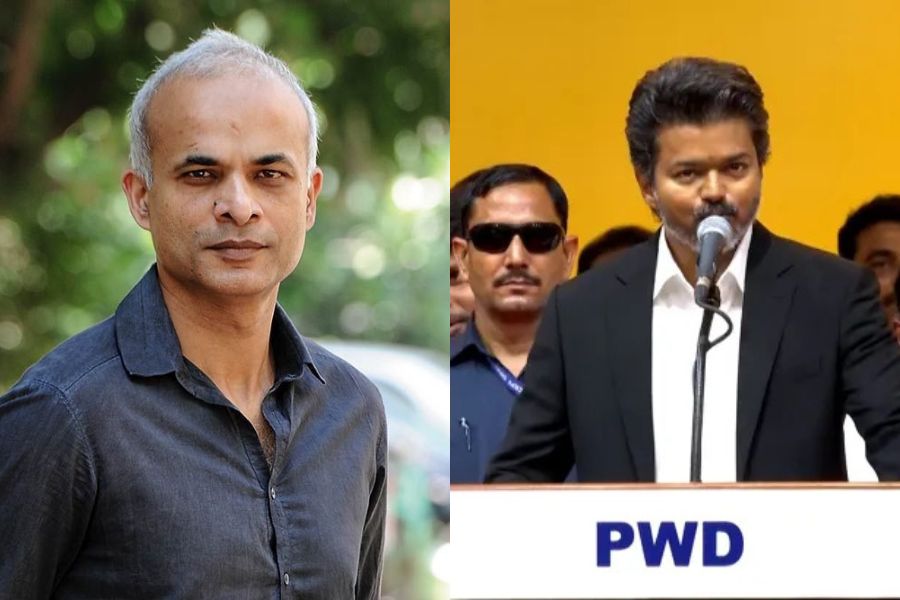
Just hours after C. Joseph Vijay delivered an emotional first speech as the new Chief Minister of Tamil Nadu, the speech itself has now become the center of a heated public debate. The controversy began after author and screenwriter Manu Joseph — who claims to have studied with Vijay during childhood — publicly challenged the actor-politician’s remarks about growing up in poverty.
Vijay, who was officially sworn in as Tamil Nadu’s Chief Minister on Sunday as leader of Tamilaga Vettri Kazhagam, delivered a passionate speech that strongly focused on humility, social justice, and his connection with ordinary people. During the address, he said he understood poverty and hunger personally and described himself as someone who came from a non-privileged background despite eventually becoming a massive film star.
The emotional speech resonated strongly with many supporters at the ceremony, with videos even showing Trisha Krishnan visibly emotional during parts of the event. Vijay described himself as “one among the people” and insisted he did not come from royal lineage or inherited privilege. He also promised not to misuse public money and vowed to run a clean government focused on “real, secular, social justice.”
But by Monday morning, Manu Joseph had publicly pushed back against Vijay’s narrative. Posting on X, the writer claimed Vijay’s comments about poverty were exaggerated and misleading because the two had studied together during third standard at Loyola School. According to Manu, Vijay did not grow up in the kind of severe economic hardship many people in Tamil Nadu associate with poverty.
He specifically pointed toward Vijay’s family background, noting that the actor’s father S. A. Chandrasekhar was already a filmmaker who helped launch Vijay’s career in cinema from an early stage. While acknowledging that film families can face financial instability at times, Manu argued that temporary struggles within relatively privileged households are not comparable to genuine large-scale poverty experienced by many working-class families.
In one of the most widely discussed parts of his post, Manu wrote that many affluent individuals sometimes confuse periods of being financially “broke” with actual poverty, calling them “two very different things.” That line quickly triggered strong reactions online, with social media splitting sharply between those defending Vijay and those agreeing with Manu’s criticism.
Supporters of Vijay argued that financial hardship exists in different forms and that emotional or economic struggles inside middle-class or film families should not automatically be dismissed. Others pointed out that compared to many elite political dynasties, Vijay still presents himself as someone who built his public image largely through hard work and mass audience support rather than inherited political power.
Critics, meanwhile, accused the new Chief Minister of attempting to create a more relatable political image by overstating personal struggles. Some users also argued that politicians frequently use emotionally charged language about poverty to strengthen public connection, even when their actual upbringing may have been relatively comfortable compared to the average citizen.
The debate also pulled fresh attention toward Manu Joseph himself. Beyond being Vijay’s former schoolmate, Manu is already a well-known literary and media figure. His acclaimed novel Serious Men was adapted into a successful Netflix film starring Nawazuddin Siddiqui, while he also created the streaming series Decoupled. His recent non-fiction work, Why the Poor Don’t Kill Us, explored class divides and social inequality — making his comments on Vijay’s poverty claims feel even more pointed publicly.
At the same time, Vijay’s transition from cinema superstar to full-time politician remains one of the biggest political stories in South India right now. After years of speculation around his political ambitions, the actor finally entered electoral politics seriously through TVK and quickly built enormous grassroots momentum among fans and younger voters.
His political messaging has consistently focused on anti-corruption, social welfare, secularism, and portraying himself as someone closely connected to ordinary citizens rather than traditional political elites. Sunday’s speech reinforced exactly that image, especially when Vijay publicly promised he would never misuse taxpayer money or tolerate corruption within his administration.
The actor-politician also reminded supporters that he was the son of an assistant film director who entered cinema through struggle and persistence rather than inherited luxury. For many fans, that emotional framing remains powerful regardless of the criticism now circulating online.
Meanwhile, Vijay’s final film project Jana Nayagan is still awaiting release after facing multiple delays linked to certification issues. The film is expected to mark the symbolic conclusion of his acting career before fully dedicating himself to politics. But for now, the conversation surrounding Vijay is no longer just about cinema or electoral victory — it has shifted into a much broader debate about class, privilege, public image, and how political leaders choose to define their personal struggles in front of millions.