Netflix’s The Whisper Man does not appear interested in reinventing the serial-killer thriller. Instead, the film takes a familiar setup, adds a troubled father-son relationship and surrounds it with actors capable of making even well-worn material watchable. The result is a polished, reasonably tense mystery that feels closer to the dependable crime thrillers of the 1990s and early 2000s than to the darker psychological experiments of today.
Directed by James Ashcroft and adapted from Alex North’s novel, the film follows a grieving crime writer and his young son after they move into a new home in New Jersey. Their attempt at a fresh beginning quickly collapses when the boy disappears, drawing the police into an investigation connected to a convicted serial killer from decades earlier.
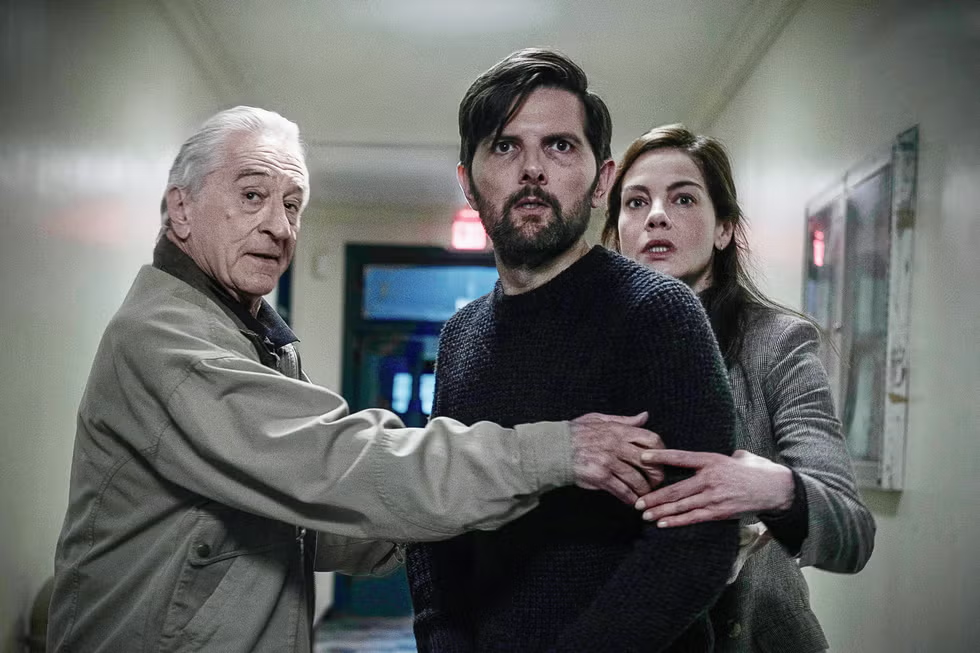
Robert De Niro plays Pete Willis, a retired detective whose earlier career is unexpectedly pulled back into the case. Adam Scott stars as Tom Kennedy, the novelist whose missing son becomes the centre of the investigation, while Michelle Monaghan plays Detective Amanda Beck, the officer trying to understand the connection between the current disappearance and an old case.
There is nothing especially radical about the formula, but The Whisper Man understands what kind of movie it wants to be. It moves at a steady pace, gives its mystery enough turns to maintain interest and relies on its cast to add personality to material that might otherwise feel completely familiar.
A Familiar Mystery Gets A Family Drama
The story begins with Tom Kennedy attempting to rebuild his life after the death of his wife. He moves with his pre-teen son Jake to a small New Jersey community, hoping that a new environment might give them both some distance from their grief.
Instead, the new house immediately feels like the wrong place for a fresh start. It is an old, oversized property with plenty of creaks, shadows and unsettling corners, while Jake is already struggling emotionally after losing his mother. The boy’s imagination begins producing strange encounters, including conversations with unseen figures, before he eventually disappears during the night.
The film wisely does not spend too long pretending that the supernatural might be responsible. Jake’s disappearance is connected to a much more human threat: a serial child predator whose methods resemble those of Frank Carter, a killer who was arrested years earlier and became known as the Whisper Man because of the quiet way he approached his victims.
Detective Amanda Beck soon realises that the present case may have links to Carter’s crimes. That leads her to Pete Willis, the retired detective who originally caught him, bringing De Niro’s character back into a world he believed he had left behind.
The investigation becomes more personal when Pete’s connection to Tom is revealed. He is not simply an experienced former detective being consulted because of his knowledge of an old killer; he is also Tom’s estranged father.
That father-son relationship gives the movie its most distinctive element. The serial-killer mystery itself follows familiar genre territory, but the emotional damage between Pete and Tom gives the investigation another reason to matter. Their estrangement is tied to the kind of parental guilt that runs through the story, particularly the idea that fathers are expected to protect their children even when circumstances make that impossible.
The screenplay by Ben Jacoby and Chase Palmer does not explore that relationship with enormous psychological depth, but it uses the family history effectively enough to connect the personal drama with the central investigation.
Robert De Niro Keeps Things Moving
De Niro’s presence gives The Whisper Man an immediate sense of authority. Pete Willis is a retired detective carrying years of emotional baggage, and De Niro plays him with the familiar combination of weariness and understated toughness that has served the actor well across countless crime stories.
This is not a performance that demands De Niro disappear completely into the character. Instead, his experience and screen presence do much of the work, giving Pete a believable history without requiring lengthy explanations about the man he used to be.
Adam Scott is also well suited to Tom’s anxious, grieving personality. His character is a successful crime writer, but the professional confidence associated with his career disappears when his own son becomes a victim. Scott gives the character enough vulnerability to make the family’s crisis feel more immediate.
Monaghan’s Amanda Beck provides the procedural backbone. She is the detective who has to connect the evidence, question the people involved and work out whether the current crimes really are connected to the imprisoned Carter. The role is familiar territory for the actor, but her controlled performance keeps the investigation grounded.
Michael Keaton gets one of the film’s most enjoyable supporting turns as Frank Carter. The character could easily have become an exaggerated Hannibal Lecter imitation, but Keaton keeps him restrained. His calm cooperation with investigators is made unsettling by the sense that something dangerous remains behind his eyes.
Hamish Linklater and Owen Teague also contribute effectively in supporting roles, adding moments of intelligence and dry humour to an otherwise grim story.
The Atmosphere Works Better Than The Mystery
Director James Ashcroft brings a steady hand to the material. His earlier film Coming Home in the Dark demonstrated a greater interest in ambiguity and character-driven unease, while The Whisper Man operates within a much more conventional thriller structure.
That does not make the direction ineffective. Ashcroft keeps the story moving without allowing the investigation to become too slow, and he gives the house and surrounding locations enough atmosphere to maintain a sense of unease.
Cinematographer Peter Deming contributes heavily to that mood. His work here is less visually distinctive than some of his collaborations with David Lynch, but the damp colours, dark interiors and muted palette create the appropriate environment for a story involving missing children and an old serial-killer case.
The film’s greatest weakness is also its biggest source of comfort: it is very familiar. The detectives behave like detectives, suspicious characters look suspicious, old cases return to haunt the present and the central mystery develops through information that gradually connects one storyline to another.
That predictability means The Whisper Man rarely becomes genuinely surprising. There are opportunities for the movie to dig deeper into the psychology of its killer, its detectives or the fractured relationship between Pete and Tom, but it generally chooses forward momentum over deeper exploration.
For some viewers, that may be a limitation. For others, it will be exactly the appeal.
There is something almost nostalgic about watching a thriller that is primarily interested in telling a reasonably compelling crime story for two hours. It does not need to become a sprawling franchise, a puzzle box or a philosophical examination of evil. It simply wants to keep you watching until the mystery is resolved.
At 114 minutes, the film also benefits from not overstaying its welcome. The story has enough material to sustain its runtime without becoming dramatically bloated, and the performances help smooth over the more conventional stretches of the screenplay.
The Whisper Man ultimately lands as a solid Netflix thriller rather than an essential crime movie. It has a strong cast, a suitably dark premise and enough family drama to give its familiar investigation some emotional weight. De Niro’s presence adds gravitas, Keaton brings a welcome streak of menace, and Ashcroft and Deming create an atmosphere that keeps the film watchable even when the plot follows well-established genre paths.
It may not linger in your mind for weeks after the credits roll, but that is not necessarily a criticism. The Whisper Man is the kind of thriller designed to keep you engaged for an evening, deliver its mystery and leave you satisfied enough when it ends. For a film that consciously recalls the dependable crime movies of another era, doing that job well is arguably the point.
The Whisper Man Review: FAQs
What is The Whisper Man about?
The Whisper Man follows crime writer Tom Kennedy and his young son Jake after they move to New Jersey following the death of Tom’s wife. Jake disappears, leading Detective Amanda Beck to investigate a possible connection to an imprisoned serial killer known as the Whisper Man.
Who stars in The Whisper Man?
The film stars Robert De Niro, Adam Scott, Michelle Monaghan and Michael Keaton, alongside Acston Luca Porto, Hamish Linklater, Owen Teague and other supporting performers.
Who directed The Whisper Man?
The Whisper Man was directed by James Ashcroft, with a screenplay by Ben Jacoby and Chase Palmer based on Alex North’s novel.
Is The Whisper Man based on a book?
Yes. The film is adapted from the novel The Whisper Man by Alex North, the pseudonym used by British crime novelist Steve Mosby.
Is The Whisper Man a horror movie?
The film contains horror elements through its serial-killer premise, unsettling locations and threatening atmosphere, but it primarily functions as a crime and mystery thriller rather than a supernatural horror film.
Is The Whisper Man worth watching?
If you enjoy traditional serial-killer mysteries and character-driven crime thrillers, the film offers a reasonably entertaining watch. It does not radically reinvent the genre, but its cast, atmosphere and steady pacing make it an effective two-hour thriller.