Brad Bird has spent more than three decades trying to bring Ray Gunn to the screen, and the result is certainly unlike most animated films arriving in Hollywood today. Blending old-fashioned detective fiction with futuristic science fiction, the director behind The Incredibles, Ratatouille and The Iron Giant creates a spectacular world of flying cars, alien citizens and towering skyscrapers. Yet beneath its extraordinary visual imagination lies a surprisingly conventional mystery. The film’s greatest achievement is the universe Bird has created, while its biggest weakness is a story that doesn’t always match that ambition.
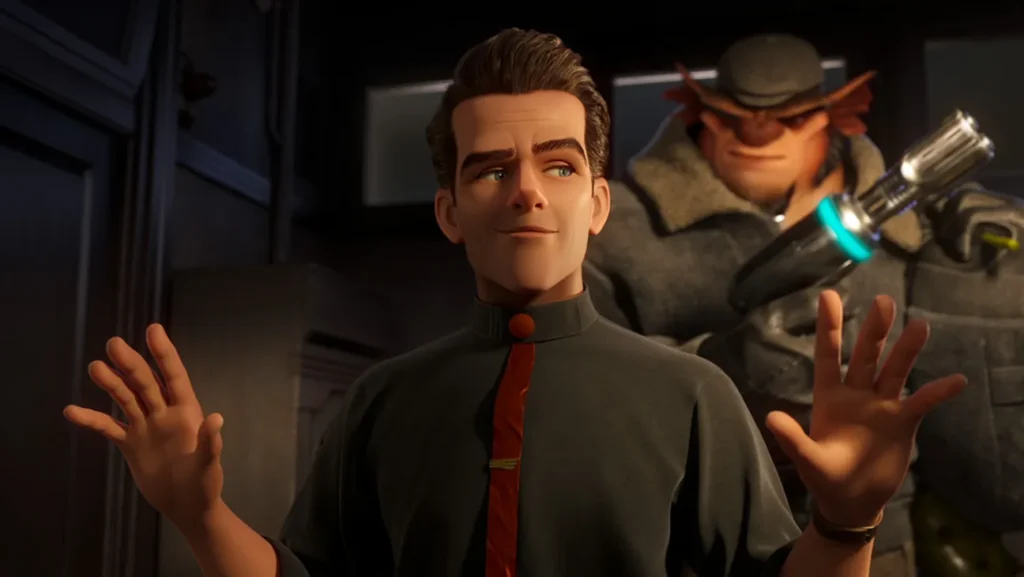
Premiering at the BFI London Film Festival on October 10, 2026, Ray Gunn features Sam Rockwell as Raymond Gunn, a struggling private detective living in Metropia, a futuristic city imagined through the aesthetics of the 1930s. Alongside his one-eyed alien partner Eyera (Tom Waits), Ray becomes involved in a complicated investigation surrounding celebrity singer Venus Nova (Scarlett Johansson). What begins as a seemingly straightforward assignment gradually develops into a mystery involving murder, deception and powerful individuals with dangerous secrets.
The premise gives Bird considerable room to experiment, and the resulting adventure offers plenty of entertainment. However, early festival reviews have been divided over whether its impressive presentation compensates for its increasingly complicated screenplay.
Metropia is the real star of Ray Gunn
The most immediately distinctive element of Ray Gunn is its production design. Metropia looks like the future imagined by filmmakers and illustrators nearly a century ago, combining Art Deco architecture with enormous skyscrapers, jetpacks and airborne traffic. Even familiar detective-story locations, including nightclubs and cramped offices, receive an imaginative science-fiction makeover.
Rather than presenting technology through the clean, minimalistic aesthetic common in contemporary science fiction, Bird embraces a world filled with mechanical detail and exaggerated visual personality. The result recalls classic Hollywood noir while borrowing the scale of films such as Metropolis and Blade Runner.
The animation also gives Bird opportunities to stage sequences that would be considerably harder to realise in live action. A particularly inventive zero-gravity dance sequence between Ray and Venus uses movement and physical space to develop their relationship. Elsewhere, elaborate airborne chases and unusual futuristic weapons demonstrate the director’s talent for choreographing action.
These moments help establish Metropia as more than decorative scenery. The city feels enormous, unpredictable and populated by characters whose lives continue beyond the central investigation.
Sam Rockwell and Scarlett Johansson bring personality to the mystery
Rockwell’s voice performance provides the film with an appealingly imperfect protagonist. Ray is a former police officer whose stubborn sense of morality has left him struggling financially. His cynical exterior fits the familiar hard-boiled detective archetype, but Rockwell brings enough warmth and humour to prevent the character from becoming an imitation of earlier noir heroes.
Johansson’s Venus Nova offers a contrasting presence. A glamorous celebrity surrounded by scandal, Venus initially resembles the mysterious femme fatales of classic detective films. However, her relationship with Ray introduces moments of vulnerability beneath her carefully maintained public image.
Their exchanges supply some of the film’s most entertaining material, particularly when the dialogue allows their contrasting personalities to emerge naturally.
Tom Waits is an inspired choice for Eyera. His unmistakable voice gives the alien character a distinctive identity, while the friendship between Ray and his partner introduces a more personal dimension to the story. Their relationship also connects with the film’s treatment of discrimination against extraterrestrial residents.
The mystery is entertaining but becomes increasingly tangled
The central problem is that Ray Gunn appears more confident in its world-building than in its storytelling.
Bird introduces multiple suspects, hidden motives and unexpected revelations, gradually expanding the investigation beyond its initial premise. While those developments keep the narrative moving, the accumulation of complications occasionally makes the mystery feel unnecessarily crowded.
The screenplay also introduces interesting ideas about prejudice, surveillance, celebrity culture and technological influence. Metropia may be filled with inventions that promise a better future, but its inhabitants continue struggling with familiar social problems.
That contrast provides a potentially compelling foundation for satire. Unfortunately, the film doesn’t always explore these subjects with the same precision it brings to its visual design.
The emotional storytelling is similarly uneven. Ray and Venus share enjoyable chemistry, but their relationship sometimes feels secondary to the next revelation or elaborate action sequence. Where The Iron Giant and Ratatouille connected their imaginative settings to deeply personal character struggles, Ray Gunn often prioritises spectacle.
Ray Gunn review verdict: Beautifully animated, emotionally uneven
Ray Gunn is an ambitious and frequently entertaining return to animation for Brad Bird. Its outstanding production design, energetic action and charismatic voice cast make it an appealing science-fiction adventure, particularly for audiences who enjoy detective stories with an unusual visual identity.
However, its elaborate mystery occasionally overwhelms the characters, and its social commentary lacks the emotional clarity associated with Bird’s strongest work. The film offers a remarkable place to explore, even when the story unfolding within it isn’t equally memorable.
Still, the project’s existence is worth appreciating. At a time when major animated productions often depend on familiar franchises, Ray Gunn demonstrates the creative possibilities of building an original cinematic universe around a filmmaker’s personal vision.
It may not reach the heights of Bird’s finest animated features, but its imagination and craftsmanship make it a worthwhile addition to his filmography.
Ray Gunn is scheduled for a limited theatrical release beginning December 4, 2026, before arriving on Netflix on December 18.