Director: Lynne Ramsay
Cast: Jennifer Lawrence (Grace), Robert Pattinson (Jackson), LaKeith Stanfield (The Motorcyclist), Sissy Spacek, Nick Nolte
Genre: Psychological Drama
Runtime: 118 minutes
Rating: ★★☆☆☆ (2/5)
In Theatres: November 7, 2025
Introduction — When Art Becomes Exhaustion
Lynne Ramsay’s Die My Love wants to be a masterpiece — a poetic, visceral portrait of a woman unraveling. Instead, it ends up being a punishing experience that mistakes noise for depth.
Jennifer Lawrence gives a gutsy, all-in performance that deserves better material, while Robert Pattinson does what he can with a role so underwritten it borders on invisible. But no amount of acting brilliance can save a story that feels like it’s constantly spiraling in circles.
The result? A film that’s beautifully shot, emotionally draining, and — worst of all — empty.
Storyline — A Spiral Without Purpose
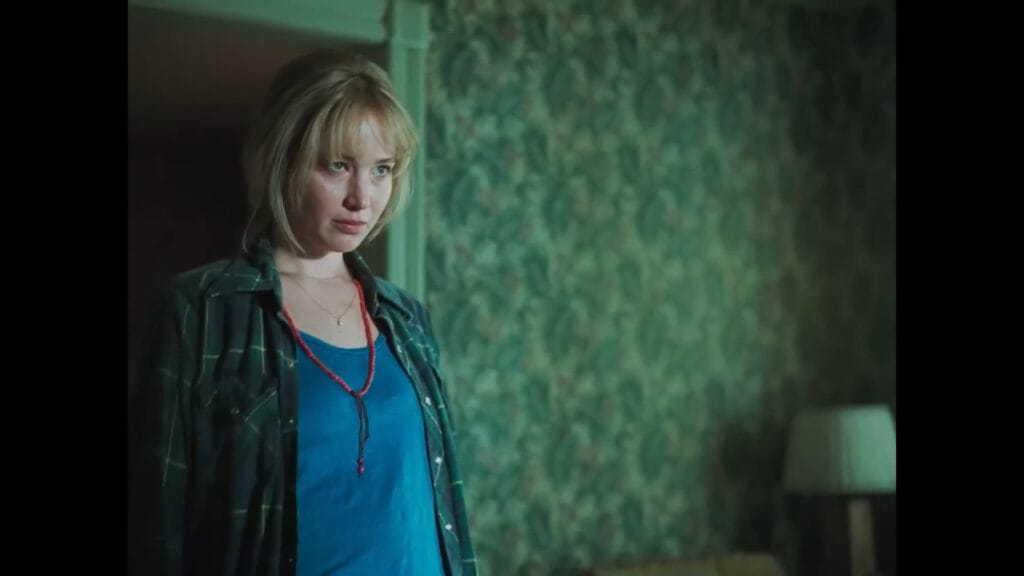
Grace (Jennifer Lawrence) and her husband Jackson (Robert Pattinson) move from New York to a rundown house in rural Montana with their newborn baby. The house once belonged to Jackson’s uncle, who killed himself there — a grim metaphor that Ramsay never lets us forget.
Grace is slipping into postpartum depression, but Die My Love never really explores that in any meaningful way. Instead, Ramsay buries the character under layers of surreal imagery — dripping milk, buzzing flies, endless close-ups of dirty walls — without saying much about the illness itself.
The film meanders between hallucination and reality without rhythm or reason. Grace meets (or imagines) a mysterious motorcyclist (LaKeith Stanfield), flirts with infidelity, and lashes out at her husband. But none of it builds toward anything resembling narrative clarity or emotional release. By the time the credits roll, you feel less like you’ve watched a story and more like you’ve been trapped in someone’s panic attack for two hours.
Cast and Performances
Jennifer Lawrence (Grace):
There’s no denying her commitment. Lawrence is fearless here — raw, physical, and often mesmerizing. But when the screenplay offers no emotional anchor, her intensity starts to feel repetitive. Every scene is at maximum volume, and after a while, even her pain loses its power.
Robert Pattinson (Jackson):
He tries to humanize a character that feels more like a symbol than a person. Jackson is underwritten, underused, and eventually unnecessary. Their marriage, supposedly the heart of the story, never comes alive.
LaKeith Stanfield (The Motorcyclist):
His scenes hint at something intriguing — maybe fantasy, maybe desire — but the film never develops him beyond an abstract presence.
Sissy Spacek & Nick Nolte:
Both fine actors are wasted in thankless supporting roles that exist only to echo Grace’s despair from the sidelines.
What Worked
✅ Jennifer Lawrence’s performance: Even in a failing film, she gives everything — wild, unfiltered emotion that occasionally cuts through the noise.
✅ Lynne Ramsay’s eye: The film is gorgeous to look at. Each frame could hang in a gallery — though it’s often more art installation than cinema.
✅ Sound design: The buzzing, barking, and scraping work as a sensory assault — but it’s effective, if overwhelming.
What Didn’t
❌ No story, no structure: The film circles the same ideas without developing them. There’s no rise, no resolution — just chaos for its own sake.
❌ Pretentious direction: Ramsay mistakes disorientation for depth. The symbolism is heavy-handed, the metaphors painfully obvious.
❌ Lack of emotional connection: Grace’s breakdown is visually striking but emotionally hollow. You watch her unravel, but you never feel it.
❌ Repetitive pacing: Every scene bleeds into the next without momentum. It’s like being stuck in a dream that won’t end.
❌ Missed opportunity: Postpartum depression is rarely portrayed honestly in film. Die My Love could’ve been groundbreaking — instead, it hides behind surrealism.
Direction and Tone
Lynne Ramsay is known for her uncompromising vision (We Need to Talk About Kevin, You Were Never Really Here). But here, that vision turns self-indulgent. She traps the film inside Grace’s head — and never lets it breathe.
The 4:3 aspect ratio, the constant close-ups, the sensory overload — it all creates an oppressive atmosphere, but one that feels more exhausting than enlightening. You admire the craft but feel nothing for the characters.
Even the editing undercuts emotional rhythm. Moments that could’ve hit hard — Grace’s outbursts, her quiet desperation — are cut too quickly, replaced by more aesthetic chaos.
Themes — Or the Lack of Them
Die My Love claims to explore motherhood, identity, and mental illness. But its refusal to engage with any of them in concrete terms makes it frustratingly vague.
Is Grace suffering from postpartum psychosis? Is she haunted by the house? Is it an allegory for female rage? Ramsay wants it to be all of these — but delivers none fully.
By the final act, you stop asking what it means and start wishing it would end.
Final Verdict
Die My Love is stunning on the surface and hollow underneath — a film so obsessed with being art that it forgets to be human.
Jennifer Lawrence is extraordinary, but her performance feels trapped inside a film that doesn’t know what to do with her. Robert Pattinson and LaKeith Stanfield are wasted in roles that exist only to orbit her chaos.
There’s beauty here — but it’s buried under layers of artistic pretension and emotional distance. Die My Love mistakes confusion for complexity, and in doing so, loses the audience completely.
⭐ Popcorn Realm Rating: 2/5
A gorgeously made, emotionally empty descent into madness that never finds its purpose. Jennifer Lawrence shines, but everything else fades into noise.