Other Mommy has the kind of premise that should make even an ordinary family home feel unsafe. An eight-year-old girl encounters a mysterious presence that looks exactly like her mother, except something about this version is deeply wrong. With Jessica Chastain playing both the loving parent and the sinister imposter, director Rob Savage has an opportunity to turn childhood insecurity into genuinely disturbing horror. Unfortunately, the film seems more interested in making audiences jump than exploring what makes its central idea so frightening.
Adapted from Josh Malerman’s 2024 novel Incidents Around the House, the supernatural thriller follows Bela (Arabella Olivia Clark), a young girl living with her mother Ursula (Chastain) and father Russell, affectionately called Daddo (Jay Duplass). Their family life is far from perfect, but things become considerably worse when Bela develops a relationship with a strange entity she calls Other Mommy. The creature resembles Ursula and gradually becomes more threatening, placing the entire family in danger.
The setup offers plenty of psychological possibilities. What could be more frightening for a child than discovering that the person who makes her feel safest might also be the thing she should fear most? Yet Other Mommy struggles to develop that unsettling idea into sustained tension. Its supernatural incidents arrive quickly, but the emotional consequences rarely receive enough attention to make the next scare feel more significant than the last.
Jessica Chastain and Arabella Olivia Clark carry the film
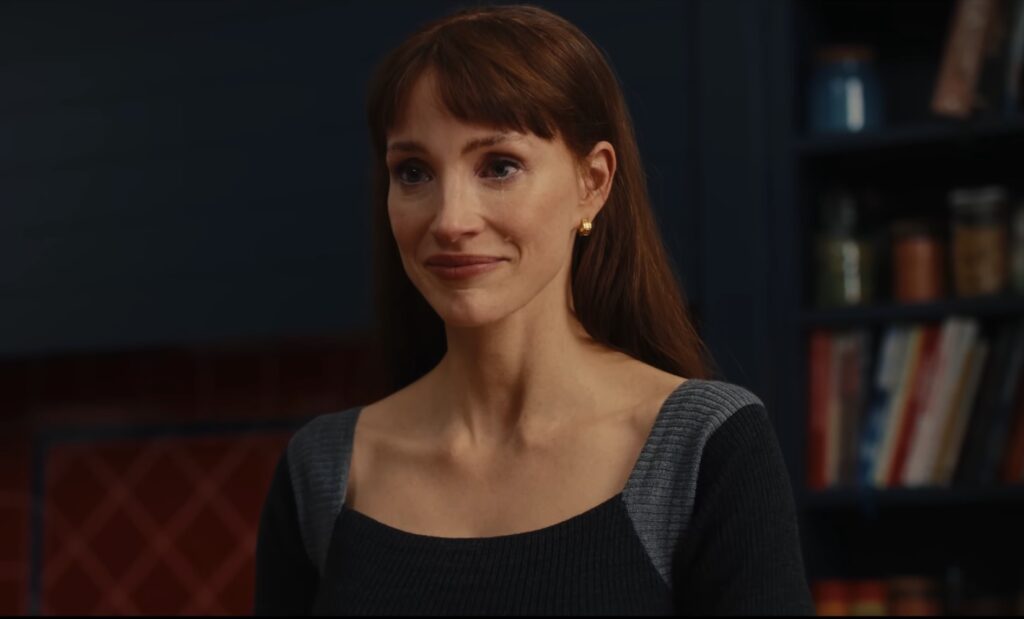
Chastain’s dual casting is easily one of the film’s most interesting creative decisions. As Ursula, she plays a mother whose relationship with her husband is strained by problems their daughter does not fully understand. As Other Mommy, she becomes a disturbing imitation of maternal affection, using a familiar appearance to conceal something dangerous.
The distinction between the two characters relies on exaggerated expressions, unnatural body language and an unsettlingly artificial warmth. Chastain’s willingness to embrace the stranger aspects of the role gives the supernatural character some personality, especially when the creature’s attempts to appear reassuring become increasingly uncomfortable.
However, the screenplay does not provide Ursula with enough complexity to make the contrast as effective as it could be. Her troubled marriage and emotional distance from Bela should establish an interesting connection between the real mother and the supernatural replacement. Instead, those relationships are often pushed aside whenever the story needs another frightening encounter.
Arabella Olivia Clark has an equally demanding role as Bela. Much of the film depends on her ability to communicate fear, confusion and loneliness without understanding the adult problems surrounding her. She conveys the vulnerability of a child trying to make sense of circumstances that are clearly beyond her control.
Her quieter moments are particularly important because Bela’s emotional experiences should determine how the audience understands the supernatural threat. The problem is not a lack of effort from the young actress. It is that the movie frequently moves on before her character has been given enough room to process what has happened.
Jay Duplass brings an appropriately relaxed presence to Daddo, a stay-at-home father whose relationship with Ursula has become increasingly complicated. However, the character remains underdeveloped, leaving the parents’ domestic conflict feeling more like a convenient source of tension than a fully convincing family crisis.
Rob Savage delivers disturbing images but struggles to build dread
Savage previously demonstrated considerable skill at creating supernatural tension with Host, the 2020 screenlife horror film that used the limitations of a video call to make every unexpected movement or background disturbance feel threatening. His 2023 adaptation of The Boogeyman also showed an interest in connecting supernatural terror with emotional distress.
With Other Mommy, he has a more elaborate production and an Oscar-winning lead actress, but the additional resources do not necessarily translate into a more effective horror experience.
The film moves through its frightening sequences at an aggressive pace. Rather than allowing audiences to gradually question the presence inside Bela’s home, the creature makes its intentions apparent relatively early. That decision produces immediate excitement, but it also reduces the uncertainty that could have made the threat more disturbing.
There are visually inventive moments, particularly when seemingly harmless childhood spaces become places of danger. Play areas, domestic interiors and ordinary family gatherings are transformed through distorted movement and supernatural imagery. The contrast between familiar surroundings and unnatural behaviour occasionally creates the atmosphere the film needs.
Savage and cinematographer Lowell Mayer also avoid the desaturated visual style commonly associated with contemporary horror. Their brighter, more colourful presentation reflects Bela’s childhood perspective, making the intrusion of something monstrous into that world more noticeable.
The difficulty lies in how those images are assembled. The rapid editing and frequent jump scares leave little opportunity for tension to develop naturally. A disturbing visual may create an immediate reaction, but horror becomes more memorable when the audience has time to anticipate danger rather than simply respond to it.
The film’s increasingly elaborate supernatural sequences also expose weaknesses in its storytelling. The rules governing the creature remain vague, while the family’s responses to extraordinary events do not always feel emotionally convincing. By the later stages, the accumulation of incidents begins to overwhelm the relatively simple character drama at the centre of the story.
The film loses something important from Josh Malerman’s novel
Perhaps the most revealing difference between Other Mommy and its source material concerns perspective.
Malerman’s Incidents Around the House places readers inside Bela’s understanding of the world. Her limited knowledge of adult relationships and supernatural danger becomes part of the horror. Readers recognise that something is wrong even when Bela cannot explain it, creating a disturbing distance between what she experiences and what others understand.
Savage has spoken about the difficulty of translating that first-person narration into visual storytelling without relying on voiceover. His solution places Bela at the centre of the film’s events while using performance, camera movement and exaggerated supernatural imagery to communicate her experiences.
It is an understandable adaptation choice, but it creates a different effect. Watching a child encounter frightening things is not necessarily the same as experiencing those encounters through her limited understanding.
That distinction becomes increasingly important as the film progresses. The creature’s unusual appearance and abilities receive considerable visual attention, while Bela’s emotional relationship with it becomes less compelling. The movie repeatedly shows how dangerous Other Mommy can be without developing the psychological manipulation that would make the character truly unsettling.
The screenplay, written by Nathan Elston, also struggles to give the family’s underlying problems sufficient dramatic weight. There are suggestions of emotional neglect, marital dissatisfaction and a child’s desire for reassurance, but these themes do not consistently shape the horror. Instead, they often surface between action sequences before the narrative returns to its supernatural disturbances.
The result is an adaptation that preserves the basic ingredients of Malerman’s story without fully translating the anxiety that made its unusual perspective meaningful.
Other Mommy review verdict: A promising idea with disappointing execution
Other Mommy is not without its strengths. Chastain commits to the unsettling physicality of the central creature, Clark gives Bela a sympathetic presence, and Savage occasionally finds striking ways to transform ordinary environments into frightening spaces. The film’s relatively short 93-minute runtime also prevents its thin premise from becoming a much longer ordeal.
Unfortunately, those elements never develop into a consistently satisfying horror experience. The direction prioritises spectacle over suspense, the family relationships lack sufficient depth, and the increasingly frantic storytelling makes it difficult to become emotionally invested in Bela’s situation.
What makes the disappointment more noticeable is how much potential exists in the original premise. A creature wearing a mother’s face could have supported a disturbing exploration of childhood trust, emotional dependence and the fear of losing someone familiar. Instead, Other Mommy frequently settles for the easier reaction of another sudden scare.
Horror enthusiasts looking for bizarre supernatural imagery and an energetic performance from Jessica Chastain may find moments worth appreciating. Those hoping for a more psychologically unsettling adaptation of Incidents Around the House, however, are likely to be disappointed.
The film understands that there is something terrifying about a child being unable to trust her own mother. It simply struggles to turn that fear into a story that stays with the audience once the screen goes dark.