Peacock’s new spy drama Ponies opens with a clever piece of espionage trivia. “Ponies,” we’re told, is CIA shorthand for persons of no interest — the kind of people intelligence agencies assume no one is watching. In the icy winter of 1977 Moscow, that label fits Bea and Twila perfectly. They’re just diplomats’ wives, living on the edges of Cold War power games. Or so everyone thinks.
What follows is a surprisingly engaging blend of espionage, grief, friendship, and self-discovery — less John le Carré, more character-first spy caper with emotional bite.
The Premise: From Invisible to Involved
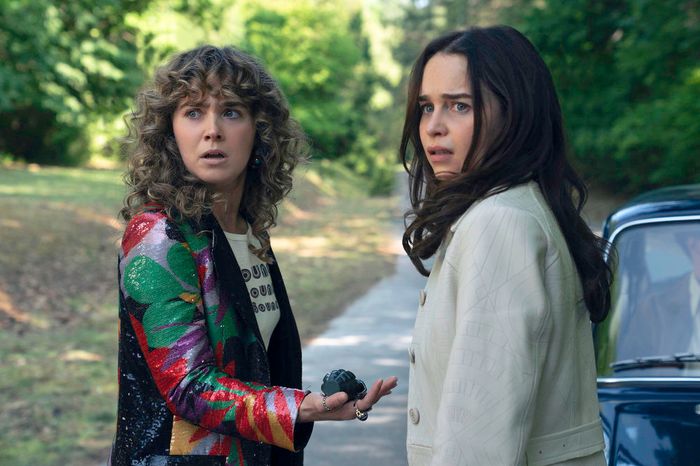
Bea (Emilia Clarke) and Twila (Haley Lu Richardson) are Americans in Moscow because of their CIA-connected husbands. When both men die in a suspicious plane crash, the women are left stranded — emotionally and politically.
What begins as a search for answers slowly pulls them into the intelligence world themselves. The CIA believes they’ll go unnoticed, underestimated by Soviet eyes. That assumption is quickly challenged, but as a narrative launchpad, it works — giving Ponies room for humor, tension, and character growth.
Emilia Clarke’s Quiet Reinvention
This marks Emilia Clarke’s first major TV lead since Game of Thrones, and she clearly chose the right moment to return. Bea is a far cry from Daenerys Targaryen — reserved, rule-following, and emotionally contained.
As the daughter of a Belarusian Holocaust survivor, Bea’s fluency in Russian makes her valuable in the field. Clarke leans into the subtlety of the role, letting grief, doubt, and resolve gradually surface. Watching Bea stumble through early missions — sometimes literally — is part of the show’s charm. Her journey isn’t about sudden competence, but earned confidence.
Haley Lu Richardson Brings Bite and Balance
Where Bea is careful and internal, Twila is brash, sharp-tongued, and outwardly fearless. Richardson plays her with raw energy, masking vulnerability beneath sarcasm and aggression.
Twila’s marriage was never built on love, and her decision to stay in Moscow feels less like duty and more like escape. Richardson excels at making Twila difficult yet deeply human — the kind of person who survives by pushing people away before they can leave first.
The chemistry between Clarke and Richardson is the show’s strongest asset. Their friendship grows naturally, through shared grief, black-market negotiations, and mutual frustration with systems that never expected them to matter.
Espionage as a Backdrop, Not the Point
Ponies isn’t obsessed with airtight spycraft. Characters regularly speak English in public, and some KGB interactions feel a little too convenient. But that’s by design. This isn’t The Americans — it’s a character-driven story using espionage as a pressure cooker.
The CIA figures around them, including bureau chief Dane (Adrian Lester), exist mainly to challenge or propel Bea and Twila forward. The real intrigue lies in how the women change — not in tradecraft perfection.
Tone, Style, and Setting
Shot in Budapest rather than Moscow, the series doesn’t fully transport you behind the Iron Curtain — but it compensates with mood. The ‘70s aesthetic is loud and clear: shag coats, smoky interiors, and a soundtrack stacked with Fleetwood Mac and Boney M.
The Cold War is more atmosphere than ideology here. It’s a backdrop that heightens isolation and danger without overwhelming the personal story at the center.
Where Ponies Stumbles — and Why It Still Works
The mystery itself isn’t always gripping, and some twists feel secondary to emotional arcs. But as Bea and Twila process loss and step into agency, the narrative tightens. By the final episodes, the show finds its rhythm — and ends on a clear cliffhanger that signals bigger ambitions.
It’s not flawless, but it’s confident in what it wants to be.
Final Verdict
Ponies succeeds because it knows its priorities. It’s not trying to outsmart the audience with labyrinthine espionage. Instead, it offers two compelling women learning to take up space in a world that dismissed them as irrelevant.
With strong lead performances, sharp dialogue, and a growing emotional core, Ponies feels like a series that’s just getting started. If Peacock gives it a second season, this Cold War story could warm into something even more rewarding.