Big-budget cinema has become a global race now. Every film industry wants its own giant spectacle that can travel across countries, dominate streaming later, and prove that local cinema can stand beside Hollywood. India is building massive projects like Ramayana and Varanasi, Korean cinema keeps expanding its scale with expensive action dramas, while China recently shocked the industry after Ne Zha 2 crossed the billion-dollar mark worldwide. Saudi Arabia also wanted its own global cinematic moment. Instead, what it got was one of the most shocking box office disasters the movie business has ever seen.
The film was called Desert Warrior, a historical action epic mounted on an enormous scale with international stars, huge battle sequences, and a budget so massive that people expected it to become a turning point for Saudi cinema. But after years of production, endless delays, and a quiet release, the film collapsed almost instantly at the global box office. Its final earnings were so low compared to its production cost that industry trackers are now calling it the biggest box-office bomb in film history.
The project was first announced back in 2021 by MBC Studios, the film production arm of Saudi media giant MBC Group. The intention behind the movie was much bigger than just making another action film. Saudi Arabia has been investing heavily into entertainment and cinema over the last few years as part of its larger push to transform the country into a global cultural and tourism hub. Massive sporting events, international concerts, gaming expos, and film productions have all become part of that strategy. Desert Warrior was supposed to be the cinematic centerpiece of that movement.
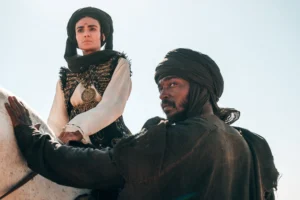
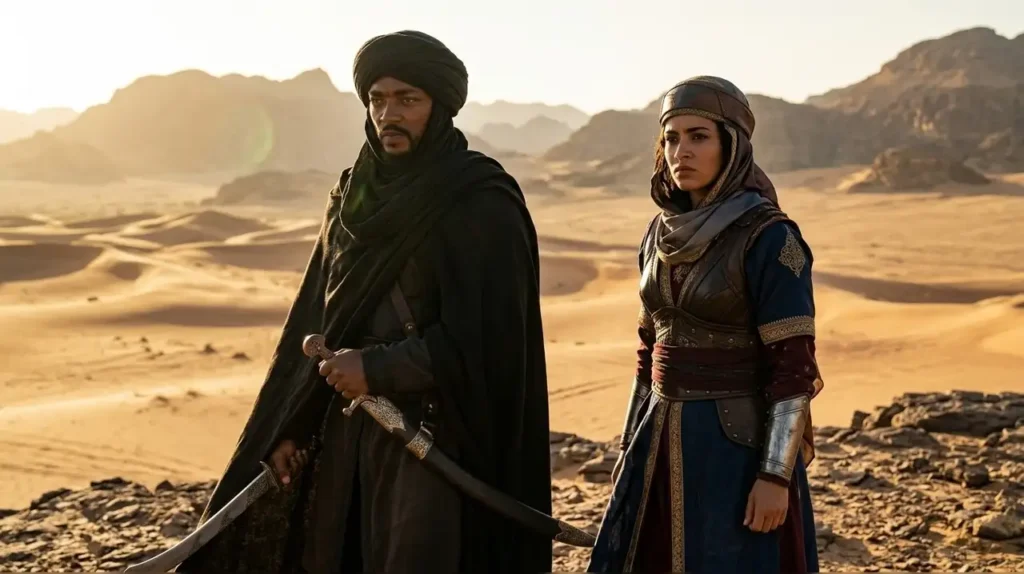
To give the project international attention, the makers assembled a surprisingly strong cast. Anthony Mackie, who recently took over as Marvel’s new Captain America, played the warrior Hanzala. Legendary actor Ben Kingsley appeared as Emperor Kisra, while Sharlto Copley and Aiysha Hart also featured in major roles. The film was directed by Rupert Wyatt, the filmmaker known for Rise of the Planet of the Apes. On paper, it looked like a serious global production rather than a regional experiment.
Set in seventh-century Arabia, the story followed Princess Hind and her rebellion against Emperor Kisra, with Mackie’s warrior character helping lead the resistance. The film tried mixing historical drama with large-scale battle action in a style similar to Hollywood epics like Gladiator or Kingdom of Heaven. Huge desert sets were built, international technicians were flown into Saudi Arabia, and local workers were trained alongside foreign crews during filming. Reports from the production claimed that nearly 500 people were working on set daily during peak shooting schedules.
But that ambition came with a dangerous price tag. The production budget reportedly climbed to around $150 million, which converts to nearly ₹1400 crore. For a film industry still finding its global footing, that number was enormous. Even some established Hollywood studios hesitate before spending that kind of money on original historical action films today. The long production timeline and extensive post-production work only made things worse. After filming wrapped, the movie reportedly remained stuck in post-production for more than two years, causing the early hype around the project to slowly disappear.
By the time the film finally premiered at the Zurich Film Festival in 2025 before releasing internationally in 2026, almost nobody was talking about it anymore. That silence became painfully visible during its theatrical opening. In North America, Desert Warrior opened to just around $472,000 despite releasing in more than 1000 theatres. For a film carrying a $150 million budget and Hollywood stars, those numbers were catastrophic. Even smaller independent films sometimes perform better on limited screens.
What shocked industry analysts even more was the response from the Middle East itself. In Saudi Arabia, where the film was expected to attract strong local support, it reportedly debuted only at the eighth position during its opening weekend and earned around $87,000. Across the rest of the Middle East, the numbers remained equally weak. The film’s total worldwide earnings eventually stopped at roughly $665,000 — barely around ₹6 crore globally. That means the movie recovered less than one percent of its reported production cost, resulting in an estimated 99.6% loss. Very few films in cinema history have collapsed at this scale.
A major reason behind the disaster appears to be the almost invisible marketing campaign. Despite having recognisable stars, the film never really built momentum before release. There were very few interviews, hardly any aggressive promotional push in Western markets, and even Anthony Mackie himself stayed mostly absent from the film’s publicity cycle. In today’s market, where social media hype often matters as much as the movie itself, Desert Warrior simply arrived without noise.
Then came the poor reviews. Critics who did watch the film described it as visually ambitious but emotionally flat, with weak storytelling and forgettable action. Review aggregation site Rotten Tomatoes currently shows very limited critic reviews for the movie, and its approval rating remained extremely low. That negative reception completely killed whatever little curiosity the film still had after years of delays.
The collapse of Desert Warrior also reflects a bigger issue affecting modern blockbuster filmmaking worldwide. Studios and governments increasingly believe that scale alone can create success. But audiences today are far more selective. Spectacle may attract initial attention, but without strong storytelling, memorable characters, or real emotional connection, even gigantic productions can vanish within days. Over the last decade, Hollywood itself has seen several expensive films crash despite massive marketing and star power.
Ironically, the failure of Desert Warrior may still become an important learning moment for Saudi cinema. The country is clearly serious about becoming a major entertainment player globally, and setbacks like this often shape industries more than successes do. But for now, the film that was supposed to announce Saudi Arabia’s arrival on the world cinema stage has instead become remembered for an entirely different reason — as the costliest box office collapse the industry has ever witnessed.