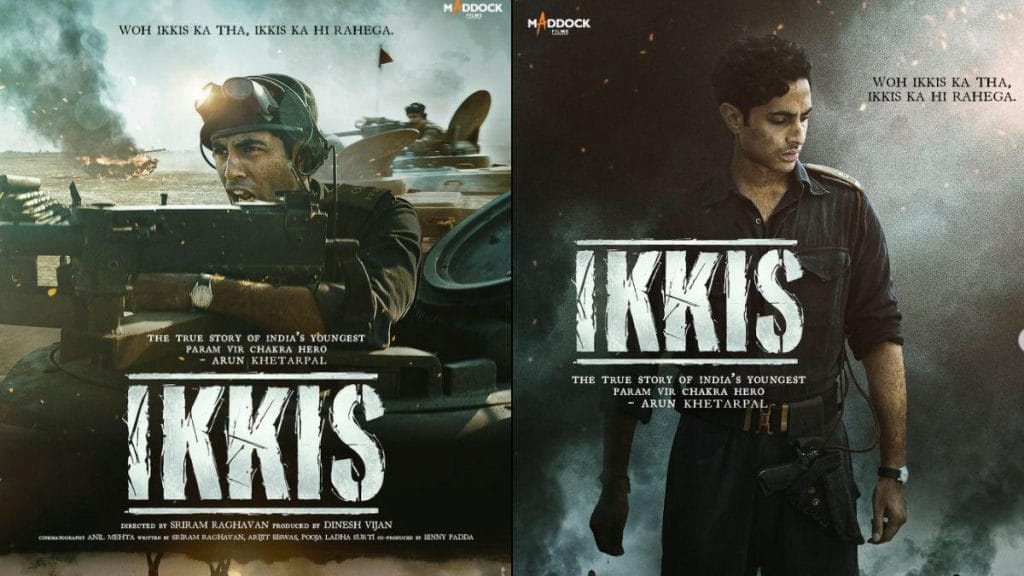
War films often rely on spectacle to leave an impact. Ikkis takes a different route. Directed by Sriram Raghavan, the film chooses memory, silence, and emotional weight over loud patriotism — and that choice largely works in its favour.
Based on the life of Second Lieutenant Arun Khetarpal, the youngest recipient of the Param Vir Chakra, Ikkis isn’t just about battlefield heroics. It’s about what remains after the war — grief, pride, unanswered truths, and legacy.
The story: A life remembered across time
Ikkis traces Arun Khetarpal’s journey through the defining moments of his short but extraordinary life — his family bonds, early love, training days at the NDA, his time with the Poona Horse regiment, and finally, the Battle of Basantar during the 1971 Indo-Pak war.
The film opens years later, in 2001, with Brigadier M.L. Khetarpal travelling to Lahore for a college reunion. The visit becomes deeply personal as memories of pre-Partition life resurface. He stays with an old acquaintance, Naseer, unaware that his host has been carrying a buried truth connected to Arun’s final days.
From there, the film moves fluidly between past and present, slowly piecing together a life shaped by duty and sacrifice.
Direction & writing: Controlled, thoughtful, and non-linear
Sriram Raghavan brings his trademark control to Ikkis, opting for a non-linear narrative that allows the past and present to bleed into each other. Written with Arijit Biswas and Pooja Ladha Surti, the screenplay avoids dramatic excess and instead trusts quiet moments to speak louder.
The transitions between timelines are often striking, occasionally even jolting — but when they land, they deepen the emotional experience. The structure encourages reflection rather than instant gratification, which suits the subject matter.
Visually, the muted colour palette complements the film’s reflective tone, especially in scenes dealing with memory and loss.
What works
- Dharmendra’s presence: Every scene featuring him carries emotional gravity without melodrama
- War sequences: Crisp, intense, and grounded — especially Agastya Nanda’s battlefield moments
- Non-linear storytelling: Adds emotional depth when it flows naturally
- Training and discipline scenes: Offer an honest glimpse into a soldier’s preparation
What doesn’t
- Uneven first half: Frequent timeline shifts can break emotional immersion early on
- Romantic subplots: Feel unnecessary and dilute narrative focus
- Editing issues: Some transitions feel abrupt rather than organic
Performances: Carried by dignity and restraint
Agastya Nanda delivers his most committed performance yet. As Arun Khetarpal, he brings physical sincerity, discipline, and quiet confidence. His war scenes are where he shines most, suggesting genuine growth as a performer.
Dharmendra is the emotional soul of Ikkis. His portrayal of a father grappling with memory, loss, and pride is deeply affecting. Without raising his voice, he conveys decades of emotion — making his performance linger long after the film ends.
Jaideep Ahlawat, as Naseer, plays his role with controlled vulnerability. His emotions simmer beneath the surface, and when they surface, they hit with impact rather than theatrics.
Final verdict
Ikkis isn’t flawless, but it is honest — and that honesty gives it strength. Sriram Raghavan crafts a respectful, emotionally grounded war drama that prioritises remembrance over spectacle. Dharmendra anchors the film with quiet dignity, while Agastya Nanda proves he’s capable of carrying serious, demanding roles.
Despite its pacing issues and occasional missteps, Ikkis never loses sight of its purpose: honouring a real-life hero with sincerity rather than noise.
Rating: ★★★☆☆