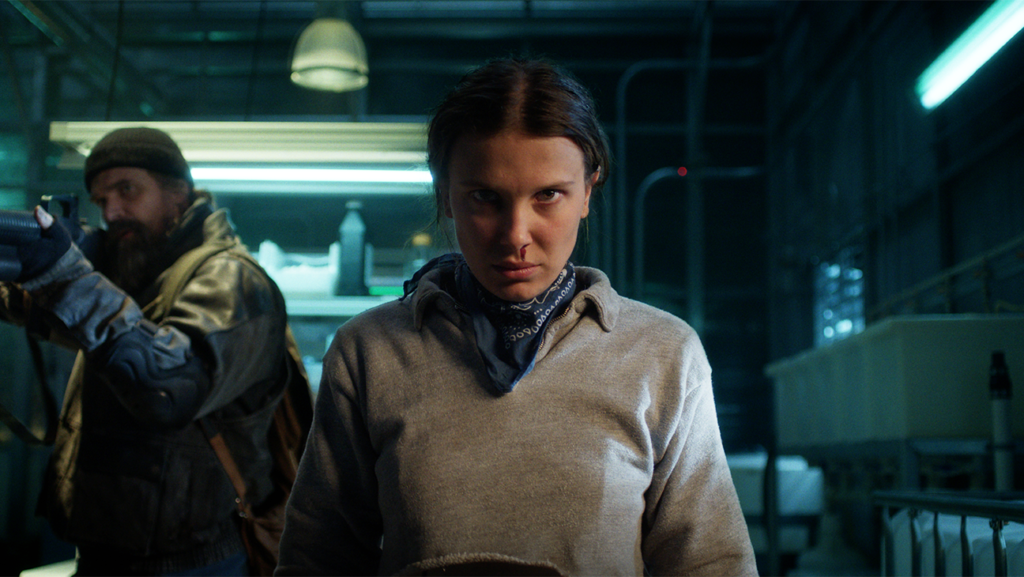
After nearly ten years of monsters, mysteries, and childhood friendships tested by unimaginable horror, Stranger Things finally reaches its end. Season 5 Volume 3 — headlined by Millie Bobby Brown — delivers the final chapter with scale, sentiment, and a heavy sense of inevitability.
It’s not a finale built to surprise you at every turn. Instead, it’s one designed to make you feel — and for most fans, that’s exactly what it needed to be.
The story: One last stand for Hawkins
Everything comes down to a final push into the Upside Down. With Hawkins hanging by a thread, Eleven, Hopper, and the rest of the gang launch a desperate mission to stop Vecna once and for all.
The plan splits the group across worlds. Eleven teams up with Kali and Max to confront Vecna inside his fractured mind, while others venture deep into the Abyss to rescue trapped children before it’s too late. Looming over all of it is the U.S. military, with Dr. Kay determined to seize control — even if it means destroying both worlds in the process.
It’s messy, dangerous, and emotionally exhausting — exactly how a Stranger Things ending should feel.
Writing & direction: Full circle, by design
Matt and Ross Duffer take complete control of the finale, both writing and directing the last episode, and their intent is clear: this is about closure, not chaos.
The story has grown far beyond the disappearance of a single boy in Season 1. What began as a small-town mystery ends as a full-blown saga about power, trauma, and resistance. The Duffers lean into callbacks, near-death fake-outs, and nostalgic echoes from earlier seasons. Some twists are predictable, but they’re executed with sincerity rather than cynicism.
The Mind Flayer’s return adds symmetry, though it no longer carries the raw terror it once did. By now, the threat feels familiar — almost expected — and the show leans more on emotional stakes than fear.
Music & mood: Nostalgia does the heavy lifting
Music once again plays a key role. Prince’s When Doves Cry and Purple Rain, along with David Bowie’s Heroes, are used effectively — though nothing quite matches the lightning-in-a-bottle moment that was Running Up That Hill in Season 4.
Still, the soundtrack reinforces the show’s identity: deeply rooted in memory, loss, and growing up.
Performances: A proper send-off
Jamie Campbell Bower owns the finale as Vecna, injecting just enough vulnerability into Henry Creel to remind us he was once human. It doesn’t redeem him, but it adds texture.
Millie Bobby Brown brings quiet restraint to Eleven’s final arc, while David Harbour and Winona Ryder offer emotional grounding that recalls the show’s earliest days. Finn Wolfhard, Noah Schnapp, Gaten Matarazzo, Caleb McLaughlin, and Sadie Sink all get meaningful closure — less about spectacle, more about acceptance.
Natalia Dyer’s Nancy finally gets her action-hero moment, though Linda Hamilton’s Dr. Kay feels underutilized given the weight of her casting. On the brighter side, supporting players like Priah Ferguson’s Erica steal scenes with sharp, memorable lines.
What worked
- Emotional payoff over shock value
- Strong performances across the ensemble
- Clear thematic closure about growing up and letting go
- Nostalgic parallels to Season 1
What didn’t
- Few genuine surprises
- Some characters underserved in the final stretch
- A slightly softened sense of danger
Final verdict
At 2 hours and 8 minutes, Stranger Things Season 5 Volume 3 does its best to tie up a sprawling story — and mostly succeeds. Not every mystery is answered, and not every thread is perfectly resolved, but the finale understands what truly mattered all along: the characters.
The extended epilogue, set 18 months later, mirrors the show’s very first episode in a quiet, meaningful way. Childhood ends. Life moves on. And some stories are best remembered, not continued.
Stranger Things doesn’t end with terror — it ends with reflection.
And honestly, that feels right.
Final Rating: ★★★★☆