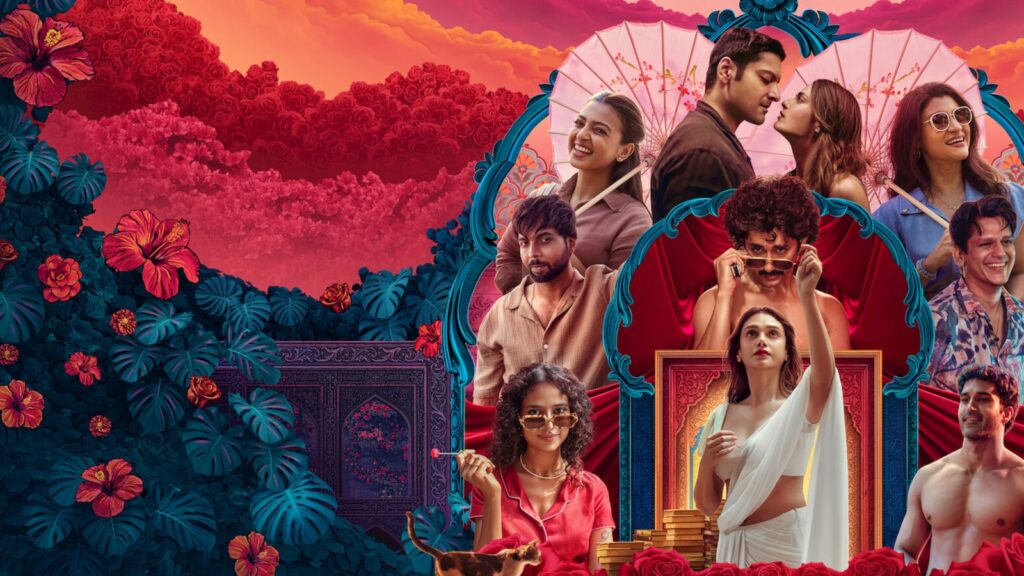
Netflix’s Lust Stories 3 arrives with an unusually strong filmmaking lineup, bringing together Vikramaditya Motwane, Kiran Rao, Shakun Batra and Vishal Bhardwaj for four stories about desire, relationships and intimacy. The anthology premiered on Netflix on September 18, 2026, continuing the franchise that began with its Emmy-nominated first instalment in 2018. With Konkona Sen Sharma, Radhika Apte, Vijay Varma, Gurfateh Pirzada, Sana Thampi, Ali Fazal, Radhika Madan, Aditi Rao Hydari and Siddharth leading the cast, the expectations are naturally high.
The interesting part is that Lust Stories 3 does not try to make all four stories feel alike. Each filmmaker approaches intimacy from a different direction, moving between marriage, attraction, fantasy, jealousy and emotional dissatisfaction. That variety is exactly what makes an anthology interesting, but it also exposes the difference between having a strong premise and turning that premise into a fully satisfying story. Lust Stories 3 has several memorable performances and some genuinely intriguing ideas, yet the four segments do not land with the same force.
Vikramaditya Motwane’s Story Builds Intrigue, Then Loses Its Way
The opening segment from Vikramaditya Motwane brings Konkona Sen Sharma, Radhika Apte, Vijay Varma and Abhishek Banerjee into a story built around two married women who feel that their husbands no longer desire them in the same way. Their answer is an unusual plan involving a partner swap during a staycation, initially framed as an attempt to put their own desires ahead of their insecurities. It sounds like the kind of premise that could lead into an uncomfortable examination of marriage, attraction and the fear of becoming unwanted.
Motwane also has a cast capable of making complicated emotions feel believable, particularly because the story depends heavily on what the characters are thinking rather than simply what they do. The problem is that the screenplay keeps changing its emotional direction, making some of the characters’ decisions feel less convincing than the setup suggests. Jealousy is introduced as an important complication, but the film does not always give the characters enough space to develop beyond the immediate situation.
The segment is at its most interesting when it deals with insecurity inside a long relationship. The fear that your partner may no longer see you in the same way can be more emotionally revealing than the provocative premise itself, and there are glimpses of that idea here. However, the story eventually becomes increasingly messy, with the conclusion leaving a stronger impression of confusion than emotional resolution.
Kiran Rao Finds the Right Balance Between Romance and Chaos
Kiran Rao’s segment is arguably the most confident of the four because it understands that desire becomes more interesting when the audience is allowed to question the people involved. Gurfateh Pirzada plays Karan, a delivery worker who meets Sana Thampi’s Lisa and quickly develops a connection with her. Their relationship appears straightforward at first, but Karan is hiding an important part of his life, and the arrival of his twin brother turns a promising romance into something considerably more complicated.
Unlike some of the other segments, this story does not rush to explain every character. Rao allows the circumstances to unfold gradually, which gives the narrative a playful quality while still keeping an uncomfortable question at its centre. The characters are neither presented as completely innocent nor reduced to simple villains, and that moral grey area gives the story considerably more personality.
The lighter tone also works in its favour. Lust Stories 3 can become quite serious when dealing with marriage and desire, but Rao’s segment understands that romantic confusion can sometimes be funny, awkward and unpredictable at the same time. That balance makes it easier to stay invested in the characters even when their choices become increasingly questionable.
Shakun Batra’s Marriage Story Needed More Depth
Shakun Batra returns to the emotional territory of complicated relationships with Ali Fazal and Radhika Madan playing Varun and Sailee, a married couple who have reached the point of seeking divorce. Their six-month cooling-off period creates the perfect opportunity to examine why two people might want to end a marriage even when physical attraction and emotional familiarity have not completely disappeared.
That contradiction is potentially the strongest idea in the segment. The couple’s lack of intimacy is presented as part of the reason for their separation, yet their interactions suggest that physical chemistry is not necessarily the central problem. This creates an interesting gap between what a couple says is wrong and what might actually be happening underneath their relationship.
Unfortunately, the writing does not explore that conflict as deeply as it could. The conversations between Varun and Sailee are easy to follow, and Fazal and Madan share convincing chemistry, but the larger emotional problem remains somewhat unclear. The six-month period could have become a powerful examination of resentment, companionship, routine and the difference between loving someone and wanting to remain married to them, but the story does not fully dig into those layers.
As a result, the segment feels like it has the framework for something stronger than what eventually reaches the screen. There are moments where the relationship feels authentic, but the overall narrative keeps circling its central problem instead of giving it enough emotional weight.
Vishal Bhardwaj Turns Desire Into Imagination
Vishal Bhardwaj takes the anthology in a noticeably different direction with Aditi Rao Hydari and Siddharth as Saira and Badru, a married couple living in 1987. Saira is dissatisfied with her husband sexually and begins imagining erotic scenarios that allow her to explore a side of herself that does not exist comfortably within her marriage. Those fantasies eventually become the inspiration for her to write an erotic book, creating a story about desire, imagination and finding a voice.
The segment has a deliberately theatrical and quirky personality, which immediately separates it from the other three. Aditi Rao Hydari brings charm and curiosity to Saira, while Siddharth plays a character who becomes part of her increasingly elaborate imagination. Bhardwaj’s approach is less interested in straightforward realism and more focused on the strange relationship between what people desire, what they imagine and what they are willing to express.
That creative choice gives the segment some memorable moments, but it also prevents the relationship from developing the emotional intensity the premise promises. Bhardwaj has previously spoken about connecting desire with imagination and the stories people are sometimes afraid to tell aloud, which is reflected in the segment’s focus on Saira’s creative expression.
The Hyderabad setting and language also give the story its own flavour. Bhardwaj has explained that he wanted the linguistic world to contribute to the storytelling rather than become a caricature, while Kiran Rao praised the way Hyderabad comes through in the film. Still, the segment occasionally feels as though its visual and tonal personality is stronger than the emotional material underneath it.
Performances Keep Lust Stories 3 Moving
One of the anthology’s biggest strengths is its ensemble. Konkona Sen Sharma, Radhika Apte and Vijay Varma bring enough experience and personality to make Motwane’s complicated marriage story watchable even when the writing becomes inconsistent. Gurfateh Pirzada and Sana Thampi benefit from Kiran Rao’s more relaxed storytelling, while Ali Fazal and Radhika Madan make the central marriage in Batra’s segment feel lived-in.
Aditi Rao Hydari and Siddharth are particularly interesting together because the fourth story depends heavily on their chemistry and the difference between fantasy and reality. Their presence gives Bhardwaj’s segment a playful energy, even when the narrative itself begins to wander. Netflix’s official description similarly frames the anthology around different perspectives on love, relationships, desire and human connection rather than treating the four stories as variations of exactly the same idea.
The anthology therefore works best when it allows each filmmaker to have a distinct voice. The problem comes when the premise of a segment appears more developed than the screenplay supporting it. That inconsistency explains why one story can leave you thinking about its characters while another feels like an intriguing idea that needed another round of writing.
What Works and What Doesn’t
The biggest strength of Lust Stories 3 is its willingness to approach desire from multiple angles rather than reducing the subject to physical attraction. Marriage, insecurity, fantasy, emotional distance and personal agency all appear in different forms across the four stories. The anthology also benefits from directors who bring clearly recognisable filmmaking personalities to their respective segments.
The biggest weakness is consistency. Some stories establish their characters and conflicts with enough detail to make their decisions believable, while others introduce promising ideas without giving them enough time to develop. This is particularly noticeable because the cast is strong enough to make even weaker material feel more engaging than it might otherwise be.
There is also a noticeable difference in how each segment handles tone. Kiran Rao’s story benefits from its playful ambiguity, while Vishal Bhardwaj embraces theatricality and fantasy. Motwane and Batra lean more heavily into relationship drama, but their stories sometimes struggle to turn their central conflicts into satisfying emotional journeys.
Lust Stories 3 Review: Final Verdict
Lust Stories 3 is an uneven anthology with enough strong performances, unusual ideas and tonal variety to remain interesting, even when several stories fall short of their potential. Kiran Rao’s segment stands out for the way it handles moral ambiguity, while the other stories offer individual moments that show why this franchise continues to attract filmmakers with very different sensibilities. The film does not always deliver the provocative or emotionally layered experience its premises suggest, but it remains a worthwhile watch for viewers interested in relationship-driven stories that are willing to explore uncomfortable questions.
The third instalment ultimately works less as one complete cinematic experience and more as four separate experiments around the same broad subject. Some experiments connect, others do not, but that unpredictability is also part of what makes an anthology like this worth discussing after the credits roll.
Lust Stories 3 FAQs
What is Lust Stories 3 about?
Lust Stories 3 is a four-part anthology exploring love, desire, intimacy, marriage and complicated human relationships through stories directed by Vikramaditya Motwane, Kiran Rao, Shakun Batra and Vishal Bhardwaj.
Where can you watch Lust Stories 3?
Lust Stories 3 is streaming on Netflix following its September 18, 2026 release.
Who directed Lust Stories 3?
The four segments are directed by Vikramaditya Motwane, Kiran Rao, Shakun Batra and Vishal Bhardwaj.
Who stars in Lust Stories 3?
The ensemble includes Konkona Sen Sharma, Radhika Apte, Vijay Varma, Abhishek Banerjee, Gurfateh Pirzada, Sana Thampi, Ali Fazal, Radhika Madan, Aditi Rao Hydari and Siddharth.
Is Lust Stories 3 connected to the earlier films?
Yes. It is the third instalment of the anthology franchise, but it presents four new stories with different characters and filmmakers.
Is Lust Stories 3 worth watching?
The anthology is likely to work best for viewers who enjoy relationship dramas and stories about intimacy told from different perspectives. Its four segments vary considerably in writing, tone and emotional depth.