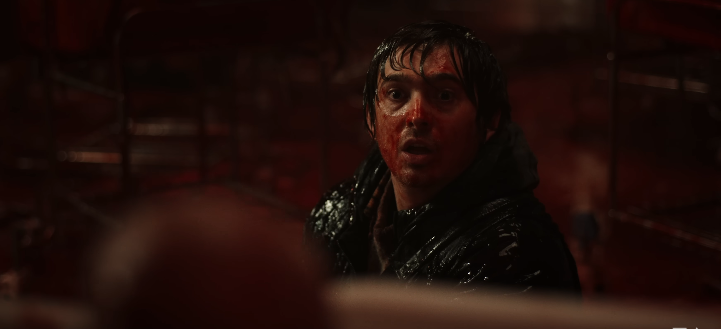
For years, Resident Evil movies have been built around people who seem suspiciously prepared for the end of the world. Guns, combat skills, impossible escapes and larger-than-life heroes have often been part of the formula, leaving little room for the ordinary person who would realistically panic when surrounded by monsters. Zach Cregger’s new Resident Evil takes the franchise in a noticeably different direction by putting an unprepared medical courier at the centre of the nightmare, and that simple change gives the reboot much of its personality.
Austin Abrams plays Bryan, a medical courier whose seemingly routine assignment sends him toward Raccoon City during one very bad night. His journey quickly turns into a fight for survival after an encounter on a snowy road pulls him into the outbreak, forcing him to navigate infected creatures, dangerous locations and situations for which absolutely nothing in his everyday job has prepared him. The film arrives in cinemas on September 18, 2026, with Cregger directing and co-writing with Shay Hatten.
What makes Bryan interesting is precisely what he isn’t. He isn’t Alice, a trained operative or a veteran monster hunter, and Cregger doesn’t immediately transform him into one. Instead, the character spends much of the film trying to understand what is happening while desperately figuring out how to stay alive, giving Abrams room to build a performance around fear, frustration and increasingly frantic improvisation.
Austin Abrams Gives Resident Evil Its Human Face
Abrams is the film’s biggest advantage because he makes Bryan feel like somebody who could actually exist outside a horror movie. His reactions aren’t polished, and his decisions aren’t always heroic in the traditional sense, but that is exactly why the character works. When Bryan encounters something horrifying, the performance allows the fear to register before the action takes over, making the danger feel immediate rather than routine.
There is also a dry comic quality running through Abrams’ performance. Bryan’s muttering, confusion and increasingly desperate attempts to make sense of the situation provide much of the film’s humour without turning him into a parody of a horror protagonist. The jokes emerge from the circumstances and from his personality, which helps the lighter moments coexist with the violence rather than completely interrupting it.
That balance is important because Cregger’s Resident Evil is not interested in maintaining one consistent mood. It can move from genuine suspense to grotesque creature horror and then into an unexpectedly funny moment without completely losing its rhythm. Several reviews have highlighted this mixture of scares and humour as one of the film’s defining qualities, with the approach allowing the reboot to feel closer to the unpredictable experience of playing a survival-horror game.
The film also understands that vulnerability can be more effective than competence. Bryan doesn’t have the answer every time something attacks him, and his survival often depends on whatever object, opportunity or piece of information happens to be available. That keeps the audience closer to his perspective and prevents the action from becoming another sequence of an apparently unstoppable hero defeating increasingly powerful enemies.
Zach Cregger Turns Raccoon City Into A Horror Playground
Cregger arrives at Resident Evil after Barbarian and Weapons, two films that established his interest in manipulating audience expectations. Here, he applies that instinct to a franchise with decades of established imagery, but instead of attempting to recreate a familiar storyline, he constructs a new adventure around Bryan. Sony describes the film as an all-new story and a reinvention of the franchise, which gives Cregger considerable freedom to use the game’s world without simply retelling one of its campaigns.
The structure feels deliberately game-like. Bryan moves from one dangerous situation to another, with each location introducing a different problem and another reason to keep moving. The journey begins in the snowy wilderness before expanding into increasingly disturbing environments and eventually reaching the hospital, giving the movie the feeling of a survival run where every new area could contain something worse than the previous one.
That approach also allows Cregger to play with the franchise’s familiar visual language. Reviews have noted the presence of recognizable Resident Evil elements, including objects and environmental details associated with the games, while the film remains focused on its own story.
The result isn’t trying to recreate the earlier Milla Jovovich-led films. Those movies leaned heavily into action spectacle and a recurring central hero, whereas Cregger’s version starts much closer to survival horror before gradually expanding into bigger and more outrageous territory. The difference is particularly useful because Resident Evil no longer needs to prove that it can produce another giant action sequence; it needs to establish why this particular story deserves to exist.
And for much of its runtime, it does exactly that.
Horror And Comedy Work Better Together
The most enjoyable aspect of the movie is the way its comedy grows out of its horror. Bryan isn’t cracking perfectly timed jokes because the screenplay needs a laugh every few minutes; instead, his personality creates humour naturally while the situation around him becomes increasingly absurd. That distinction helps the film avoid feeling like a horror movie repeatedly stopping to tell the audience that it is funny.
The scares benefit from the same restraint. Cregger doesn’t need every creature encounter to become a giant action sequence, because the uncertainty surrounding Bryan is often enough to generate tension. When the film does unleash its larger monsters and more elaborate set pieces, they feel like an escalation rather than the default setting.
There is also a pleasing physicality to the horror. The film isn’t afraid of gore, grotesque creatures or unpleasant imagery, and that gives the Raccoon City outbreak a tactile quality that suits the franchise. At the same time, the humour prevents the violence from becoming monotonous, creating a rhythm in which tension, disgust and laughter continually push against each other.
That tonal combination has been one of the more consistent points of praise in early reviews. The Associated Press highlighted the film’s mixture of jump scares, gore and dark humour, while The Irish Times described it as a fast-moving, self-aware action romp.
What Works And What Doesn’t
The strongest decision is making Bryan an ordinary man. It gives Abrams a character who can evolve during the story rather than beginning as someone who already knows exactly how to handle the apocalypse. His transformation therefore feels connected to the events around him, even when the film occasionally pushes that progression toward more conventional action territory.
Cregger’s pacing is another major strength. At roughly 90 minutes, Resident Evil does not spend much time wandering through unnecessary mythology or lengthy explanations, and the official Sony listing describes it as a non-stop race for survival. The compact runtime helps the movie maintain momentum, particularly during the sections where Bryan is simply trying to get from one dangerous location to another.
The game-inspired structure is also handled intelligently. Instead of requiring audiences to know the entire Resident Evil mythology, the film gives newcomers a simple objective and gradually introduces the strange rules of its world. Longtime players can enjoy the Easter eggs and recognizable touches, while viewers unfamiliar with the games can follow Bryan’s survival story without needing a franchise encyclopedia beside them.
The weakness is that the movie’s character development does not always keep pace with its increasingly elaborate set pieces. Some reviews have pointed to a loss of momentum or weaker narrative material later in the film, particularly as the story moves away from the intimate survival setup and becomes more conventional.
There are also moments when the comedy threatens to become a little too pleased with itself. The best jokes emerge organically from Bryan’s predicament, while some later beats feel more deliberately designed to get a reaction. Fortunately, the film’s energy and Abrams’ performance keep those moments from derailing the overall experience.
Final Verdict
Resident Evil doesn’t need to reinvent every piece of the franchise to feel fresh. Its smartest move is much simpler: it changes the person standing in the middle of the nightmare. By following an exhausted medical courier instead of another highly trained action hero, Zach Cregger gives the audience someone whose fear, confusion and desperation make the monsters feel dangerous again.
Austin Abrams carries that idea exceptionally well. His Bryan is funny without becoming a cartoon, frightened without becoming passive and increasingly capable without suddenly turning into an action superhero. That progression gives the film an emotional centre that allows the blood, creatures and set pieces to work around something recognisably human.
Cregger’s direction then adds the second half of the equation. He understands the strange personality of Resident Evil — a franchise where horror can sit beside absurdity, grotesque creatures can share space with game-like puzzles and genuine danger can suddenly produce a laugh. The result is a reboot that feels less interested in copying what came before and more interested in capturing the sensation of being trapped inside a particularly nasty survival-horror game.
It isn’t flawless, particularly when the story moves into its later stages, but the experiment largely works. For longtime fans, there are enough recognizable touches to make the connection to Capcom’s world clear, while newcomers get a fast, bloody and surprisingly funny horror adventure. Resident Evil ultimately succeeds because it remembers that survival horror is most effective when the person trying to survive feels human.
Frequently Asked Questions
What is the new Resident Evil movie about?
Zach Cregger’s Resident Evil follows Bryan, a medical courier played by Austin Abrams, who becomes trapped in a nightmare involving an outbreak and mutated creatures while trying to complete a delivery in Raccoon City.
Who plays Bryan in Resident Evil?
Austin Abrams plays Bryan, the ordinary medical courier at the centre of the film’s survival story.
Who directed Resident Evil 2026?
The film was directed by Zach Cregger, who also co-wrote the screenplay with Shay Hatten.
Is the new Resident Evil movie connected to the previous films?
The 2026 film is presented as an all-new story and reinvention of the franchise rather than another chapter in the earlier film continuity.
Is Resident Evil based on the video games?
Yes. The film is a new cinematic interpretation of Capcom’s Resident Evil video game franchise, using its survival-horror world, imagery and gameplay-inspired structure while telling an original story.
When was Resident Evil 2026 released?
The film is scheduled for a wide theatrical release on September 18, 2026. Its listed runtime is approximately 90 minutes.