Netflix’s Unabomber begins with a difficult question: how does a 16-year-old mathematics prodigy at Harvard eventually become a domestic terrorist responsible for a bombing campaign that killed three people and injured nearly two dozen others?
Director Janus Metz has an intriguing piece of history with which to explore that question. Ted Kaczynski participated in controversial psychological experiments while studying at Harvard, and Unabomber puts those sessions at the center of his younger years. Jacob Tremblay plays the teenage Kaczynski, Russell Crowe portrays psychologist Henry Murray, while Shailene Woodley leads a parallel 1990s storyline as FBI agent Joanne Miller.
The result is frequently well acted and occasionally disturbing. But whenever the movie seems close to examining Kaczynski with real complexity, it retreats into the safer structure of a conventional streaming crime thriller.
Jacob Tremblay gives the movie its most unsettling material
The Harvard storyline is easily Unabomber’s strongest section.
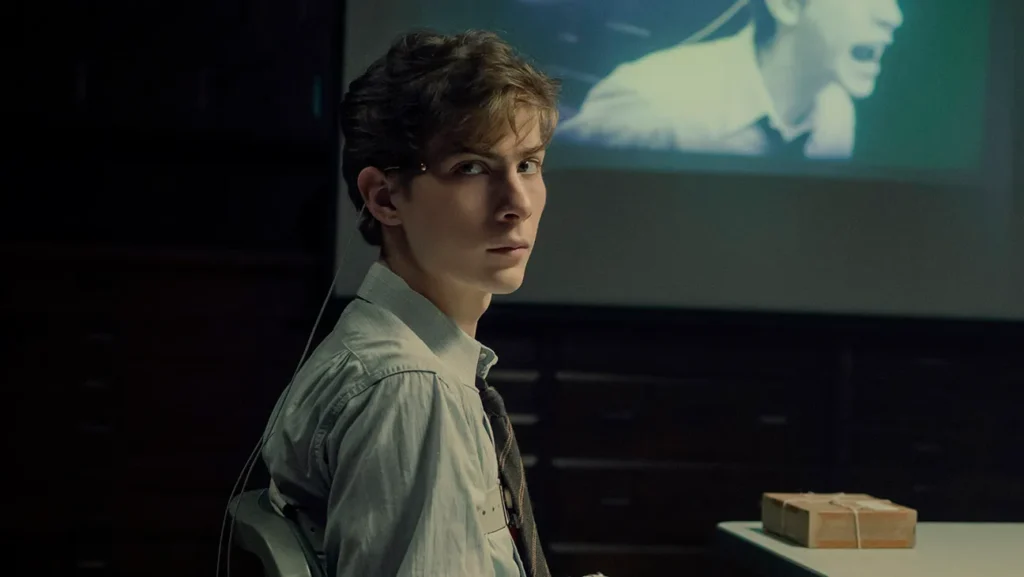
Tremblay does not play the young Kaczynski as though a future murderer is already waiting behind his eyes. Instead, he begins with intelligence, social awkwardness and a visible discomfort around people considerably older than him. That restraint is important because it prevents the performance from becoming an imitation of a historical villain.
Netflix says Kaczynski entered Harvard at 16, and Metz has explained that the movie intentionally cuts between “the making of the Unabomber and the capture of the Unabomber.”
Tremblay makes the first half of that idea much more interesting than the second.
Opposite him, Crowe gives Henry Murray an intimidating intellectual authority. The psychological sessions become some of the film’s tensest scenes precisely because nobody needs a weapon. Kaczynski’s beliefs are recorded, attacked and turned back against him while he is subjected to deliberately stressful interrogation.
Those experiments were real. Historical accounts describe Kaczynski participating in Murray’s Harvard study beginning in 1959, with subjects exposed to highly confrontational attacks on their personal philosophies. The methods would be considered deeply problematic under modern research standards.
That history gives Metz material far more unsettling than a standard true-crime reconstruction.
The movie gets into trouble when explanation becomes causation
This is also where Unabomber becomes most uncomfortable for the wrong reason.
There is an obvious dramatic temptation to place Kaczynski’s Harvard experience beside the violence he committed decades later and allow viewers to draw a straight line between them: vulnerable prodigy enters experiment, experiment damages prodigy, damaged prodigy becomes terrorist.
History is considerably less tidy.
There is no established causal connection showing that Murray’s experiment caused Kaczynski’s later bombing campaign. Historians and psychologists have cautioned against treating it as a simple explanation for his subsequent ideology and violence.
Unabomber does not explicitly say “this experiment created the Unabomber,” but the film’s structure comes dangerously close to implying it.
That makes its psychological portrait feel easier than the real question deserves. Kaczynski made deliberate decisions over many years. Beginning in 1978, he constructed and delivered increasingly sophisticated bombs; the FBI says 16 devices were ultimately connected to his campaign before his arrest in Montana in April 1996.
Showing the forces that shaped someone can be valuable. Turning those forces into an origin story risks converting explanation into excuse, even unintentionally.
The movie needed more confidence in that distinction.
Shailene Woodley gets the more conventional half of the film
The 1990s timeline is much less distinctive.
Woodley plays FBI agent Joanne Miller, who works to identify Kaczynski while dealing with colleagues reluctant to follow her instincts. There is a perfectly functional investigative thriller buried in these scenes, and Woodley gives Miller enough determination to keep them moving.
The problem is that Joanne Miller was not a real individual investigator in the Unabomber case.
Woodley has explained that the character is fictional, describing Joanne as an amalgamation of detectives who worked on the investigation. The real UNABOM investigation was a huge multi-agency effort involving the FBI, ATF and U.S. Postal Inspection Service over many years.
Condensing that history is understandable. Movies do it constantly.
But here it makes the investigation feel more generic just as the Harvard material is becoming unusually specific. Joanne repeatedly risks resembling the familiar fictional detective who sees what everyone else misses while unimaginative colleagues stand in her way.
Other early reviews have identified the same imbalance. /Film found the Harvard story considerably more effective than the FBI material, while TheWrap criticized the movie for trying to combine too many different approaches without developing them fully.
The difference is noticeable every time the film changes decades.
At Harvard, Unabomber feels like a disturbing psychological drama.
At the FBI, it often feels like an episode from a competent crime procedural.
The most important part of the real investigation gets less attention
There is another story sitting inside the case that arguably deserved more room: Kaczynski was ultimately identified because of his own writing and his family.
After the Unabomber demanded publication of his manifesto in 1995, Kaczynski’s sister-in-law Linda Patrik noticed similarities between the document and ideas he had previously expressed. She persuaded her husband, David Kaczynski, to examine the writing and eventually contact authorities. Linguistic comparisons helped investigators build the case that led them to Ted’s Montana cabin.
That is a remarkable story about language, family loyalty and moral responsibility.
Unabomber touches this part of the investigation, but its decision to concentrate so heavily on its fictional FBI protagonist means some of the strangest—and most human—elements of the actual case never become as powerful as they could.
Unabomber works better as a performance piece than a definitive portrait
Metz has made a polished film. The Harvard environments carry an appropriately claustrophobic academic formality, the experiments generate genuine discomfort, and Tremblay demonstrates again that he can handle material much darker than the roles that first made him famous.
Crowe is imposing without needing to turn Murray into a cartoon villain, and Woodley does respectable work with a character who largely exists to simplify an enormously complicated investigation.
But Unabomber never quite solves the problem at the center of many true-crime biopics: explaining a notorious person without making one formative experience appear to explain everything.
The actual Kaczynski case lasted almost two decades. It involved ideology, meticulous planning, technological resentment, murder, an enormous federal investigation and, finally, recognition of his writing by his own family.
That story is messier than the psychological equation Unabomber sometimes wants it to become.
PopcornRealm verdict: Jacob Tremblay gives Unabomber a compelling and unsettling center, while Russell Crowe makes the Harvard sections its strongest material. But the split timeline weakens the momentum, the fictional FBI storyline feels overly familiar, and the film gets too close to offering a neat psychological explanation for a history that was anything but simple.
Unabomber is streaming on Netflix from September 25, 2026.