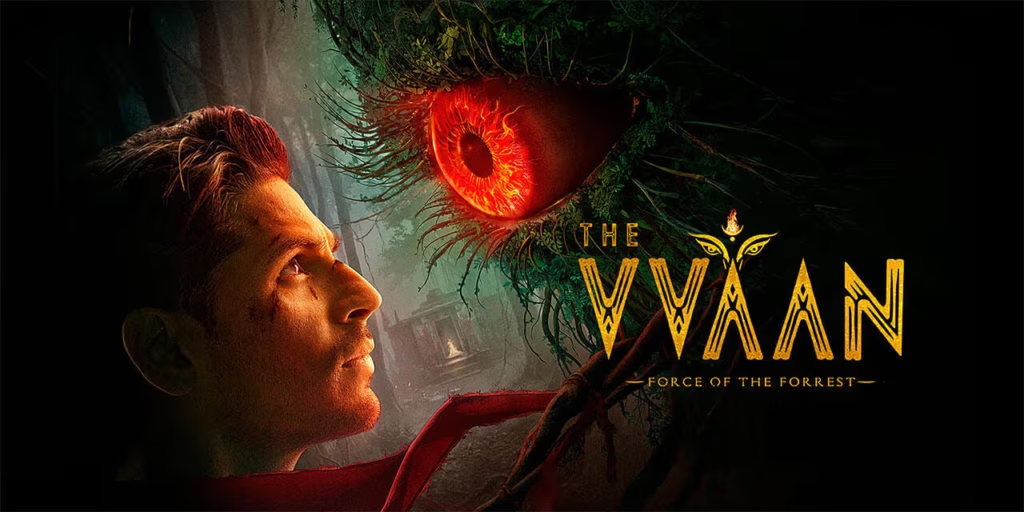
There is a genuinely interesting movie hiding inside The Vvaan: Force of the Forrest. It involves an ancestral village, a forbidden forest, a guardian goddess, a grieving couple and a conflict between modern development and beliefs passed down through generations.
For a while, director Deepak Kumar Mishra finds that movie.
Then The Vvaan starts explaining everything.
The September 25 release stars Sidharth Malhotra as Rishi, a rational urban man who returns to his ancestral village of Devanchal with his wife Mamta, played by Tamannaah Bhatia. Rishi dismisses warnings about entering a forest after sunset and supports a development project that would cut through land the villagers regard as sacred. His scepticism becomes much harder to maintain once the mythology surrounding Van Devi begins intruding on reality.
It is a strong foundation for a Hindi folk-fantasy film. Unfortunately, The Vvaan is considerably better at establishing its mystery than paying it off.
The first half understands why folklore works
The most convincing stretches are not the expensive supernatural sequences. They are the quieter scenes where the village actually feels shaped by belief.
The film draws inspiration from folklore associated with a Van Devi temple near Patna, with writer Arunabh Kumar and Mishra expanding that starting point into a larger supernatural mythology. The setting gives The Vvaan something many fantasy films struggle to manufacture: a cultural foundation underneath the monsters and magic.
Chhath Puja is particularly effective because it is not treated simply as attractive production design. Ritual, family history and Mamta’s faith create texture around a story that is also about grief. Rishi’s loss of belief is connected to something painful in his marriage, which gives his rationalism more emotional weight than the standard movie atheist who exists only so supernatural events can prove him wrong. India Today similarly identified the couple’s grief and Rishi’s crisis of faith as some of the film’s strongest dramatic material.
There is an equally interesting conflict underneath the land dispute. Is the forest protected because of superstition, or has inherited belief preserved something that modern development does not understand? The road project could have allowed the film to explore faith, environmental preservation and generational tension without turning any side into an obvious caricature.
For perhaps half the film, it seems ready to do exactly that.
Sidharth stays grounded while Tamannaah gets the emotion
Sidharth Malhotra benefits from playing Rishi relatively straight.
He does not enter the movie as a fantasy-action hero waiting for his transformation scene. Rishi’s scepticism and distance from the village make the mythology around him more effective because his reaction initially resembles the audience’s own: curiosity mixed with disbelief.
Malhotra handles that restrained section better than the moments when The Vvaan begins demanding conventional heroic grandeur from him. His strongest scenes come when Rishi is processing what he believes rather than fighting whatever the screenplay has placed in front of him.
Tamannaah Bhatia has less narrative control as Mamta, but she gives the story much of its emotional credibility. Her character’s desire to become a mother again and her continued religious faith offer a counterpoint to Rishi’s bitterness. Several early reviews have also singled out Bhatia’s sincerity, particularly during the Chhath sequences.
The supporting cast is more uneven. Anup Soni and Shweta Tiwari help establish the family and village dynamics but could have been used more substantially. Sunil Grover takes on a darker role than audiences generally associate with him; the performance is committed, even when the writing around the character becomes increasingly predictable.
Maniesh Paul, meanwhile, is assigned much of the comic relief. His timing saves individual lines, but the film repeatedly brings comedy back at moments when its atmosphere would benefit from silence. Hindustan Times similarly noted that one recurring joke is stretched far beyond its usefulness.
Deepak Kumar Mishra’s biggest strength becomes the missed opportunity
Mishra is best known for his work on Panchayat, which makes The Vvaan an intriguing feature-directing leap. Sidharth Malhotra even said the Panchayat connection was enough to make him interested in working with the TVF team.
And strangely, the movie works best when it behaves most like something made by people who understand Panchayat.
The village conversations, cultural details and clashes between people with different relationships to Devanchal feel more distinctive than the eventual fantasy spectacle. There is humor in personalities rather than punchlines, and the supernatural threat feels more powerful while it is still something people whisper about.
Then the movie seems to lose confidence in that simplicity.
The mythology expands, explanations multiply and the forest becomes less frightening with every new piece of information. Instead of trusting atmosphere, The Vvaan increasingly depends on background music, digital creatures and escalating confrontation. Multiple reviews have landed on essentially the same problem: a promising first half gives way to a much more conventional and cluttered second.
That is particularly frustrating because the movie’s central location should be its greatest asset.
A forest villagers refuse to enter after sunset does not need constant visual effects to feel dangerous. Darkness, sound and uncertainty could do much of the work. Once the film starts showing too much, the illusion weakens.
The VFX cannot carry what the screenplay abandons
The effects are another issue.
Some wide compositions successfully sell the scale The Vvaan is reaching for, and the production design gives its mythology an identifiable visual language. But several supernatural elements have the overly digital appearance that is especially damaging in folk horror, where the threat needs to feel as though it has occupied the landscape long before the protagonists arrived. India Today specifically criticized the stiffness of some creatures and the way the effects reduce rather than increase the sense of danger.
The Australian Classification Board lists the film at approximately 134 minutes, which is not extreme for contemporary Indian cinema. Yet it feels longer because the second half repeats information and emotions that the first half had already communicated more elegantly.
This is where comparisons with movies such as Tumbbad and Kantara become unavoidable—not because The Vvaan copies either film, but because both demonstrated something important about folklore on screen. Local mythology becomes most powerful when viewers feel they have entered an existing belief system, rather than when mythology is reduced to exposition before an action finale.
The Vvaan understands that lesson early. It simply does not trust it for long enough.
There are good ingredients here: a culturally specific legend, a marriage affected by grief, Chhath rituals, questions about faith and development, and a protagonist whose disbelief has an emotional reason behind it. That is more than enough material for an eerie, intimate supernatural story.
Instead, the movie keeps adding mythology until the mystery that originally made the forest interesting begins disappearing.
PopcornRealm verdict: The Vvaan is most compelling when it is a rooted folk mystery about grief, faith and a village afraid of what lives beyond its boundary. Sidharth Malhotra stays grounded and Tamannaah Bhatia supplies genuine emotion, but an overloaded second half, inconsistent VFX and too much explanation prevent Deepak Kumar Mishra’s promising idea from becoming the haunting fantasy it could have been.