There is no shortage of ambition in The Paradise. Srikanth Odela’s second collaboration with Nani is bigger, louder and considerably more aggressive than Dasara, placing its star inside an enormous period-action world built around oppression, identity and rebellion.
The problem is that bigger does not necessarily mean deeper.
Set against 1980s Secunderabad, The Paradise follows the Savaari community, a marginalised group living without the dignity and recognition afforded to everyone around them. Nani plays Jadal, a man who eventually becomes the face of their resistance against Shikanja Malik, played by Mohan Babu.
It is the kind of role designed to produce whistles: a transformed star, an oppressed community waiting for someone to rise, towering villains and bursts of bloody action. Yet the film frequently feels caught between wanting to say something specific about marginalisation and wanting to become another mythic mass-hero origin story.
Nani commits completely to Jadal
Nani remains the strongest reason to stay invested.
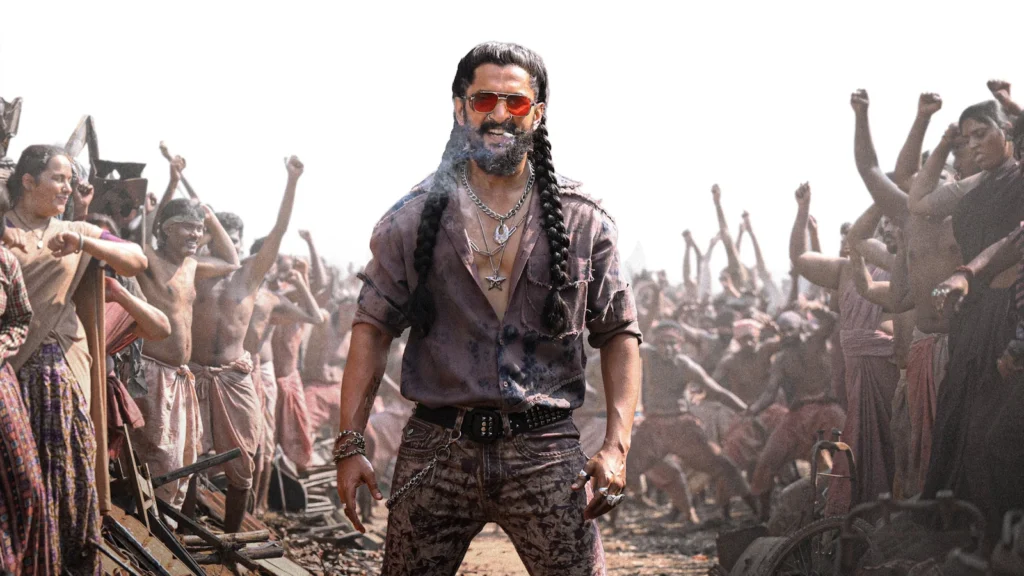
His transformation is not limited to the long braids and beard that dominated the promotional material. Jadal moves differently from the more approachable characters that built Nani’s reputation. There is a physical heaviness to him, an aggression in the action sequences and a sense that the character has been shaped by the environment around him.
That commitment has been one of the few points on which opening-day reviews broadly agree. The Indian Express praised Nani’s physical transformation and conviction even while giving the film two stars, while India Today similarly described him as the performer holding together an otherwise fragmented film.
The difficulty is that Jadal often feels more developed as an icon than as a person.
Odela knows how to frame him. Entrances carry weight. Violence is staged to turn him into a figure larger than the men surrounding him. But when a movie spends so much energy announcing that its hero is becoming a legend, the quieter emotional work becomes even more important.
That is where The Paradise begins losing its grip.
The scale has grown since Dasara, but some of the specificity is gone
Dasara also used familiar ingredients, but its coal-mining setting gave those ingredients texture. Veerlapally felt lived in before the movie began transforming its characters into larger-than-life figures.
The Paradise has considerably more money and machinery on screen. CH Sai’s cinematography gives the film a grim, imposing visual identity, while Avinash Kolla’s production design helps create a world large enough to support Odela’s ambitions. Ram-Lakshman and the other stunt teams have also been given plenty of room to build elaborate confrontations. The official production credits underline just how technically expansive the film became.
And yet the more spectacular The Paradise becomes, the more familiar it can feel.
The oppressed-community narrative, chapter-based storytelling, brutal ruler and hero who becomes the voice of people denied dignity all recall ideas Indian action cinema has visited repeatedly in recent years. Hindustan Times highlighted that sense of déjà vu, while The Indian Express argued that Odela’s screenplay relies on a template without finding enough fresh character work to distinguish it.
There is nothing inherently wrong with a familiar structure. Dasara itself demonstrated that an old framework can work when atmosphere and characters make it personal.
Here, spectacle too often arrives before emotional investment.
The supporting characters needed more room
That problem becomes clearer around the ensemble.
Mohan Babu has the presence needed for Shikanja Malik, while Raghav Juyal brings an intentionally unstable energy to Vikram. Sonali Kulkarni’s Sammakka carries greater thematic significance than simply being Jadal’s mother; Kulkarni herself stressed before release that the character has an independent story rather than existing only through her son.
But the screenplay does not always give the wider ensemble enough space to become as memorable as the world they occupy.
Kayadu Lohar’s Subbu, in particular, risks functioning more as a mechanism for Jadal’s journey than as a fully realised character. Similar complaints have appeared across early reviews, which repeatedly point to supporting figures being reduced to familiar archetypes while Jadal absorbs most of the dramatic oxygen.
That matters because the movie is supposedly about an entire community’s fight for identity.
If the audience knows the people only as a suffering collective waiting for Jadal to act, the rebellion becomes visually powerful without always becoming emotionally specific.
The action gets louder as the story gets thinner
The pre-interval stretch gives The Paradise some of its strongest mass-cinema energy. Odela understands escalation, and Nani is convincing enough physically to make Jadal’s violent transformation feel credible.
But repetition eventually dulls that impact.
Violence works best when each confrontation changes something—our understanding of a character, a relationship or the stakes. Here, successive bursts of brutality increasingly begin serving the same purpose: reinforcing that Jadal is dangerous and his enemies deserve his rage.
By then, the film’s roughly three-hour runtime becomes harder to ignore. Published listings vary slightly, with Rotten Tomatoes giving 2 hours 45 minutes and The Times of India listing 2 hours 54 minutes, but either way this is a substantial sit.
Anirudh Ravichander’s songs provide welcome propulsion, but even his music cannot consistently smooth over the screenplay’s stop-start rhythm. 123Telugu also noted abrupt editing and sound-mix issues, while praising the cinematography and production scale.
That creates the central contradiction of The Paradise: individual scenes are often mounted like climaxes, yet the film itself struggles to keep building.
The Paradise is most frustrating because the potential is visible
This is not a film lacking effort.
Nani has clearly pushed himself. Odela has been given a canvas far larger than Dasara. The technical teams have built an imposing world, and the underlying story—people denied identity fighting to be seen—contains more than enough material for a powerful drama.
But The Paradise too often chooses iconography over intimacy.
You remember Jadal standing tall, the braids, the crowds, the violence and the enormous frames. What is harder to carry out of the theatre is the same emotional connection that made Dasara’s rougher, smaller world work.
Nani does everything possible to give Jadal a pulse. The frustration is that the movie surrounding him keeps trying to turn that pulse into a roar.
And eventually, the noise becomes louder than the story.
PopcornRealm verdict: The Paradise delivers scale, a committed Nani and several forceful theatrical moments, but its familiar writing and underdeveloped emotional core keep Srikanth Odela’s ambitious second film from matching the impact of Dasara.