Hollywood has spent decades selling the idea of the perfect American suburb. Neat lawns, quiet streets, friendly neighbours and a family that appears to have everything under control are usually shorthand for safety. The End of Oak Street takes that familiar picture and tears it apart almost immediately, dropping Anne Hathaway and Ewan McGregor’s family into a neighbourhood where prehistoric predators suddenly turn suburban comfort into a nightmare.
Directed by David Robert Mitchell, the film initially looks like a conventional dinosaur survival movie. A mysterious phenomenon brings massive prehistoric creatures into a modern residential community, leaving ordinary people trapped between their homes and animals built to hunt. But Mitchell is less interested in making the dinosaurs objects of wonder than using them to expose the cracks that already existed inside one family.
The result is a surprisingly mature creature thriller. There is blood, chaos and plenty of prehistoric violence, but the film’s real subject is what happens when the comfortable illusion of control disappears and a family that was already struggling has nowhere left to hide.
The End of Oak Street Review: Story
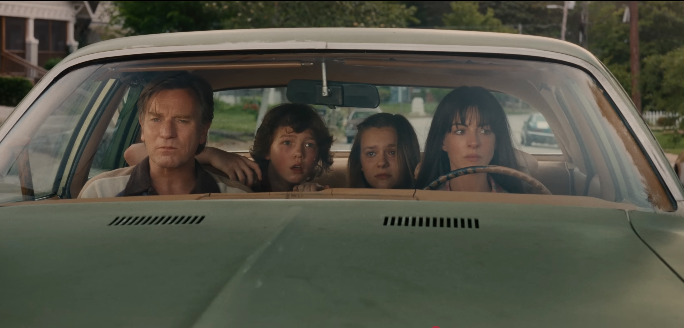
The story centres on Denise and Greg Platt, played by Hathaway and McGregor, and their children Audrey and Brian. Before the prehistoric nightmare begins, the Platts already have problems that they have not resolved, with the seemingly perfect Flowervale suburb hiding tensions beneath its polished exterior.
Everything changes after powerful flashes of white light precede the arrival of prehistoric creatures. The neighbourhood is suddenly transformed into a hunting ground, with enormous predators roaming streets that moments earlier represented security and normality. The family has little choice but to forget their personal disagreements and concentrate on staying alive.
What makes the setup work is the film’s decision to keep the action largely confined to the neighbourhood. The Platts cannot simply escape into another city or wait for a rescue team to arrive and solve everything. Their world becomes smaller as the danger outside grows, turning familiar houses, gardens and streets into increasingly claustrophobic spaces.
That approach also gives the film an interesting psychological dimension. The family’s first instinct is to barricade themselves inside their home and create a physical separation between themselves and the catastrophe. For a while, the suffering happening outside their front door becomes something they can almost treat as background noise because their immediate concern is protecting their own family.
That uncomfortable behaviour becomes part of Mitchell’s larger observation. The dinosaurs may be the obvious threat, but the film is also interested in how quickly people can detach themselves from a crisis when they believe it belongs to someone else. Once the danger enters their own space, however, the Platts are forced to confront both the outside world and problems they had previously avoided.
Why The Dinosaurs Feel Different
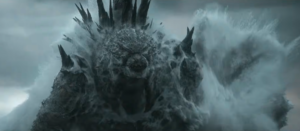
The most refreshing thing about The End of Oak Street is that it does not treat its dinosaurs like attractions in a theme park. There is very little sense of the creatures being presented as majestic prehistoric celebrities. They are predators, and the film wants you to understand exactly what that means.
This makes the movie considerably more brutal than a conventional dinosaur adventure. The creatures behave more like monsters in a survival horror film than animals audiences are expected to admire from a safe distance. Mitchell uses their unpredictability to keep the tension alive, while the suburban setting makes every encounter feel uncomfortably close to home.
That is also where the movie separates itself from the Spielberg-style dinosaur tradition. Instead of building toward moments of awe before unleashing danger, Mitchell often removes the comforting distance between the audience and the creatures. The dinosaurs are not simply there to create spectacular sequences; they become an unpredictable force capable of destroying the routines that make the characters feel safe.
The suburban setting does much of the rest of the work. Manicured lawns, familiar houses and quiet roads suddenly become meaningless when prehistoric predators occupy them. Every street feels like it could lead to another trap, and the physical confinement of the neighbourhood gives the movie a persistent sense of unease.
There is an interesting irony in the family’s attempt to maintain routine during all of this. They repeatedly move from one emergency to another while still trying to protect some sense of normal life. Their behaviour reflects how people can gradually normalise even extraordinary circumstances when there is no obvious way to escape them.
Anne Hathaway Leads a Strong Family Performance
Hathaway gives the film one of its strongest performances as Denise. She brings maternal aggression and emotional exhaustion to a woman who is frightened by what is happening but refuses to let that fear prevent her from protecting her children.
What makes Denise effective is that she is not written as an unstoppable action hero. She gets tired, she becomes frightened and she is clearly overwhelmed by the situation, but her determination never disappears. Hathaway keeps those contradictions visible, which helps the character feel like an ordinary parent rather than a Hollywood survival machine.
McGregor takes a quieter approach as Greg. His performance gives the family another emotional texture, particularly because Greg’s vulnerability contrasts with the expectation that a father should always know what to do in a crisis. The film benefits from allowing both parents to appear uncertain rather than turning either one into an obvious leader.
Maisy Stella and Christian Convery also contribute strongly to the family dynamic. Stella captures Audrey’s uncertainty as a teenager watching her family and familiar world collapse around her, while Convery gives Brian a believable mixture of youthful confidence and genuine terror. Their reactions make the prehistoric threat feel more immediate because the children are never reduced to simple plot devices.
The ensemble ultimately works because the characters remain ordinary. There is no chosen-one mythology here and no conveniently brilliant survivor who suddenly knows how to defeat the dinosaurs. The Platts are simply trying to keep each other alive, and that grounded approach gives the larger spectacle an emotional centre.
What Works and What Doesn’t
The film’s greatest strength is the way it combines creature horror with family drama. The dinosaurs provide the immediate danger, but the emotional tension comes from the Platts themselves and the unresolved problems they brought into the crisis. That gives the movie more to work with than a simple sequence of people running away from prehistoric animals.
Mitchell is particularly effective when he lets the environment tell part of the story. The once-perfect neighbourhood becomes increasingly hostile without losing its recognisable suburban appearance. That contrast creates some of the film’s best imagery because the setting remains familiar even when everything happening inside it becomes completely abnormal.
The movie also deserves credit for resisting the temptation to make every sequence a giant spectacle. Some of its strongest moments are quieter, particularly when the family is forced to confront what the disaster has revealed about them. Those scenes give the violence a purpose instead of allowing it to become repetitive noise.
And repetition is where the film does occasionally stumble. The Platts repeatedly find themselves dealing with another immediate crisis, trying to rescue one another and then facing another threat. The structure reflects their attempts to survive, but after enough cycles, some of the tension begins to feel familiar rather than escalating.
Still, the emotional purpose behind that repetition helps. The family is effectively trapped in a loop where survival becomes the only routine available to them. Their attempts to find normality inside an impossible situation are both frustrating and strangely believable.
The End of Oak Street Review: Verdict
The End of Oak Street is more interested in the people running from dinosaurs than the dinosaurs themselves. That is what ultimately separates it from a standard summer creature feature. Beneath the bloodshed and enormous predators is a story about a family whose carefully maintained image of happiness is already collapsing before the apocalypse arrives.
Anne Hathaway provides the film with its emotional centre, while Ewan McGregor brings a quieter vulnerability to the family. Maisy Stella and Christian Convery complete a convincing family unit, making the Platts feel like people rather than characters assembled purely to survive set pieces.
The film is not flawless. Its repeated rescue-and-survival structure can become predictable, and its attempt to balance family drama with brutal dinosaur horror occasionally makes the pacing uneven. But its ambition is what makes it memorable, particularly when Mitchell uses the prehistoric invasion to question the idea that suburban America can ever be completely safe.
Verdict: 3.5/5. The End of Oak Street is a bloody, tense and unexpectedly emotional dinosaur thriller that gives its prehistoric chaos a human heartbeat. It may not reinvent the creature-feature formula completely, but its decision to make family fractures as important as dinosaur attacks gives the film considerably more personality than a conventional summer blockbuster.
The End of Oak Street Review Q&A
What is The End of Oak Street about?
The film follows a suburban family whose neighbourhood is suddenly transformed by the arrival of dangerous prehistoric creatures. Their fight for survival also forces them to confront problems within their own family.
Is The End of Oak Street a Jurassic Park-style movie?
It uses dinosaurs, but its approach is considerably darker. The creatures are presented primarily as predators and threats rather than objects of wonder, giving the movie more of a survival-horror feel.
Who stars in The End of Oak Street?
Anne Hathaway and Ewan McGregor lead the film as Denise and Greg Platt. Maisy Stella and Christian Convery play their children, Audrey and Brian.
Is Anne Hathaway good in The End of Oak Street?
Hathaway is one of the film’s strongest performers. She gives Denise a combination of fear, exhaustion and fierce determination as she tries to protect her children.
What makes The End of Oak Street different?
The movie uses a dinosaur apocalypse to explore family problems and suburban isolation. Its focus on ordinary people rather than chosen heroes gives the survival story a more grounded quality.
Is The End of Oak Street worth watching?
Yes, particularly if you want a dinosaur thriller with more character drama than a conventional creature feature. The film’s strongest moments come from the combination of family tension, claustrophobic survival and brutal dinosaur encounters.