There is something almost stubbornly old-fashioned about Heart of the Beast. David Ayer’s survival drama has a movie star, dangerous wilderness, wild animals and a catastrophic plane crash, yet none of those things are really its main attraction. The film works because it keeps reducing itself until almost everything unnecessary has fallen away: one damaged soldier, one battle-scarred dog and a simple question of whether either will abandon the other when survival becomes increasingly difficult.
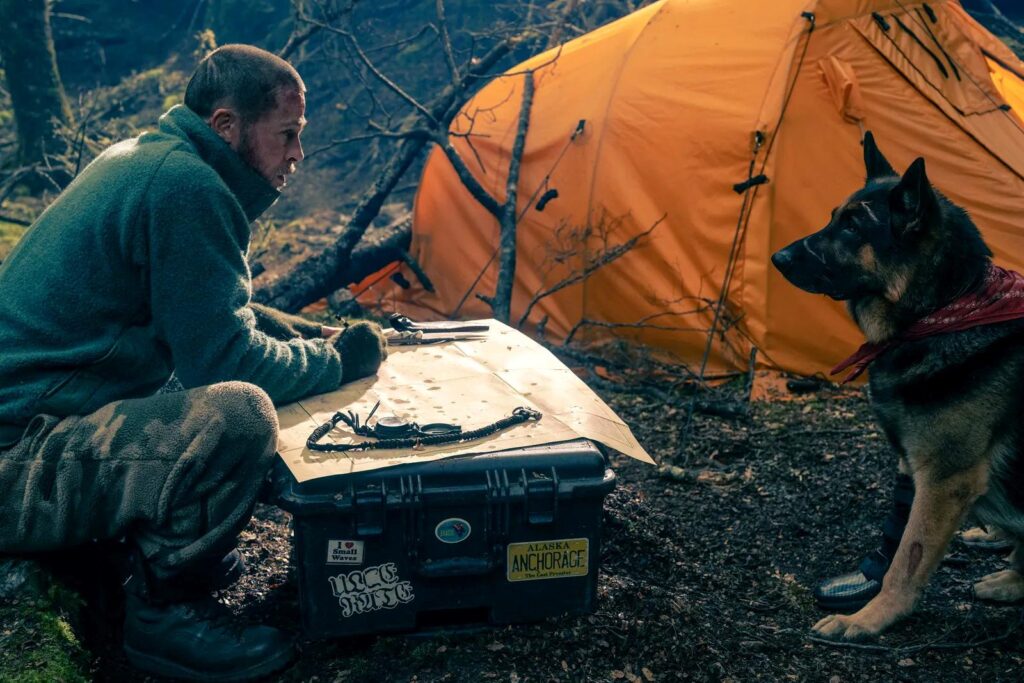
Brad Pitt plays James Belmont, a retired Special Forces officer whose isolation in the wilderness feels less like an adventure than an attempt to put distance between himself and the life he once lived. Odin, his retired combat dog, carries his own visible reminders of war. When a plane crash strands them deep in the Alaskan wilderness, Heart of the Beast could easily have become another exercise in increasingly elaborate survival set pieces. Instead, its strongest stretches are concerned with dependence, trauma and the uncomplicated loyalty between two veterans who understand each other without needing much dialogue.
Paramount officially describes the film as an adventure thriller about the “unbreakable bond” between Belmont and Odin, and that unusually straightforward description is essentially the whole movie. What matters is not discovering some elaborate twist buried underneath the premise. It is watching how much emotional mileage Ayer can get from something deliberately simple.
Brad Pitt does less, and the movie gains more
Pitt has spent much of his career demonstrating how easily he can dominate a scene through charisma, eccentricity or movie-star confidence. James requires almost the opposite approach. His performance is quieter, physically tired and frequently dependent on reaction rather than dialogue, which is important in a film where his most significant scene partner cannot speak.
That restraint also explains why Odin never feels like a cute accessory attached to a Brad Pitt vehicle. The dog is effectively the film’s second lead. Multiple trained dogs were used to portray Odin, with Uber serving as the primary canine performer, according to reporting around the production. Pitt himself has referred to Uber as “the star of the film,” which may sound like promotional charm until you see how much of the story depends on the animal communicating fear, vigilance and attachment without dialogue.
The relationship was apparently what affected Pitt before cameras ever rolled. Recalling his first encounter with Cameron Alexander’s screenplay, Pitt said, “I just silently wept. It just really, really moved me.”
That reaction makes sense after seeing the finished film. Heart of the Beast does not treat the dog as a mechanism for manufacturing easy sentiment every few scenes. James and Odin feel like soldiers who came home together but did not necessarily leave the war behind. Their scars are different, yet the movie repeatedly frames survival as something they accomplish for each other rather than individually.
This simple story spent almost nine years reaching theaters
One of the more interesting pieces of history behind Heart of the Beast is that its uncomplicated premise has been waiting a surprisingly long time to become a movie.
Cameron Alexander’s screenplay appeared on the 2017 Black List, the annual survey of well-regarded unproduced screenplays. The original listing described a former military operator and his retired combat dog trying to return to civilization after a catastrophe in Alaska. The script received nine mentions that year.
With Paramount releasing the finished film on September 25, 2026, nearly nine years separate that Black List appearance and its theatrical arrival. That long journey is interesting because the central idea seems to have survived largely intact. Hollywood development often adds mythology, supporting characters and additional narrative machinery to a concept over time; Heart of the Beast instead arrives feeling like a movie determined to protect the simplicity that made the screenplay attractive in the first place.
It is also a reunion with its own history. Ayer previously directed Pitt in Fury, released in 2014, making Heart of the Beast their first feature together in roughly 12 years. The contrast between the two films is striking. Fury surrounded Pitt with soldiers, machinery and the violence of World War II; here, Ayer removes the platoon and leaves Pitt with one companion and nature itself.
Ayer has described Alexander’s screenplay in similarly stripped-down terms. Speaking to GQ, he said reading it “made me cry,” describing its core as essentially “just a guy, a dog, mountains.” That simplicity proves to be both the film’s greatest strength and, occasionally, its limitation.
New Zealand convincingly becomes an unforgiving Alaska
The wilderness does a considerable amount of acting too.
Although James and Odin are stranded in Alaska, Heart of the Beast was filmed in New Zealand’s South Island, with the New Zealand Film Commission identifying locations including Queenstown, Milford Sound/Piopiotahi and Mt Aspiring National Park. The production also worked with local crews, cultural advisers and iwi and hapū around culturally significant locations.
That choice matters because the landscapes give the movie scale without forcing it to become spectacle. Rivers, steep terrain, forest and rapidly changing weather make James’ situation feel physically exhausting. The film is most convincing when the surroundings themselves create the threat: cold water, exhaustion, distance and the difficulty of moving an injured body through terrain that does not care how capable someone once was.
The animal encounters are less consistently convincing. Bears and wolves raise the danger level and provide some of the movie’s biggest thriller moments, but the more overtly constructed encounters occasionally clash with the grounded quality Pitt and Odin establish elsewhere. Other early reviews have similarly pointed to the digital wildlife as one of the places where the illusion weakens.
Still, the film rarely loses sight of its real source of suspense. The question is not whether James is an elite enough soldier to defeat nature. It is how long two exhausted companions can continue making decisions for each other’s survival.
At 101 minutes, Heart of the Beast is also smart enough not to overstay the premise. Official ratings information lists the film at one hour and 41 minutes, a comparatively compact runtime for a contemporary studio adventure. There are stretches where the succession of environmental hazards begins to feel familiar, but the movie generally moves before survival becomes repetition.
David Ayer’s most effective weapon here is sincerity
Ayer is usually associated with much louder forms of masculine drama. His filmography has repeatedly examined soldiers, police officers, criminals and men placed under extreme pressure, often with violence as the primary language through which those characters reveal themselves.
Heart of the Beast operates within that same broad territory but reaches for vulnerability instead.
James is capable, certainly, but capability does not erase grief, age or accumulated trauma. Odin is trained, disciplined and physically extraordinary, but the dog is not presented merely as equipment belonging to a soldier. The movie’s emotional idea is that both of them have already given something to war, and survival may mean learning how to exist when there is no mission left except getting the other one home.
That is why the movie can tolerate a certain amount of sentimentality. There are moments when Ayer pushes harder than necessary, and viewers resistant to emotionally direct animal stories will probably sense exactly where the film is heading. Yet cynicism would be a strange demand to place on a movie so openly built around loyalty.
The ending lands because the film has spent its runtime establishing a language between James and Odin that barely requires words. Going into its specifics would diminish one of the movie’s strongest emotional turns, but the payoff transforms earlier ideas about commands, duty and obedience into something more personal. What begins as a survival instruction ultimately becomes an expression of care.
Heart of the Beast will not surprise anyone with the complexity of its plot. It probably does not want to. Its achievement is making that simplicity feel deliberate rather than thin.
A man, a dog and a mountain were enough to move David Ayer when he first encountered the screenplay. Nearly nine years after Cameron Alexander’s script appeared on the Black List, they are enough to carry the finished film as well. For all the bears, cold rivers and wilderness danger surrounding them, Pitt and Odin remain the reason to watch.
Heart of the Beast opens in U.S. theaters on September 25, 2026.
Q&A
Is Heart of the Beast based on a true story?
No. The film is based on an original screenplay by Cameron Alexander, which appeared on the 2017 Black List of notable unproduced scripts.
Where was Heart of the Beast filmed?
Although the story is set in Alaska, filming took place in New Zealand’s South Island, including areas around Queenstown, Milford Sound/Piopiotahi and Mt Aspiring National Park.
Who plays Odin in Heart of the Beast?
Several trained dogs contributed to the role, with a dog named Uber serving as the principal canine performer.
How long is Heart of the Beast?
The film runs approximately 101 minutes, or one hour and 41 minutes.