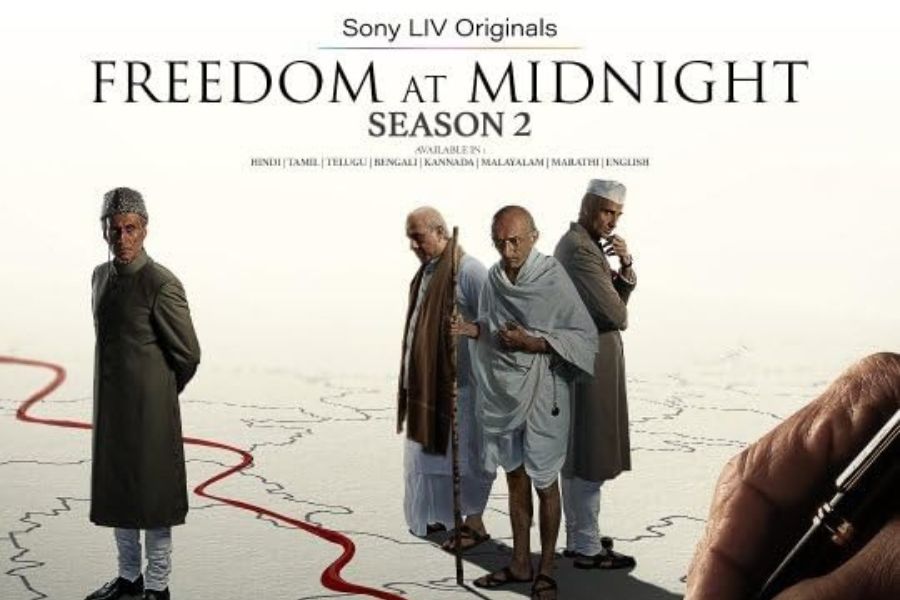
Some stories don’t end when freedom is declared — they begin there. Freedom at Midnight returns with its second season and shifts focus from celebration to consequence. Created and directed by Nikkhil Advani, Season 2 dives straight into the emotional wreckage left behind by Independence and Partition, offering a quieter, heavier, and far more devastating chapter of India’s history.
Premiering on SonyLIV after the first season’s November 2024 debut, this installment feels less like a political chronicle and more like a collective memory — painful, unresolved, and deeply human.
Storyline: When lines on a map change lives forever
Set in 1947 after the British announce the division of India and Pakistan, Season 2 explores what happens when history turns theoretical decisions into real suffering. The task of drawing borders falls to Sir Cyril Radcliffe, played with restraint by Richard Teverson, under the supervision of Lord Louis Mountbatten, portrayed by Luke McGibney.
What unfolds is a tense political chessboard. Sidhant Gupta’s Jawaharlal Nehru, Rajendra Chawla’s Sardar Vallabhbhai Patel, and Arif Zakaria’s Mohammad Ali Jinnah clash over borders, power, and ideology — all while millions wait to find out where they now belong.
Amid the chaos, Chirag Vohra’s Mahatma Gandhi continues to plead for peace, even as violence spirals beyond control. The series also steps beyond Delhi politics to explore princely states, refugee crises, and a dedicated, deeply reflective episode on Kashmir — treating it not as a slogan, but as a wound.
Writing & direction: Thoughtful, restrained, and emotionally sharp
The writing team — Abhinandan Gupta, Gundeep Kaur, Adwitiya Kareng Das, Divy Nidhi Sharma, Revanta Sarabhai, and Ethan Taylor — approach Partition with rare balance. No side is simplified. Leaders are shown as visionaries and flawed humans, while ordinary citizens carry the true burden of decisions they never made.
Nikkhil Advani’s direction avoids melodrama. Instead, it trusts silence, faces, and aftermaths. Cinematographer Malay Prakash drains colour from riot and refugee sequences, visually underlining the loss of humanity in those moments. Editor Shweta Venkat Mathew keeps the sprawling narrative focused, ensuring no storyline overwhelms the others.
Most importantly, the show remains faithful to Freedom at Midnight, while still feeling emotionally contemporary.
Performances: An ensemble that carries history with dignity
Season 2 belongs to its cast. Sidhant Gupta, Chirag Vohra, Rajendra Chawla, and Arif Zakaria continue to anchor the series with layered performances that never slip into caricature.
Vohra’s Gandhi is especially affecting in the final stretch, as the series moves toward his assassination — handled with restraint and deep respect. McGibney’s Mountbatten and KC Shankar’s VP Menon leave lasting impressions despite limited screen time.
Two standout surprises elevate the season further. Abhishek Banerjee delivers a brief but disturbing cameo as a rioter, while Anurag Thakur is heartbreaking as Madanlal Pahwa, a Lahore refugee whose desperation forces him into a tragic choice.
What worked / What didn’t
What worked
- A mature, unsensational portrayal of Partition trauma
- Strong writing that respects history and emotion
- Excellent ensemble performances
- Courage to explore Kashmir and refugee suffering without shortcuts
What didn’t
- The dense political material may feel heavy for viewers expecting fast-paced drama
- Some characters deserved more screen time given their importance
Final verdict: A necessary watch, not an easy one
If Season 1 of Freedom at Midnight was about winning freedom, Season 2 is about paying its price. It doesn’t offer comfort or easy answers — and that’s precisely its strength. Together, both seasons feel complete, respectful, and painfully relevant.
This is not just a historical series. It’s a reminder of what division costs, and why remembering still matters.
PopcornRealm Verdict: ⭐⭐⭐⭐½
A powerful, essential watch — especially for Indians who want to understand not just how freedom was won, but what it took from us in return.