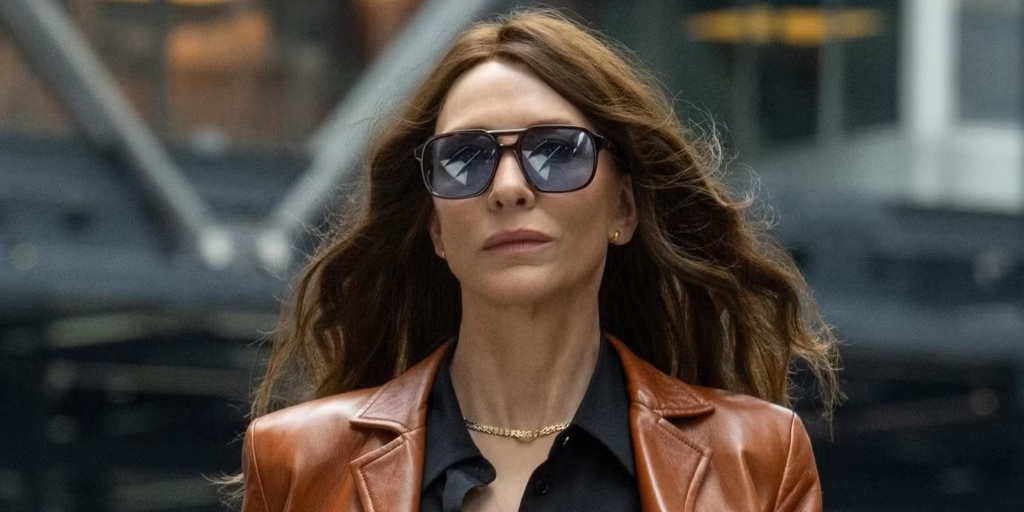
Cate Blanchett made one of the strongest statements at this year’s Cannes Film Festival after reflecting on how the #MeToo movement changed Hollywood — and how quickly she feels the momentum around it disappeared. During a conversation with moderator Didier Allouch at Cannes 2026, the Oscar-winning actress openly spoke about power imbalance, abuse in the industry, and why she believes conversations around systemic problems slowly faded away despite the movement’s global impact.
Blanchett didn’t hold back while discussing the subject. The actress questioned why women speaking up about abuse or harassment often face resistance once the initial public support begins to cool down. According to her, #MeToo exposed much deeper issues that weren’t limited to the entertainment business alone. She explained that the movement revealed a widespread system of abuse existing across multiple industries, and argued that problems can never truly be solved if people stop acknowledging them publicly.
The actress also reflected on her own experiences while working on film sets even today. Blanchett pointed out that gender imbalance behind the camera still remains very visible in Hollywood productions despite years of conversations about equality and representation. She mentioned that on many sets she still notices overwhelmingly male-dominated crews, sometimes with only a handful of women surrounded by dozens of men. While she made it clear she has no issue with men personally, she admitted that working in such homogeneous environments eventually becomes repetitive and limiting creatively.
Her comments instantly reminded many people about the historic moment at Cannes back in 2018 when Blanchett served as jury president during the height of the global #MeToo movement. That year, she led a major women’s march on the Cannes red carpet alongside stars and filmmakers including Kristen Stewart, Léa Seydoux, Ava DuVernay, and legendary filmmaker Agnès Varda. The image of dozens of women standing together on the Palais steps quickly became one of the defining moments of that festival year.
At the time, 82 women participated in the protest, and that number carried a symbolic meaning. It represented the total number of female directors whose films had competed at Cannes throughout the festival’s history, compared to more than 1,800 male directors during the same period. Blanchett had described the protest as a statement about visibility, opportunity, and the need for lasting change inside the film industry rather than temporary headlines.
Another Oscar-winning actress, Julianne Moore, also echoed similar concerns during her own appearance at Cannes this year. Speaking during the Kering Women in Motion Talk, Moore recalled being on a film set where she and another female crew member were the only women present. She described the experience as isolating and admitted it made her realize how slowly things have actually changed behind the scenes despite years of industry conversations about inclusion.
What makes Blanchett’s remarks especially significant is that they arrive at a time when Hollywood seems far quieter about #MeToo compared to the movement’s peak years. Back in 2017 and 2018, major studios, celebrities, producers, and festivals publicly aligned themselves with initiatives like Time’s Up and broader calls for accountability. But in recent years, public discussions around these topics have become less visible, something critics and activists have repeatedly pointed out.
Even now, the conversation around representation in cinema remains complicated. While more female directors and creators are receiving opportunities than before, statistics across major film industries still show a heavy imbalance in leadership positions, technical departments, and studio decision-making roles. Blanchett’s comments at Cannes seemed less about creating controversy and more about reminding people that progress can easily stall if conversations stop too early.
The actress has spent decades working with some of cinema’s most celebrated filmmakers and remains one of the most respected voices in the industry. Because of that, her words carried weight at Cannes this year, especially among younger filmmakers and actors attending the festival. And judging by the strong online reaction following the discussion, it’s clear the debate around gender equality in Hollywood is far from over.