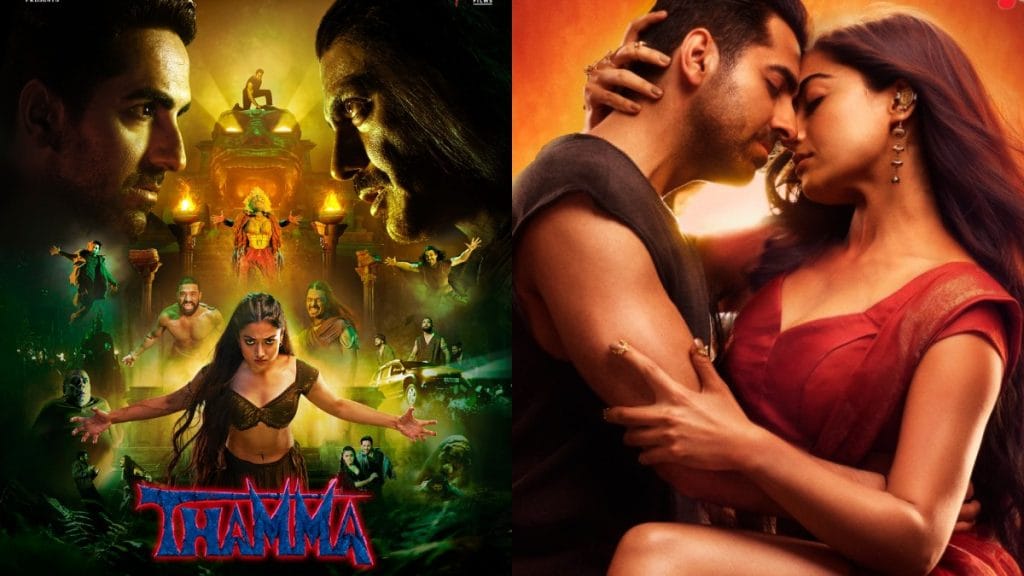
The much-anticipated film Thamma, starring Ayushmann Khurrana, Rashmika Mandanna, and Nawazuddin Siddiqui, has finally hit theatres, and it’s already creating waves across India. Directed by Amar Kaushik and produced under Maddock Films, Thamma is not just another addition to Bollywood’s horror-comedy universe — it’s a genre-bending emotional rollercoaster that blends folklore, supernatural fantasy, and heartfelt romance. Released during the Diwali season, Thamma arrives with high expectations, and the result is a film that’s ambitious, visually stunning, and emotionally engaging — even if it stumbles in a few places.
Cast and Performances
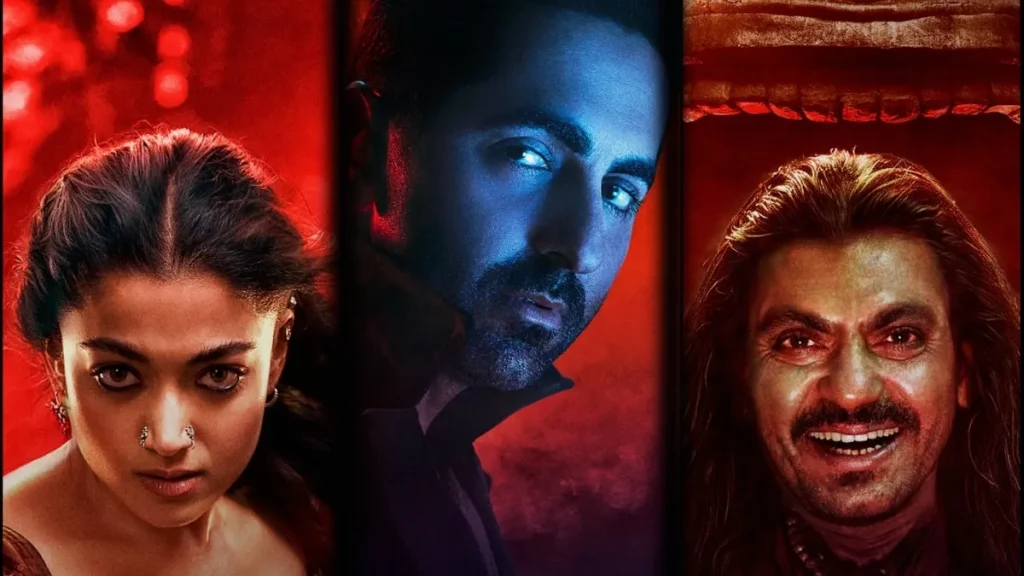
The cast of Thamma is undoubtedly one of its strongest aspects. Ayushmann Khurrana once again proves his mettle as a versatile actor. He plays Alok Goyal, a historian whose life takes a terrifying yet mystical turn when he discovers that his bloodline is tied to an ancient vampire clan. Ayushmann brings charm, vulnerability, and intensity to the role. His ability to balance humor and emotion makes Alok a character you root for, even when he’s caught between the world of humans and bloodthirsty immortals.
Rashmika Mandanna, as Tadaka, plays the mysterious and powerful love interest whose past is deeply intertwined with Alok’s fate. Rashmika’s performance is captivating — she brings warmth and mystique to her role. Her chemistry with Ayushmann is one of the film’s emotional anchors, and their love story feels genuine, even amid the supernatural chaos.
Nawazuddin Siddiqui, playing the dark and menacing Yakshashan, delivers another masterclass in villainy. His screen presence is magnetic — calm, eerie, and chillingly powerful. Every time he appears, the tone of the film shifts, giving it a darker, more haunting energy. Nawazuddin’s portrayal of an ancient vampire lord obsessed with power and immortality is both terrifying and strangely poetic.
The supporting cast — including Paresh Rawal as Alok’s eccentric grandfather, and Varun Dhawan in a surprising cameo as his Bhediya character — adds layers of humor and continuity to the Maddock Horror-Comedy Universe (MHCU).
Storyline and Plot
Thamma follows the story of Alok Goyal, a history professor obsessed with uncovering hidden truths about Indian mythology. During one of his research trips, he stumbles upon an ancient relic that awakens a dormant curse — one that reveals his connection to a forgotten bloodline of vetalas, or Indian vampires.
As Alok grapples with this shocking revelation, he meets Tadaka, a woman who seems to know more about his destiny than he does. Their meeting isn’t accidental — it’s fate. Tadaka is part of the same mystical world that Alok is about to enter. Together, they must face Yakshashan, a powerful and ruthless vampire lord who wants to revive an ancient order that once ruled over humankind.
The story moves across two time periods — the present day and flashbacks to the Vijayanagara Empire — where the origins of this blood curse are revealed. The film creatively connects mythology with modern-day struggles, presenting vampires not as creatures of Western horror, but as beings rooted in Indian spiritual legends.
The love story between Alok and Tadaka forms the emotional heart of the movie. It’s a tale of eternal love, sacrifice, and redemption — one that transcends lifetimes. But what makes Thamma special is its tone. It doesn’t rely purely on scares; it uses mythology, emotions, and humor to tell a story about love surviving in the shadows of immortality.
Direction and Screenplay
Amar Kaushik, who has previously helmed hits like Stree and Bhediya, takes a bold step with Thamma. This time, he experiments with darker emotions, ancient legends, and romantic depth. While Thamma belongs to the same universe as Stree and Bhediya, it’s tonally different — less comedy, more passion and mystery.
The screenplay, written by Niren Bhatt, is layered with symbolism. The first half sets up the world beautifully, mixing humor and intrigue. The scenes where Alok’s transformation begins are particularly gripping. The second half, however, leans heavily on spectacle — with epic battle sequences, dramatic confrontations, and moments of heartbreak. While it occasionally feels overstuffed, the emotional beats keep it grounded.
The dialogues are sharp and often poetic, especially in scenes between Ayushmann and Rashmika. Some lines stay with you, reflecting on love, destiny, and the eternal battle between good and evil.
Cinematography and Music
Visually, Thamma is a feast. Cinematographer Jishnu Bhattacharjee captures the contrast between modern India and its mythical underworld beautifully. The film’s color palette moves from warm golds to chilling blues and reds, symbolizing the clash between life and death. The flashback sequences set in ancient India are breathtaking — filled with grand temples, misty forests, and surreal dreamscapes.
The background score by Sachin–Jigar deserves special mention. It enhances the film’s mood — haunting during the vampire scenes, soft and emotional during the romantic moments, and thundering during the action sequences. The songs, especially “Raat Ka Vaada” and “Khoon Mein Likha”, are already topping charts. They perfectly balance melody with mystery, becoming part of the story rather than distractions.
Strengths of the Film
Thamma’s biggest strength is its originality. Instead of copying Western vampire tropes, it gives the concept a uniquely Indian identity. The way the film ties ancient mythological elements with modern characters feels fresh and authentic. The idea that vampires, or vetalas, existed in Indian folklore long before Western cinema is explored beautifully.
The emotional depth of the story is another standout. Beneath the blood and fantasy lies a heartfelt love story about two souls cursed to meet across lifetimes. The chemistry between Ayushmann and Rashmika makes their relationship believable and touching.
The film also benefits from its world-building. It connects smartly with other movies from the Maddock Horror Universe, leaving hints of future crossovers. The cameo by Varun Dhawan as Bhediya teases something bigger on the horizon, making fans excited for what’s next.
Weaknesses and Shortcomings
While Thamma is ambitious, it’s not flawless. The pacing, especially in the second half, can feel uneven. Some scenes stretch longer than necessary, and the climax — though grand — could have been tighter.
The film occasionally struggles to balance its tones. The mix of romance, fantasy, and action sometimes feels disjointed. A few jokes also fall flat, especially in moments where emotional tension should have taken precedence.
Despite Nawazuddin’s brilliant performance, his character could have used more backstory. His motivations are strong but not always fully explored. Similarly, some of the side characters are underdeveloped, existing mainly to move the plot forward.
Audience Response
The audience reaction to Thamma has been largely positive. Fans are praising the film’s creativity, visuals, and strong performances. Many have called it a “perfect Diwali entertainer” — a movie that offers emotion, humor, and thrills in equal measure.
Social media is filled with admiration for Ayushmann and Rashmika’s chemistry. Audiences have also loved the way Indian mythology has been blended with modern storytelling. The film’s use of practical effects and minimal CGI for the vampire sequences has also received praise.
However, some viewers have expressed mixed feelings about the length and pacing. A section of the audience believes that the film’s emotional subplot slightly overpowers its horror elements. Still, most agree that Thamma is a refreshing change from formulaic Bollywood horror flicks.
Overall Verdict
Thamma isn’t just a movie — it’s an experience. It’s bold, imaginative, and deeply emotional. It dares to mix genres — romance, mythology, fantasy, and horror — and though it occasionally wobbles under its own ambition, it never loses its heart.
Ayushmann Khurrana carries the film with effortless grace, Rashmika Mandanna shines as the soulful Tadaka, and Nawazuddin Siddiqui steals every scene he’s in. The film’s technical excellence, music, and visual beauty make it a treat for the big screen.
In a year filled with remakes and sequels, Thamma stands out as something original — a story that redefines how Indian cinema can handle the supernatural. It’s not just about vampires or blood; it’s about destiny, love, and the eternal connection between light and darkness.
Final Rating: 3.5 out of 5 stars