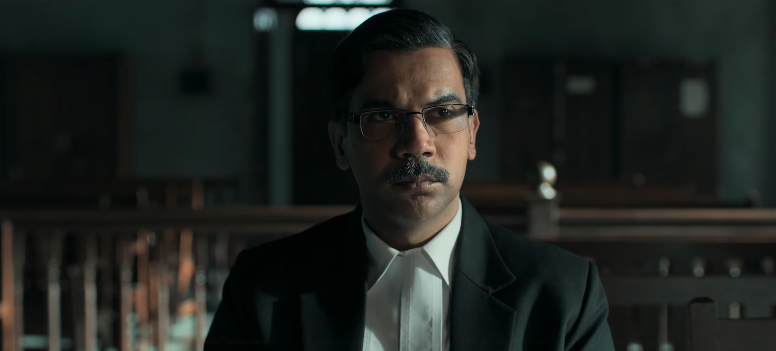
Rajkummar Rao’s Prahaar: The Untold Story of Ujjwal Nikam approaches the 2008 Mumbai terror attacks from a perspective that Hindi cinema has rarely explored in detail: the courtroom battle that followed. Instead of concentrating entirely on the violence of November 26, director Avinash Arun examines the legal process that brought Ajmal Kasab, the only surviving attacker, to justice. The result is a sincere and occasionally gripping drama, strengthened by committed performances but weakened by a screenplay that struggles to maintain its focus.
Released on October 16, 2026, Prahaar stars Rajkummar Rao, Wamiqa Gabbi, Lalit Prabhakar, Sikandar Kher and Jaideep Ahlawat. Early critical reviews have been generally mixed to positive, with particular appreciation for its courtroom confrontations, restrained storytelling and performances.
However, the film’s attempts to explore its protagonist’s troubled family relationships have divided reviewers. While these scenes establish the personal sacrifices behind his professional dedication, they also interrupt an otherwise compelling legal narrative.
Prahaar Story: The Legal Battle After the 26/11 Attacks
The film follows special public prosecutor Ujjwal Nikam (Rajkummar Rao), whose professional life changes dramatically following the November 2008 Mumbai terror attacks.
Already recognised for handling major criminal cases, including the 1993 Bombay blasts prosecution, Nikam is entrusted with building the case against Ajmal Kasab (Lalit Prabhakar).
Although Kasab’s involvement in the attacks appears obvious from the available evidence, securing a conviction requires more than public outrage.
Every piece of evidence must withstand legal scrutiny, witnesses must testify, and the accused must receive the procedural protections guaranteed under Indian law.
This becomes the film’s most interesting conflict.
Rather than presenting justice as an immediate act of punishment, Prahaar explores why even someone accused of horrific crimes must receive a fair trial.
Sikandar Kher plays defence lawyer Abbas Kazmi, who faces enormous public hostility for representing Kasab.
The character introduces an important question: does defending an accused person’s constitutional rights mean supporting the crime?
The film’s answer is clear. A fair legal process protects the legitimacy of justice, regardless of how serious the allegations are.
Rajkummar Rao and Lalit Prabhakar Lead Strong Performances
Rajkummar Rao provides the film with its strongest emotional and dramatic foundation.
His portrayal of Nikam combines professional determination, controlled aggression and an unwavering commitment to the legal process. Rather than relying entirely on patriotic speeches, Rao uses courtroom exchanges and confrontations to establish the prosecutor’s authority.
Some critics have nevertheless questioned whether his attention to Nikam’s mannerisms occasionally makes the performance feel overly calculated.
The role also provides an interesting contrast with Rao’s acclaimed performance in Shahid (2013), where he portrayed lawyer Shahid Azmi, who defended people accused in controversial criminal cases.
In Prahaar, Rao approaches the justice system from the prosecution’s perspective, giving his filmography another significant legal drama.
Lalit Prabhakar, meanwhile, has received particularly strong appreciation for his portrayal of Ajmal Kasab.
His performance captures the unsettling behaviour of an indoctrinated young terrorist without attempting to excuse the violence committed during the attacks.
Sikandar Kher also makes an impression as the defence lawyer, whose professional responsibilities place him in an almost impossible public position.
Jaideep Ahlawat appears as Pakistani prosecutor Chaudhry Zulfiqar Ali. Despite limited screen time, his exchanges with Rao introduce a welcome element of professional rivalry and mutual respect.
Wamiqa Gabbi plays Nikam’s wife, Jyoti, while Ritvik Sahore portrays their son, Aniket.
Their performances contribute to the film’s domestic storyline, although the writing doesn’t always give these relationships sufficient depth.
Prahaar Works Best When It Focuses on Justice
One of the film’s more interesting achievements is its refusal to reduce the legal proceedings to simplistic religious or nationalist confrontation.
The screenplay recognises the anger surrounding the attacks while allowing space for constitutional principles, legal responsibilities and professional ethics.
This approach becomes particularly effective during the courtroom testimony of a young survivor.
Rather than depending on exaggerated speeches, the sequence reportedly communicates the human consequences of terrorism through the experience of someone directly affected.
Avinash Arun, who also works as a cinematographer, brings a relatively controlled visual approach to the courtroom proceedings.
The staging allows attention to remain on the lawyers, witnesses and their arguments rather than distracting audiences with excessive visual spectacle.
However, the film struggles whenever it moves too far from this central conflict.
The strained relationship between Nikam and his son, alongside his wife’s personal difficulties, attempts to explain the cost of his demanding profession.
These developments are relevant, but several critics believe they receive more screen time than necessary.
Consequently, the second half reportedly becomes less focused than the first, moving between courtroom tension and family drama without consistently balancing the two.
Another limitation is the story’s predictability. Since the real-life outcome of Kasab’s trial is already widely known, the screenplay must generate interest through the legal arguments and human relationships rather than suspense about the verdict.
It succeeds when those arguments reveal something meaningful about the judicial process, but loses momentum when the personal subplots repeat familiar emotional conflicts.
Prahaar Verdict: Strong Performances, Uneven Storytelling
Prahaar offers a worthwhile perspective on one of India’s most devastating terrorist attacks by concentrating on the difficult legal work that followed.
Rajkummar Rao delivers a committed central performance, while Lalit Prabhakar, Sikandar Kher and Jaideep Ahlawat strengthen the courtroom sequences.
The film’s emphasis on due process also distinguishes it from more conventional patriotic dramas.
However, its ambitious attempt to combine a legal thriller with a family biography creates pacing problems, particularly during the second half.
Verdict: Based on published critical assessments, Prahaar is a respectable but uneven courtroom drama. Its strong performances and thoughtful treatment of justice make it worth considering, although viewers expecting consistently gripping legal proceedings may find the family detours frustrating.
Ultimately, the film’s most compelling idea is also its simplest: justice gains meaning not merely from convicting the guilty, but from ensuring that the law is followed while doing so.