Some Partition films try to recreate the scale of history. Batwara 1947 takes a more intimate route, asking what happens to ordinary people after the borders have already been drawn. Rajkumar Santoshi’s film puts a Muslim family in a Hindu-owned haveli in Lahore and gradually turns a conflict over property into a story about compassion, survival and the strange ways people can become family. That choice gives the film its strongest quality, even when its emotional presentation becomes louder than necessary.
The film, formerly titled Lahore 1947, brings Santoshi and Sunny Deol together again after their collaborations on Ghayal, Damini and Ghatak. It also marks Preity Zinta’s return to mainstream Hindi cinema, while Shabana Azmi, Ali Fazal, Karan Deol and Abhimanyu Singh add to an ensemble built around the human cost of Partition. Produced by Aamir Khan, the film released in theatres on August 14, 2026, making its Independence Day weekend arrival particularly fitting.
Batwara 1947 Review: A Different Partition Story
The film begins with a family forced to leave behind the life they knew and travel toward Lahore amid the chaos surrounding Partition. Their new home is a custodian haveli occupied by an elderly Hindu woman, Mai, who refuses to surrender the place that once belonged to her family. What begins as a dispute between people who have every reason to distrust each other slowly develops into something much more complicated.
This is where Batwara 1947 finds its emotional identity. Santoshi is less interested in turning the Partition into a parade of historical events and more interested in showing what displacement does to people who have suddenly lost their homes, security and familiar surroundings. The film understands that a border can be drawn on a map within hours, but rebuilding a life after crossing it is a much longer and more painful process.
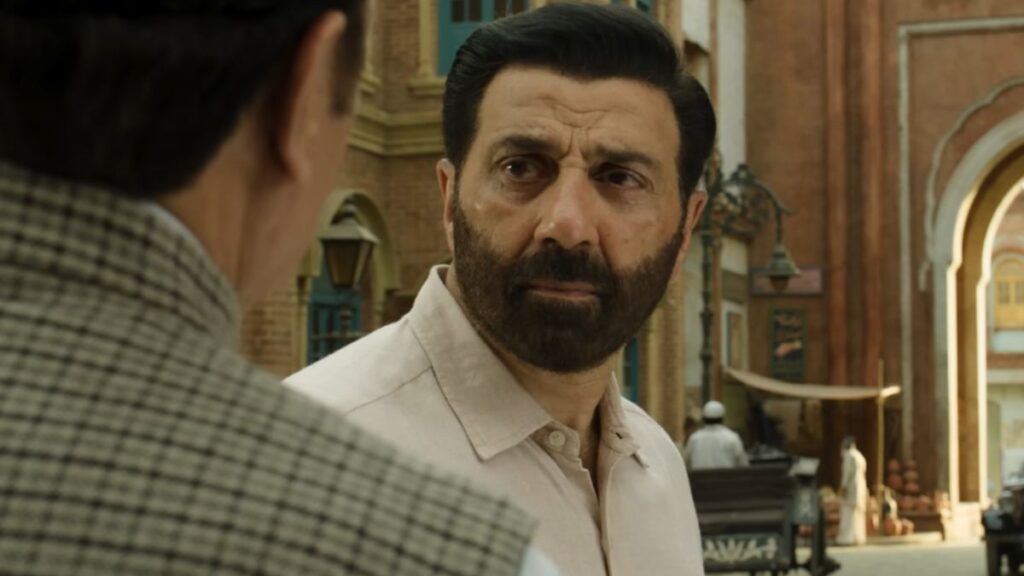
Sikandar Mirza, played by Sunny Deol, becomes the person through whom much of this conflict is explored. He is protective of his family but isn’t driven simply by religious anger or revenge, which separates the character from the kind of larger-than-life roles Deol has often played. His decision to protect Mai becomes one of the film’s clearest statements about humanity surviving even when everything around it is pushing people toward hatred.
The story is based on Asghar Wajahat’s acclaimed play Jis Lahore Nai Vekhya, O Jamya E Nai, and that theatrical foundation is visible in the film’s concentration on characters and relationships. Rather than constantly expanding the scale, the movie often returns to the haveli and the people trapped within its emotional and political tensions. That intimacy is arguably more interesting than another conventional Partition spectacle.
Sunny Deol and Shabana Azmi Lead the Film
Sunny Deol gives one of his more restrained performances in Batwara 1947. There are still moments when the familiar Deol intensity comes through, particularly when Sikandar has to protect his family, but the performance is not built entirely around anger. His vulnerability becomes more important as the story progresses, and that gives the character a dimension that would have been missing if he had simply been written as another heroic protector.
Shabana Azmi is the film’s emotional powerhouse. As Mai, she has to communicate decades of loss, attachment to her home and suspicion toward the people who have suddenly arrived in her life. Azmi never needs to overplay those emotions, and her presence gives several of the film’s quieter scenes the weight that the more dramatic passages sometimes struggle to achieve. Early reviews have also consistently singled her out as one of the film’s biggest strengths.
Preity Zinta makes a welcome return as Hamida Mirza, and the role allows her to move beyond simply being a nostalgic casting choice. She plays a woman trying to keep her family together while the world around them becomes increasingly unstable. Her performance benefits from the film’s domestic moments, particularly when Hamida’s strength is shown through everyday responsibilities rather than grand speeches.
Ali Fazal’s appearance is shorter but memorable. His poetic character brings some lightness into an otherwise heavy story, and the film benefits whenever his scenes provide a little breathing room from the surrounding tragedy. Karan Deol, meanwhile, represents the younger generation caught between fear, anger and the pressure of an environment where violence has become normalised.
Abhimanyu Singh also fits naturally into the film’s darker side, while the ensemble generally works best when the screenplay allows individual characters to exist beyond the larger historical backdrop. That is ultimately what Santoshi seems to be chasing: not simply telling audiences that Partition was devastating, but showing how its consequences changed relationships between people who had once lived side by side.
Where Batwara 1947 Works and Stumbles
The strongest scenes are the ones that resist the temptation to become grand. Sikandar lighting a diya for Mai, Hamida trying to care for her, and Mai gradually discovering a new sense of family all carry more emotional power than the film’s louder declarations. These moments make the central idea tangible: religion does not automatically determine whether someone is good or cruel; individual choices do.
Santoshi deserves credit for keeping that human conflict at the centre. The film does not treat its characters as symbols alone, even though the Partition inevitably hangs over every relationship. The reunion with Sunny Deol also gives the director a performer who can communicate enormous emotion with relatively simple gestures, which becomes particularly effective when Sikandar’s anger gives way to concern.
The problem is that Batwara 1947 sometimes trusts melodrama more than its characters. Several scenes push the emotion so hard that they begin to feel designed to produce a reaction rather than allowing the situation itself to create one. That approach can work for viewers who enjoy old-school Hindi cinema, but it can also make parts of the film feel more theatrical than cinematic.
There is a similar issue with the screenplay. The premise has enormous potential, but the story does not always build toward the kind of dramatic peak its first half promises. The film comes close to a genuinely powerful climax before pulling back, leaving the feeling that something larger was missing from the final stretch.
That divided reaction is already visible among early reviews. Some critics have praised the film’s emotional force and humanist message, while others have found its storytelling too heavy-handed or old-fashioned. Cinema Express described it as an emotionally visceral drama, while Gulf News argued that the film’s potentially moving core was buried beneath an overly loud presentation.
The music adds another layer to the presentation. With A. R. Rahman composing and Javed Akhtar writing the lyrics, the film carries considerable musical pedigree, although the songs and score do not always have the same lasting impact as the performances. The technical credits are equally strong, with Santosh Sivan handling cinematography and Resul Pookutty credited for sound.
Batwara 1947 Review: Final Verdict
Batwara 1947 works because it understands that Partition was not only about the moment a country was divided. It was also about families leaving homes, strangers occupying unfamiliar spaces, people losing loved ones and communities being forced to decide whether fear would become stronger than humanity. By focusing much of the story on Sikandar and Mai, the film gives those enormous historical questions a personal face.
It is not as consistently powerful as its subject deserves to be, though. The melodrama occasionally becomes excessive, the screenplay can feel predictable, and some sequences appear too polished or stage-like for a story that demands rawness. Yet the central performances repeatedly pull the film back from those weaknesses, particularly Sunny Deol and Shabana Azmi.
Deol’s restraint is perhaps the biggest surprise. This is a character who could easily have become another variation of the angry protector associated with some of his iconic roles, but Santoshi gives him enough vulnerability to make Sikandar feel human. Azmi goes even further, turning Mai into the emotional conscience of the film without making her simply a symbol of suffering.
Verdict: 3.5/5. Batwara 1947 is worth watching for its performances, its human-centric approach to Partition and the emotional bond at its centre. It may not reach the dramatic heights of the subject it tackles, but it has enough heart to stay with you after the credits, particularly if you appreciate character-driven Hindi cinema and old-school emotional storytelling.
Batwara 1947 Review Q&A
Is Batwara 1947 worth watching?
Yes, especially if you enjoy historical dramas built around characters rather than large-scale spectacle. Sunny Deol and Shabana Azmi are the biggest reasons to watch it.
What is Batwara 1947 about?
The film follows people affected by the Partition and focuses particularly on a Muslim family settling in Lahore and their relationship with an elderly Hindu woman who refuses to leave her home.
How is Sunny Deol’s performance in Batwara 1947?
Deol delivers a comparatively vulnerable performance as Sikandar Mirza. The character relies less on anger and more on his instinct to protect his family and defend his conscience.
Is Preity Zinta good in Batwara 1947?
Yes. Zinta’s return to Hindi cinema is handled as part of the story rather than simply as nostalgia, and she gives Hamida a grounded emotional presence.
Who gives the best performance in Batwara 1947?
Shabana Azmi is arguably the standout. Her portrayal of Mai provides much of the film’s emotional weight, while Sunny Deol anchors the story with a restrained performance.
Is Batwara 1947 similar to Gadar?
Both films involve the Partition era and feature Sunny Deol, but they approach the period differently. Batwara 1947 is more focused on displacement, communal relationships and humanity than on the larger action-driven spectacle associated with Gadar.