There is a genuinely good survival thriller hiding inside Netflix’s The Last House. Directed by Louis Leterrier and led by Wagner Moura and Greta Lee, the film begins with an unnerving question: what would happen if your home suddenly became impossible to leave? A mysterious rainstorm traps a family inside their suburban house, cutting them off from the outside world and forcing them to rethink everything from food and electricity to family relationships.
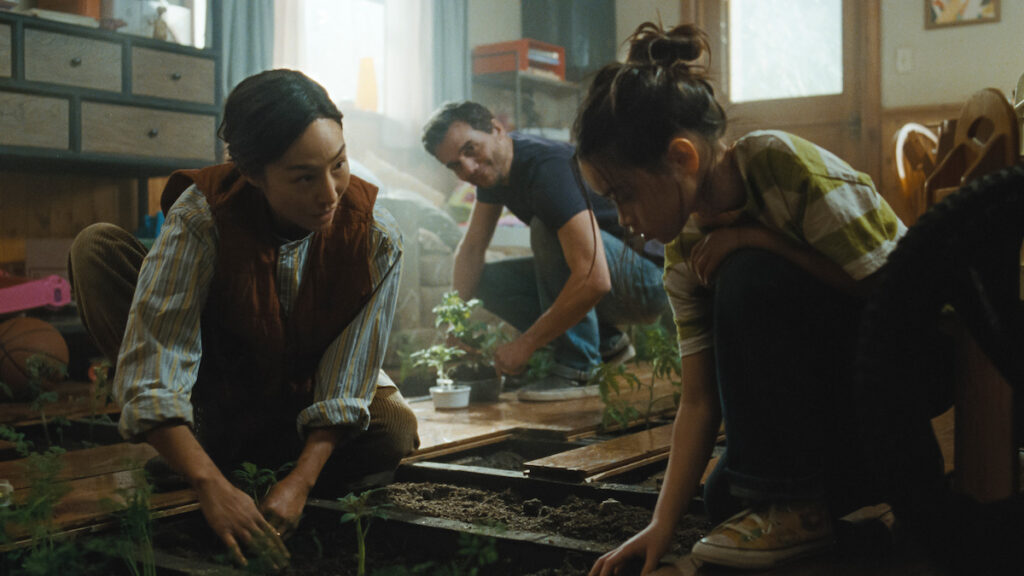
It is a terrific setup because the house initially feels less like a prison than a temporary shelter. Jason and Riley, along with their two children, try to convince themselves that the situation can be managed until whatever is happening outside eventually passes. Netflix describes the movie as a survival story about a family mysteriously sealed inside their home while their resources diminish and an ominous force keeps them trapped.
The problem is that The Last House is much more confident when it refuses to explain what is happening. Once the film starts peeling away its mystery and moves toward conventional science-fiction horror, the carefully built tension begins to disappear. What starts as a claustrophobic family drama eventually becomes a much less convincing creature story, leaving the film somewhere between an intriguing survival experiment and a frustrating missed opportunity.
The Survival Story Is The Best Part
The opening stretch is easily the strongest section of The Last House. Leterrier takes time to show Jason and Riley adapting to a situation that is terrifying precisely because it does not immediately behave like a traditional disaster movie. There is no easy escape, no obvious explanation and no guarantee that the strange weather will end tomorrow.
That allows the film to focus on small details that gradually become important. Food has to be rationed, everyday conveniences disappear, communication becomes difficult and the family has to figure out how to make an ordinary suburban house function as a long-term shelter. The survival problems feel tangible because they are built around things most people recognise from their own homes.
The film also finds an unexpectedly interesting social element in the situation. Neighbours are suddenly forced to communicate from inside their own houses, sometimes relying on written messages across windows rather than simply walking next door. It is a small detail, but it gives the premise a strange modern-world quality because people who have lived beside one another can discover just how little they actually know about each other.
That is where The Last House feels closest to the kind of intimate thriller it could have become. The mystery outside matters, but the family itself remains the real story. Their attempts to solve practical problems using whatever they can find around the house create some of the film’s most effective suspense.
The contained setting also works surprisingly well visually. The longer the family remains inside, the more the house stops feeling comfortable, and Leterrier uses the limited space to create a genuine sense of claustrophobia. The movie understands that four people sharing the same rooms for an extended period can become as psychologically exhausting as the threat outside.
Wagner Moura Gives The Film Its Heart
Wagner Moura is the biggest reason the emotional side of The Last House works. As Jason, he begins as a relatively cheerful father trying to keep his family calm, but the situation gradually strips away that optimism. His performance captures the exhaustion of someone who is constantly trying to solve the next problem while knowing there may never be a normal life waiting on the other side.
Moura brings enough authority to Jason that his survival decisions feel believable even when the screenplay becomes increasingly questionable. The character is not simply trying to protect himself; his entire sense of purpose becomes tied to keeping his family alive. That gives the quieter scenes considerably more weight than the movie’s later action sequences.
Greta Lee is also committed to the material, although Riley is given less to work with. The character has moments of vulnerability and determination, but the screenplay does not develop her with the same consistency it gives Jason. That becomes more noticeable as the story progresses because the film needs both parents to feel equally essential to the family’s survival.
The younger members of the family are similarly used more as emotional stakes than as fully developed characters. That is not necessarily a major problem during the early survival section, because the parents’ responsibility toward their children naturally drives many of their decisions. But once the movie expands into its larger mythology, the lack of deeper character development becomes harder to ignore.
Still, Moura keeps the film grounded for longer than the screenplay perhaps deserves. His performance gives Jason a sense of history and emotional exhaustion that the increasingly complicated plot cannot completely erase.
The Mystery Loses Its Grip
This is where The Last House starts moving away from its best ideas. The film spends considerable time making the outside world mysterious, and that uncertainty is what makes the first half so effective. You want to know what is happening, but you also understand that revealing too much could destroy the fear.
Unfortunately, the eventual answers are not strong enough to justify the buildup. The movie introduces increasingly elaborate science-fiction and horror elements, but they never feel as fully developed as the original survival premise. The mystery becomes less unsettling as more information is revealed because the explanations do not have the same emotional or conceptual power as the questions.
That problem becomes particularly noticeable in the final act. The intimate family survival story gradually gives way to a creature-driven confrontation, and the change in tone is difficult to ignore. Instead of making the earlier mystery feel more meaningful, the final stretch makes some of the film’s strongest ideas feel like setup for a much more conventional monster movie.
The creature design does not help. There is an oddly familiar, almost swashbuckling quality to parts of its appearance that works against the oppressive atmosphere established earlier. The visual concept needed to feel strange and frightening, but instead the creature sometimes looks as though it has wandered into the wrong movie.
The action-heavy climax also becomes increasingly messy. Where the earlier survival sequences derive suspense from watching the characters think through practical problems, the finale relies more heavily on spectacle and movement. The result should feel like a release of all the tension that came before, but instead it often feels less focused.
Current reviews have similarly pointed to the movie’s tonal and narrative problems, even while acknowledging the strength of Moura and Lee’s performances and the appeal of the central premise.
What Works And What Doesn’t
The biggest success of The Last House is its basic idea. A family being unable to leave its own home is simple enough to understand immediately, but it also provides countless opportunities for psychological and practical tension. The film is at its best when it asks how ordinary people would adapt if the temporary inconvenience of staying home suddenly became permanent.
The resourcefulness is particularly enjoyable. Watching the family improvise solutions with ordinary household objects gives the film a grounded quality that many survival thrillers lose when they become too interested in explaining their apocalypse. There is something compelling about seeing a comfortable suburban home gradually transformed into a long-term survival system.
The film also benefits from Leterrier’s handling of space. The house becomes increasingly oppressive without needing constant jump scares, and the rain outside provides a simple but effective visual reminder that the family is not in control. Even the idea of communicating with neighbours from separate homes carries an unsettling sense of isolation.
But the screenplay ultimately does not trust its own best material. The more it tries to explain the outside world, the less interesting that world becomes. The final act then compounds the problem by turning an unusual survival drama into a creature feature that does not possess enough originality to match the promise of the opening.
The result is a film that is easy to recommend for its first half and much harder to defend by the time the credits arrive.
Final Verdict
The Last House is a classic case of a great premise being more interesting than the movie built around it. Louis Leterrier creates an effective atmosphere during the family’s early struggle, and Wagner Moura gives Jason enough emotional depth to make the ordeal feel personal. Greta Lee also brings sincerity to a role that the screenplay does not develop as fully as it should.
But the movie loses its way when it begins explaining the mystery. The science-fiction and creature elements never reach the level of imagination promised by the opening, while the final action sequence sacrifices the claustrophobic tension that made the film work in the first place.
If you enjoy contained survival thrillers and do not mind a movie eventually becoming much stranger and more conventional than its opening suggests, The Last House can still make for an entertaining Netflix watch. Just do not expect the intriguing first half to receive an equally satisfying payoff.
PopcornRealm Verdict: 2.5/5
The Last House Review Q&A
Is The Last House worth watching on Netflix?
The Last House is worth considering if you enjoy contained survival thrillers, especially for its atmospheric opening and practical survival sequences. The film becomes less satisfying once its mystery develops into a larger creature story.
What is The Last House about?
The film follows a family that becomes mysteriously trapped inside its suburban home and must find ways to survive as resources become limited and an unknown threat keeps them from leaving.
Who stars in The Last House?
Wagner Moura plays Jason and Greta Lee plays Riley, the parents at the centre of the story. The cast also includes Riley Chung, Emma Ho, Noah Alexander Sosnowski and Gabriel Barbosa.
Who directed The Last House?
Louis Leterrier directed the film, with Matthew Robinson credited as the screenwriter. Netflix classifies the movie as a science-fiction thriller with horror and survival elements.
What is the best thing about The Last House?
The film works best when it focuses on the family’s resourcefulness and psychological struggle. The contained setting, practical survival problems and Wagner Moura’s performance provide its strongest moments.
What is the biggest problem with The Last House?
The movie’s biggest weakness is its shift from an intimate survival thriller into a more conventional creature-driven finale. The explanations for the mystery are less compelling than the mystery itself, weakening the tension built earlier.