There’s always something a bit tricky about making a film on someone like Michael Jackson. His life wasn’t just lived — it was watched, dissected, replayed again and again while he was still breathing. So when a film like Michael arrives, you don’t walk in expecting surprises. You walk in wondering: can it still make you feel something new?
Directed by Antoine Fuqua, the film doesn’t try to reinvent the wheel. In fact, it plays things pretty safe. But here’s the thing — even within that safe space, it somehow manages to pull you in more than you’d expect.
Right from the early moments, the film takes you back to Gary, Indiana. A cramped living room, five boys rehearsing like soldiers, and one man standing over them — Joe Jackson. Played by Colman Domingo, he’s not softened, not reimagined. He’s harsh, controlling, and honestly, uncomfortable to watch at times. And maybe that’s where the film finds its emotional hook — not in the fame, but in the pressure that built it.
The story moves through the expected checkpoints — the rise of the Jackson 5, the breakout with Off the Wall, and then that explosion called Thriller. You’ve seen these moments before, maybe in clips, maybe in documentaries, maybe just through pop culture memory. But here, they’re stitched together with a certain urgency. It’s less about what happened and more about how it felt for Michael in those moments.
What really holds everything together though is Jaafar Jackson. First film, and honestly, it doesn’t feel like one. He doesn’t just imitate — he sort of slips into Michael. The voice, the body language, the way he carries that mix of softness and control… it lands. Not perfectly, but enough to make you forget you’re watching someone else.
And the film leans heavily into that transformation. There’s a clear focus on Michael trying to break away — from his father, from the expectations, from the version of himself that was built for him. The moment he cuts ties with Joe isn’t played as dramatic explosion. It’s quieter, but it hits harder.
At the same time, the film does avoid things. And you notice it. The controversies, especially the allegations that followed Michael for years, are completely left out. It creates this odd gap — like you’re watching a story that’s been carefully edited to stay in the light. For some viewers, that might feel incomplete. For others, maybe it keeps the focus where the film wants it: the artist, not the headlines.
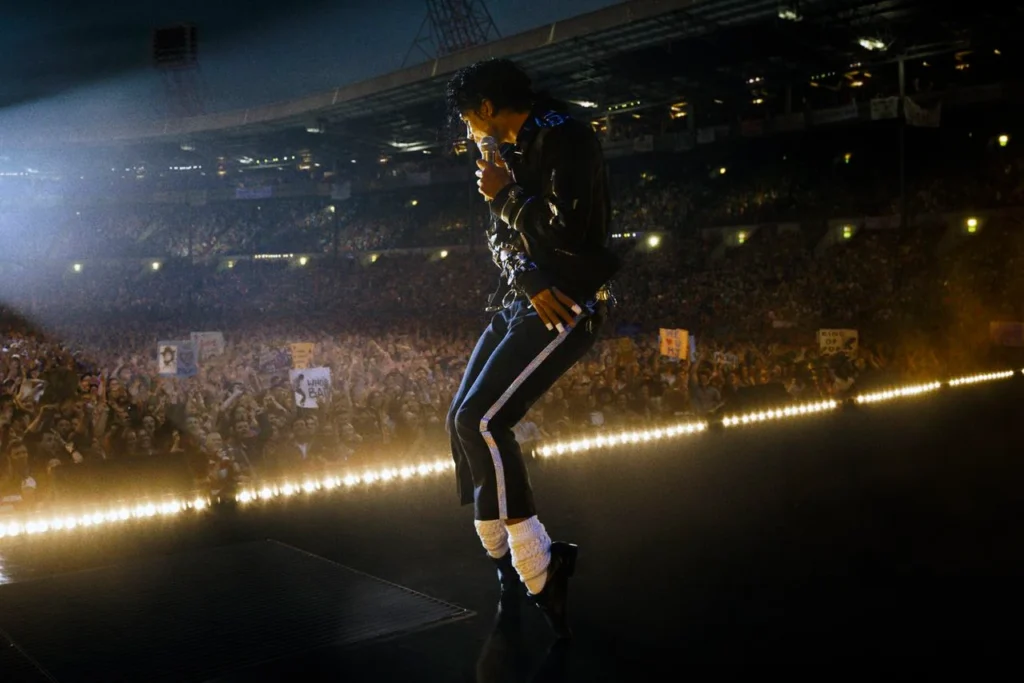
Visually, the film keeps things polished but not flashy. The concert recreations, especially moments like “Billie Jean,” do their job — they remind you why Michael wasn’t just famous, he was something else entirely. There’s also a strong presence of his music throughout, sometimes a bit too neatly placed, almost like a greatest-hits playlist stitched into scenes.
The middle portion, where Michael collaborates with Quincy Jones and builds his solo identity, probably works the best. You can feel the shift — not just in his career, but in his confidence. There’s a scene involving the creation of “Beat It” choreography that stands out, showing how he pulled inspiration from real streets, real tension, and turned it into something global.
The film also touches on his personal quirks — the animals, the isolation, the strange comfort he found in building his own world. It doesn’t dive too deep, but it leaves enough hints to understand that fame didn’t exactly bring him peace.
By the time the film reaches the Bad era, it doesn’t try to wrap everything up neatly. Instead, it kind of stops mid-journey, almost like it’s saying — this story isn’t done yet. And yeah, it clearly sets up the possibility of more films. Surprisingly, that doesn’t feel forced. If anything, it feels like the only way to tell a story this big.
What works here is simple: the performance, the emotional core around his childhood, and the way the film captures that constant push-pull between vulnerability and control. What doesn’t fully land is the selective storytelling — you can feel the edges where things have been trimmed away.
Still, for a film that could’ve easily felt repetitive, Michael ends up being more engaging than expected. Not because it tells you something new, but because it makes you sit with something familiar in a slightly different way.
And maybe that’s enough.