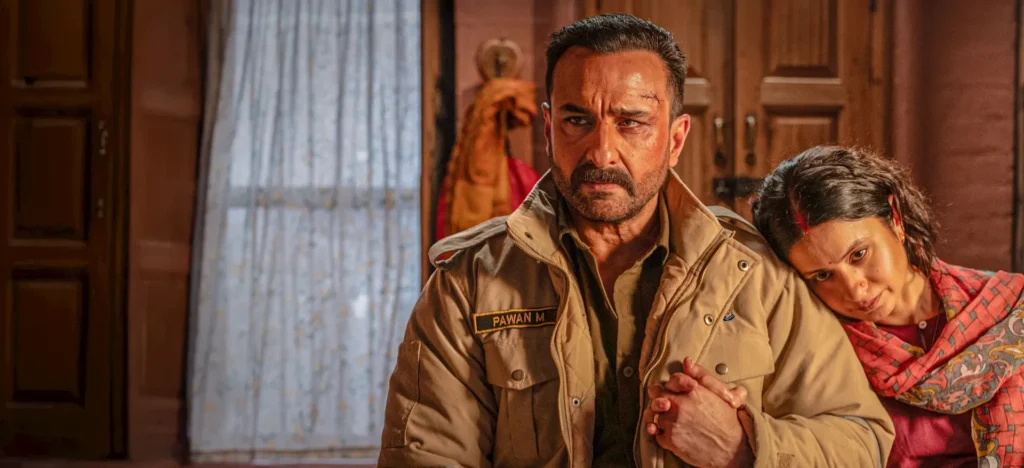
Netflix’s latest crime thriller Kartavya arrives with a setup that sounds intense right from the beginning. Small-town corruption, missing children, caste violence, political pressure, honour killings, and morally broken systems — the film throws all of this into one dark story and tries to build a gritty thriller around the idea of “duty.” Backed by Red Chillies Entertainment and fronted by Saif Ali Khan in a serious cop avatar, the film clearly wants to position itself as a hard-hitting social crime drama rather than a routine OTT thriller.
Directed by Pulkit, the film is set in the fictional town of Jhamli, where darkness exists behind almost every door. From the very first few minutes, the atmosphere feels tense and uneasy. The story doesn’t waste much time before introducing murder, corruption, and family conflict together. While the film definitely succeeds in creating a gritty mood, the bigger problem is that the screenplay becomes too easy to predict after a point. The suspense is there, but the surprises are not.
The story revolves around SHO Pawan Malik, played by Saif Ali Khan, whose birthday suddenly turns into a nightmare after a journalist investigating child disappearances gets murdered. Pawan is given only four days to solve the case or risk losing his position. At the same time, his personal life begins collapsing after his younger brother runs away with a girl from another caste, triggering outrage inside the family and village panchayat. The film constantly moves between these two tracks — the criminal investigation and the emotional family crisis — while trying to connect them under the larger theme of moral responsibility.
What works best in Kartavya is honestly the emotional side of the story rather than the mystery itself. The film’s investigation angle becomes fairly predictable midway through the runtime, but the personal conflicts keep things engaging. The family scenes especially feel more raw because they reflect how violence and toxic honour still continue under the shadow of tradition in many places. The movie also tries to explore how systems of power — whether political, religious, or patriarchal — protect themselves at the cost of vulnerable people.
Saif Ali Khan carries most of the film entirely on his shoulders. As Pawan Malik, he gives one of his more restrained performances in recent years. Instead of playing the role loudly, he keeps the character controlled and emotionally grounded. His Haryanvi accent slips in a few scenes, but overall the sincerity in his performance makes the character believable. Pawan is written as a man trapped between law, family loyalty, and humanity, and Saif handles that emotional pressure quite effectively.
One of the more interesting relationships in the film is between Pawan and Harpal, played by Yudhvir Ahlawat. Their scenes unexpectedly become the emotional heart of the movie because Pawan treats him less like a criminal and more like a damaged child trapped in terrible circumstances. Honestly, if the film had focused more deeply on this emotional track instead of juggling too many issues together, the impact could have been much stronger.
Sanjay Mishra once again proves why he remains one of the most dependable actors in Hindi cinema. As Inspector Ashok, he brings calmness and realism to the film. Even when the screenplay weakens during the final act, Mishra’s performance keeps several scenes believable. Zakir Hussain is equally powerful as the ruthless patriarch Hariyal. His confrontations with Saif Ali Khan carry genuine tension because both actors approach the scenes with seriousness instead of melodrama.
Meanwhile, Rasika Dugal appears in a role that feels intentionally opposite to her strong police officer image from Delhi Crime. Here, she plays a quiet and traditional daughter-in-law inside a deeply patriarchal environment. The role may not offer huge screen time, but Rasika still leaves an impression because of how naturally she fits into the character’s silence and emotional exhaustion. She does not need dramatic scenes to make her presence felt.
The film also deserves credit for maintaining a consistently dark atmosphere. The town of Jhamli feels dirty, tense, and emotionally suffocating almost throughout the runtime. The cinematography supports that mood well, especially during the nighttime investigation scenes and the emotionally heavy family confrontations. The background score too helps maintain urgency without becoming overly loud.
Still, Kartavya suffers because it tries to handle too many themes together. Child trafficking, caste politics, corrupt cops, fake godmen, honour violence, and family drama are all individually strong subjects, but the screenplay struggles to balance them smoothly. Some plot turns feel rushed while others become too obvious long before the reveal arrives. The climax especially lacks the emotional punch the buildup promises.
In many ways, Kartavya feels like a film that had the ingredients for something truly great but settles for being a decent one-time watch instead. The performances elevate material that sometimes becomes formulaic, and that’s mainly why the film remains engaging till the end. It may not become one of Netflix India’s strongest crime thrillers, but for viewers who enjoy socially charged dramas with intense performances, there’s still enough here to keep them invested.