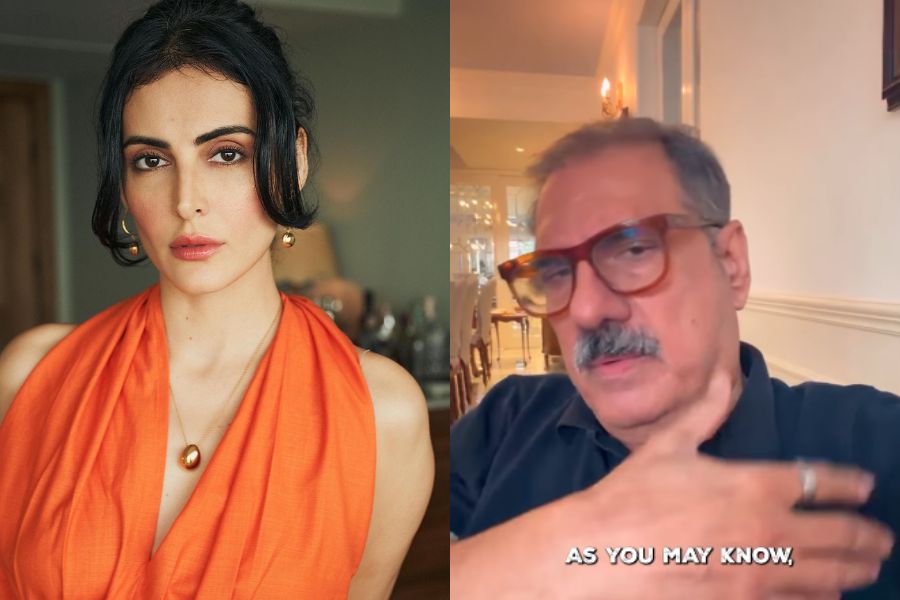
A lighthearted satire has unexpectedly turned into a serious and emotional public debate. Actor-model Mandana Karimi has strongly reacted to a humorous video posted by Boman Irani, calling him out for what she sees as selective commentary on Iran — and her response has quickly divided the internet.
What started as a joke involving global politics has now opened up a larger conversation about identity, responsibility, and lived experiences — especially when it comes to conflicts that are deeply personal for some.
The Video That Triggered the Reaction
Boman Irani recently shared a satirical Instagram video referencing Donald Trump and his reported interest in engaging with Iranians amid tensions in West Asia. In his signature humorous style, Boman imagined a scenario where he, along with Smriti Irani and Aruna Irani, would represent “Iranis” in peace talks.
The video leaned into playful absurdity — from inviting Trump to his home in Mumbai’s Dadar Parsi Colony to joking about serving dhansak and custard, all while referencing everyday concerns like gas cylinders.
For many viewers, the video landed exactly as intended — a harmless piece of satire. Several actors and fans responded with laughter, appreciating Boman’s comic timing.
But for Mandana Karimi, the tone of the video struck a very different chord.
Mandana Karimi’s Strong Response
Mandana took to the comments section of the post and wrote a detailed and emotional message, questioning the timing and intent behind Boman’s video.
She pointed out that for years, people in Iran have faced arrests, executions, and suppression, and questioned why voices like his had remained silent during those moments. According to her, turning the issue into satire now — especially in the context of global politics and fuel concerns — felt misplaced.
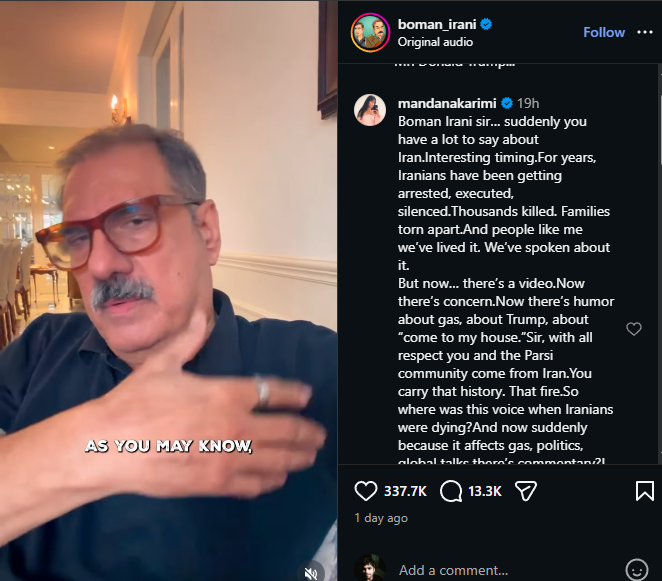
She also referenced Boman’s Parsi heritage, noting that the community traces its roots back to Iran. In her view, that connection carries a responsibility to speak up, especially during times of crisis.
Her comment wasn’t just criticism — it carried a personal undertone. Mandana emphasized that she has lived through the realities she was speaking about, making it clear that her reaction came from lived experience rather than distant observation.
“I’ve Lived It”: A Personal Angle
As the discussion grew, Mandana further explained her stance.
She shared that she was born in Tehran and lived in Iran for 18 years under the current regime. In her words, she has experienced arrest and violations firsthand — something she says shapes her perspective on the issue.
She also highlighted that her family continues to live in Iran, making the situation ongoing and deeply personal for her.
For Mandana, this wasn’t just about a video. It was about how global narratives are shaped — and how quickly serious issues can be reduced to humor when they enter mainstream discourse.
Internet Divided: Satire vs Sensitivity
As expected, the internet quickly split into two camps.
On one side were those who supported Mandana’s reaction, agreeing that sensitive geopolitical issues shouldn’t be reduced to satire — especially by those not directly affected.
On the other side were viewers who felt the backlash was unnecessary. Many pointed out that Boman’s video was clearly intended as light-hearted satire, not political commentary.
Some comments even questioned Mandana’s own stance, noting the complexities of global narratives and how different perspectives can exist simultaneously.
This divide reflects a larger pattern seen increasingly on social media — where intent and interpretation often clash, and where humor can quickly become controversial depending on who is watching.
The Silence That Followed
Interestingly, Boman Irani has not responded publicly to Mandana’s comments.
His silence has left the conversation open-ended, allowing speculation and discussion to continue without resolution. Whether he chooses to address it later or let the moment pass remains to be seen.
In many cases, public figures opt not to engage in such debates, especially when the situation involves deeply personal and political layers.
When Humor Meets Reality
This incident highlights a recurring challenge in today’s digital space — the thin line between satire and sensitivity.
Comedy has always been a way to process complex issues, but in a globally connected world, the same joke can carry very different meanings depending on who hears it.
For someone like Mandana, whose connection to Iran is personal and ongoing, the subject isn’t abstract. It’s lived reality.
For someone like Boman, the video appears to come from a place of humor and cultural playfulness — something he has built his public persona around.
Neither perspective is entirely invalid — but the clash between them is what fuels the debate.
A Larger Conversation Beyond the Individuals
Beyond the individuals involved, this moment speaks to something bigger.
It raises questions about who gets to speak on global issues, how personal history shapes public reactions, and whether humor should have limits when dealing with sensitive topics.
It also reflects how quickly conversations can escalate online — moving from a simple video to a wider cultural and political discussion within hours.
Where It Leaves the Conversation
As of now, the debate continues without a clear resolution.
Mandana Karimi has made her stance clear, grounding it in personal experience and emotional truth. Boman Irani’s video remains what it was intended to be — a piece of satire that resonated with many but not all.
In the end, this isn’t just about one comment or one video.
It’s about the space between humor and reality — and how differently that space can feel, depending on where you stand.