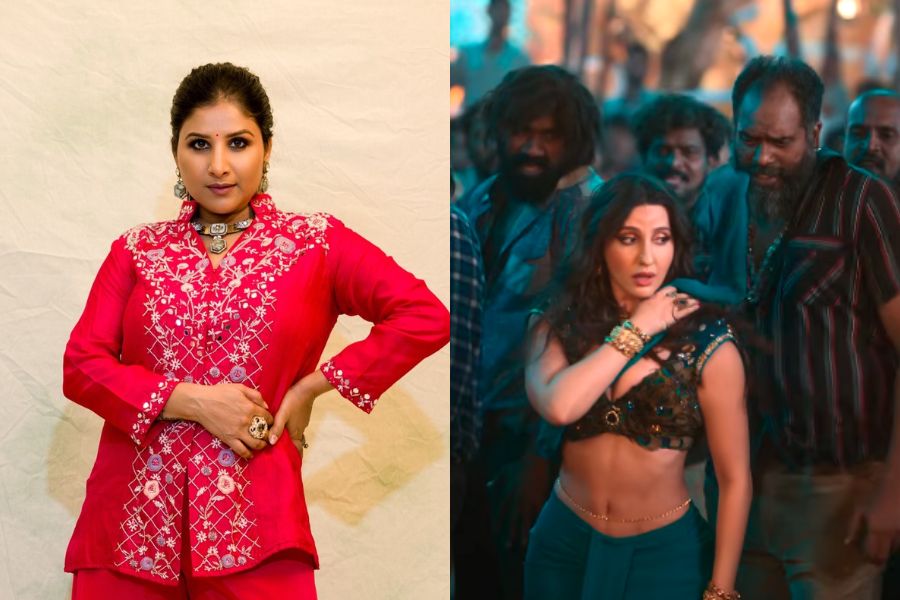
The conversation around lyrics in Indian film music has taken a sharp turn once again, and this time, it has pulled singer Mangli and actor-dancer Nora Fatehi into the spotlight. What began as just another promotional track from an upcoming film quickly spiraled into a larger debate about suggestive content, artistic responsibility, and the line between entertainment and discomfort.
At the center of the controversy is the Hindi version of a song from KD: The Devil, titled Sarke Chunar Teri Sarke, which is a dubbed adaptation of the Kannada track Sarse Ninna Seraga Sarse. While the original regional versions quietly made their way to audiences, it was the Hindi version that triggered widespread criticism, particularly over its lyrics, which many listeners found explicit and problematic.
As the backlash gained momentum across social media platforms and public discourse, the response from the creative team was swift — but not without further complications.
Mangli Issues Public Apology as Song Gets Pulled Down
Facing mounting criticism, Mangli addressed the situation through a public note on Instagram, choosing to directly acknowledge the audience’s concerns. In her message, she expressed regret over the unintended impact of the song and confirmed that the controversial version had been taken down from all platforms.
She emphasized that hurting public sentiment was never the intention and described the situation as an oversight rather than a deliberate creative choice. Alongside the apology, she revealed that the lyrics had already been revised and that a corrected version of the song would be released shortly.
Interestingly, Mangli also chose to disable comments on her post — a move that reflects just how intense the online reactions had become. For an artist known for her grounded persona and strong fan base, especially in Telugu-speaking regions, the situation marked a rare moment of public controversy.
Mangli’s career, built largely on folk-inspired music and cultural storytelling, has generally been associated with authenticity and regional pride. Having contributed to films like Ala Vaikunthapurramuloo and Hari Hara Veera Mallu, she has carved a niche for herself as a voice that connects deeply with grassroots audiences. This controversy, however, has placed her in an unfamiliar space where commercial film music and public sensitivity intersect in complicated ways.
Nora Fatehi Distances Herself, Raises Concerns Over Consent
While Mangli was addressing the lyrical controversy, Nora Fatehi’s response added another layer to the unfolding situation. Taking to Instagram, Nora clarified that she had no involvement in the Hindi version of the song that sparked outrage.
She stated that she neither performed for the Hindi track nor gave permission for her image to be used in association with it. According to her, the use of her likeness in promotional material — reportedly through AI-generated visuals — was done without her approval, which raised serious concerns about consent and digital ethics in film marketing.
Nora also revealed that she had anticipated potential backlash when she first became aware of the project and had even communicated her concerns to the film’s director. Her statement suggested that the controversy could have been avoided with more careful decision-making during the production and promotional stages.
At the same time, she addressed a wave of personal criticism directed at her online, calling it unfortunate that the situation was being used to question her character. She maintained that moving forward, her team would exercise greater caution in similar situations.
A Wider Debate on Lyrics and Responsibility
The controversy has gone beyond just one song. It has reignited a familiar debate within the Indian entertainment industry — how far is too far when it comes to suggestive or provocative lyrics?
Over the years, Bollywood and regional industries alike have often walked a fine line between catchy commercial appeal and meaningful content. While some audiences view such songs as harmless entertainment, others see them as reflective of deeper issues around representation, objectification, and cultural sensitivity.
What makes this case particularly interesting is the difference in reception between the Hindi and regional versions of the same song. While the Kannada, Tamil, Telugu, and Malayalam versions continue to remain available online, it is the Hindi adaptation that drew the most intense scrutiny. This highlights how language, audience reach, and cultural context can significantly influence how content is perceived.
The Film and Its High-Profile Buzz
KD: The Devil itself has been generating attention for its star-studded lineup and ambitious scale. With actors like Sanjay Dutt associated with the project and a visually striking promotional campaign, the film has been positioning itself as a major pan-India release.
The inclusion of a high-energy dance track featuring Nora Fatehi was clearly aimed at boosting its mass appeal. However, the controversy has now shifted focus from the film’s cinematic promise to its handling of creative decisions.
Music composer Arjun Janya, who has delivered several popular tracks in the Kannada industry, also finds himself indirectly caught in the discussion, as audiences question how such lyrics made it through multiple stages of production without concern.
Industry Impact and What Happens Next
For now, the immediate damage control is underway. The original Hindi version has been removed, a revised version is set for release, and both Mangli and Nora have issued their respective clarifications.
But the larger impact of the controversy may linger longer than the song itself.
In an era where content travels instantly across languages and regions, filmmakers and musicians are increasingly being held accountable not just for what they create, but how it is presented and promoted. The use of AI-generated imagery without consent, as alleged by Nora, also opens up a new conversation about ethical boundaries in digital filmmaking.
At the same time, the audience response shows that viewers today are more vocal and engaged than ever before. Songs are no longer just background elements — they are cultural statements that can shape or challenge public perception.
A Turning Point or Just Another Controversy?
Whether this incident leads to meaningful change or simply fades away like many past controversies remains to be seen. What is clear, however, is that both artists and filmmakers are navigating a rapidly evolving landscape where creative freedom must constantly be balanced with public sensitivity.
For Mangli, this moment may serve as a learning curve in the transition from folk roots to mainstream cinema. For Nora Fatehi, it reinforces the importance of consent and clarity in collaborations.
And for the industry as a whole, it’s yet another reminder that in today’s connected world, even a single song can spark a nationwide conversation.