Imagine being trapped inside a sperm whale, surrounded by digestive fluids, with barely an hour of oxygen remaining. That’s the terrifying premise of Whalefall, director Brian Duffield’s adaptation of Daniel Kraus’ bestselling novel. Starring Austin Abrams and Josh Brolin, the film combines an extraordinary survival nightmare with an emotionally complicated father-son relationship. The result is an ambitious thriller whose technical ingenuity frequently earns praise, even as its attempts at emotional storytelling divide critics.
Released on October 16, 2026, the 106-minute film takes a concept that sounds almost impossible to translate onto the screen and turns it into something visually elaborate and occasionally deeply unsettling. However, its biggest challenge isn’t creating a believable whale’s stomach. It’s maintaining tension while repeatedly stepping away from the desperate fight for survival.
Whalefall Story: One Man, One Whale and an Hour to Survive
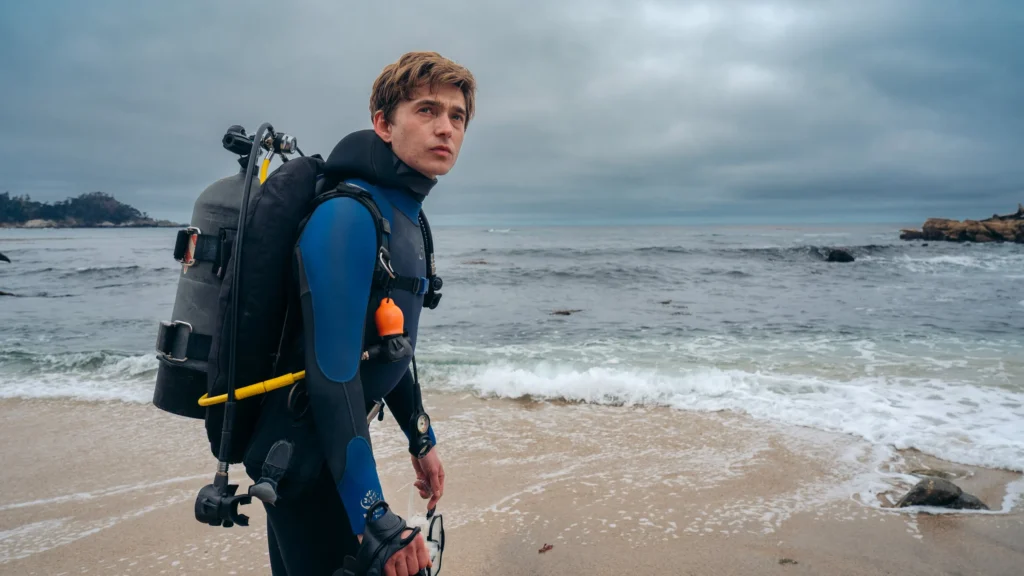
Austin Abrams plays Jay Gardiner, a young scuba diver struggling with the death of his estranged father, Mitt (Josh Brolin).
Determined to recover his father’s remains, Jay ventures into the waters off California’s Central Coast. His journey takes a horrifying turn when a massive sperm whale swallows him, leaving him trapped inside the creature with a rapidly diminishing oxygen supply.
The situation creates an unusually restrictive survival story. Jay has no rescue team, no easy communication with the outside world and virtually no understanding of his surroundings.
His only advantages are his diving equipment, knowledge of marine life and the lessons he reluctantly absorbed from his father.
But Whalefall isn’t interested exclusively in whether Jay escapes. Through flashbacks, the screenplay examines his difficult upbringing and the emotional damage caused by Mitt’s demanding personality.
The whale consequently becomes more than a physical threat. It represents a past that Jay has spent years trying to escape.
Austin Abrams Delivers a Demanding Lead Performance
Austin Abrams faces an unusual acting challenge: carrying substantial portions of a film while physically confined, frequently unable to speak and surrounded by an environment that offers almost no conventional interaction.
Published reviews have consistently recognised the difficulty of that assignment.
Abrams communicates Jay’s desperation largely through his physical reactions. His laboured breathing, panicked movements and increasingly exhausted appearance help convey the urgency of a situation that could otherwise become repetitive.
What makes the performance especially important is how little conventional dialogue is available to explain Jay’s decisions.
His reactions must communicate both immediate survival instincts and the psychological burden of confronting memories he would rather forget.
Josh Brolin provides a contrasting presence as Mitt, a rugged, intimidating father whose harsh understanding of masculinity shaped his son’s childhood.
Brolin brings the necessary authority to the character, although some critics argue that the screenplay makes Mitt’s cruelty too obvious, limiting the relationship’s emotional complexity.
Elisabeth Shue, Jane Levy and Emily Rudd complete the immediate family, but their characters receive comparatively limited development.
Production Design Creates the Film’s Most Distinctive Horror
The most fascinating achievement of Whalefall may be its recreation of the whale’s interior.
Rather than relying entirely on computer-generated imagery, production designer Ramsey Avery and his team constructed several full-scale practical environments informed by research into whale anatomy.
Some sets could rotate or move, allowing the filmmakers to simulate the unpredictable motion of an enormous living creature.
Cinematographer Aaron Morton and the visual-effects team used specialised camera technology and carefully controlled lighting to capture the constantly shifting surroundings.
The result, according to several critics, is an organic environment filled with disturbing textures, constricting spaces and dangerous digestive chambers.
James Miller’s sound design adds another layer of discomfort, emphasising the whale’s movement, violent underwater forces and Jay’s increasingly fragile breathing.
These details provide the film with its strongest argument for a theatrical viewing.
Unlike traditional creature features, where the monster threatens characters from outside, Whalefall places its protagonist inside the creature itself.
The distinction changes the nature of the horror. The environment becomes the enemy, making almost every movement potentially dangerous.
Where Whalefall Struggles: Emotion Versus Suspense
The film’s most divisive creative decision is its frequent movement between Jay’s present-day ordeal and memories of his father.
Those flashbacks provide essential context, explaining why Jay entered the ocean and how Mitt’s teachings influence his survival.
However, repeatedly interrupting a time-sensitive escape story introduces a structural problem.
The film wants audiences to fear that Jay might run out of oxygen, while simultaneously asking them to reflect on years of unresolved family conflict.
Some critics have found the emotional material moving, particularly the idea that a person can recognise a parent’s harmful behaviour while still valuing certain lessons they taught.
Others argue that the repeated flashbacks weaken the film’s momentum and make its themes unnecessarily explicit.
That disagreement highlights the central tension in Duffield’s adaptation.
The physical ordeal works best when Jay’s immediate actions carry the storytelling. The family drama is potentially richer when allowed to emerge naturally from those actions, rather than repeatedly being explained through memories.
The screenplay, co-written by Duffield and Kraus, doesn’t always achieve that balance.
Whalefall Verdict: An Inventive but Uneven Survival Thriller
Whalefall has an unusually imaginative premise, a committed central performance and production design that distinguishes it from conventional survival movies.
Its exploration of grief and inherited emotional damage gives the story ambitions beyond simple creature-feature entertainment.
However, the critical response suggests those ambitions also create the film’s biggest weakness. The tension becomes less consistent whenever the narrative moves too far from Jay’s immediate struggle.
The overall assessment is of a visually inventive, often intense thriller that works more reliably as a survival experience than as a family drama.
Viewers who enjoy claustrophobic thrillers, unconventional horror and physically demanding performances have good reason to be interested. Those looking for an uninterrupted, fast-paced escape story may find the emotional detours frustrating.
Ultimately, Whalefall offers something rare in modern survival cinema: a genuinely unusual environment and an attempt to connect physical terror with psychological consequences, even if the two elements don’t always fit together comfortably.