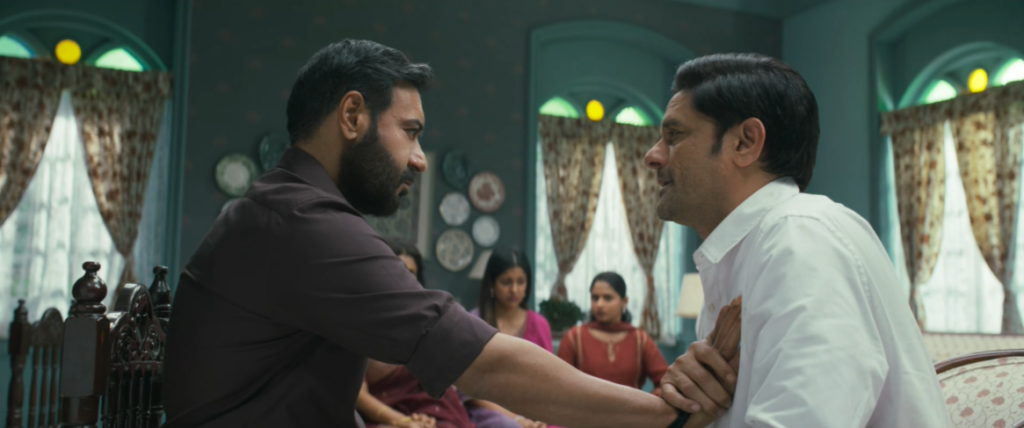
There was always a danger that Drishyam could outsmart itself.
The first film worked because Vijay Salgaonkar’s plan felt extraordinary but understandable. Drishyam 2 then pulled off an even harder trick: it returned to a crime audiences already knew almost everything about and found another layer hiding underneath it. A third film could easily have become one twist too many.
Instead, Drishyam: The Conclusion understands that its final job is not simply to invent Vijay’s cleverest escape yet. It has to make more than a decade of guilt, grief, fear and deception mean something.
Director Abhishek Pathak largely succeeds.
The final chapter is not flawless. Its first half asks for patience, the background score occasionally tells you how tense you should feel before the scene has earned it, and a few developments stretch the franchise’s famously careful relationship with plausibility. But once the pieces begin moving into place, The Conclusion becomes exactly the kind of controlled thriller this franchise needed for its farewell.
More importantly, it actually feels like an ending.
Rating: 4/5
Released in theaters on October 2, 2026, the Hindi finale brings back Ajay Devgn, Tabu, Shriya Saran, Rajat Kapoor, Ishita Dutta and Mrunal Jadhav, while Jaideep Ahlawat and Prakash Raj become crucial new pieces in Vijay Salgaonkar’s final battle with the law. The official credits list Abhishek Pathak as director and story writer, with Aamil Keeyan Khan, Pathak and Parveez Shaikh handling the screenplay.
Vijay Salgaonkar’s biggest weapon is no longer just his intelligence
The Salgaonkar family is still living inside the consequences of what happened years earlier.
Vijay has survived investigations, evidence and increasingly determined police officers, but survival has never meant freedom. Nandini remains anxious. Anju carries the emotional damage of everything the family has endured. Vijay, meanwhile, continues behaving like the composed patriarch who has already calculated what everyone around him will do next.
Ajay Devgn has played that stillness so consistently that it would have been easy for the character to become mechanical by the third movie.
He does not.
The most interesting part of Devgn’s performance here is how little Vijay needs to say. His eyes often do the work before the screenplay catches up. When another character believes they have finally cornered him, Devgn rarely responds with obvious panic. Instead, there is usually a fraction of a second where Vijay appears to be processing not the danger itself, but how much of that danger he had already anticipated.
Indian Express similarly singled out Devgn’s controlled performance, describing him as the dependable center of the film while noting how the finale continues the moral complexity surrounding Vijay’s actions.
That complexity matters more this time.
The earlier films invited audiences to admire Vijay’s intelligence because his first instinct was protecting his family. The Conclusion quietly asks a more uncomfortable question: how many lies can a man build before protecting his family becomes indistinguishable from controlling everyone around him?
The film does not completely interrogate that idea as deeply as it could have, but simply allowing it into the room gives this installment more emotional weight than another elaborate cover-up would have managed.
Jaideep Ahlawat is exactly the opponent this finale needed
Replacing or following a character such as Akshaye Khanna’s Tarun Ahlawat from Drishyam 2 is not easy. Khanna brought a wonderfully amused quality to the investigation, almost as though catching Vijay was an intellectual hobby.
Jaideep Ahlawat wisely does not imitate him.
As Crime Branch officer Rajveer Singh Tomar, he brings a heavier, more deliberate presence. His character does not need to dominate every scene because Ahlawat makes even ordinary conversations feel like interrogation rooms.
The fun comes from watching two actors who specialise in restraint trying to read each other.
Vijay rarely reveals what he knows. Rajveer rarely reveals how much he suspects. Their confrontations therefore work without requiring constant shouting, and the film is strongest when it trusts those silences.
Early critical responses have repeatedly highlighted Ahlawat as one of the film’s standouts, with MensXP particularly praising his performance and the way the new character strengthens the trilogy’s final act.
Then Prakash Raj arrives and changes the flavour again.
He brings courtroom authority and a theatrical sharpness that the film saves for its later stretches. The performance is broader than Devgn or Ahlawat’s, but intentionally so. By that stage, the story is no longer simply about investigation; it is about whether Vijay’s carefully constructed version of reality can survive when placed under formal scrutiny.
That shift gives the second half much of its momentum.
Tabu makes sure the victim’s family is never reduced to an obstacle
One of Drishyam’s smartest choices has always been refusing to make Meera Deshmukh merely “the antagonist.”
Yes, she is trying to destroy Vijay’s carefully constructed defence.
She is also a mother whose son is dead.
Tabu keeps that distinction alive throughout the finale.
There is exhaustion in Meera now. Anger remains, but it has been living beside grief for too long to remain clean or simple. Rajat Kapoor’s Mahesh functions as the quieter counterweight, a parent who is also grieving but has processed that loss differently.
The franchise could easily have encouraged viewers to treat every victory for Vijay as a defeat for villains trying to harm his family. Tabu prevents that moral shortcut.
Indian Express correctly identifies her wounded presence as one of the film’s strongest emotional elements.
That is important because the finale depends on audiences wanting two incompatible things.
We want Vijay to protect his family.
We also understand why Meera cannot stop searching for the truth.
The movie never resolves that contradiction completely. It should not.
The first half is patient — sometimes too patient
Where The Conclusion struggles most is pacing.
The film knows audiences arrive prepared to analyse everything. A glance might matter. A casual conversation might be laying groundwork. A character introduced for three minutes could become essential an hour later.
That expectation creates tension automatically.
It also gives the filmmakers permission to take their time.
Sometimes too much time.
The first half spends a considerable stretch resetting relationships, showing the Salgaonkar family’s current state and positioning the new investigation. That material is necessary, but there are scenes where the tension plateaus rather than builds.
Fortunately, much of that patience is rewarded.
Once the screenplay begins revealing why apparently disconnected details matter, the movie recovers the particular pleasure that separates Drishyam from an ordinary crime thriller: the audience is encouraged to solve the puzzle while simultaneously suspecting that Vijay solved it before the film even began.
That sensation is difficult to recreate for a third time.
Pathak and his writers manage it more often than not.
The climax understands what audiences actually want from ‘Drishyam’
A Drishyam climax cannot simply reveal the killer.
We already know the central crime.
The mystery is always how.
How did Vijay know?
How long has he known?
Which apparently insignificant moment was actually part of a larger design?
And crucially: when did the plan begin?
The Conclusion knows audiences are waiting for that familiar retrospective click — the point where earlier scenes suddenly acquire new meaning.
Without revealing the mechanics, the final stretch delivers several of those moments.
Some are easier to anticipate than the franchise’s best surprises. A couple require greater suspension of disbelief than the first film ever demanded. But the screenplay understands that cleverness alone would not be enough for the final chapter.
So the climax also asks what winning actually looks like now.
Vijay cannot return his family to the life they had before the crime. Meera cannot recover her son. Another perfect escape cannot erase years spent looking over shoulders.
That gives the film’s ending a melancholy quality underneath the satisfaction of seeing the puzzle completed.
This is where calling the movie The Conclusion ultimately feels earned rather than promotional.
Pathak has previously said this installment was intended as the endpoint rather than another setup for additional twists. Ajay Devgn similarly said at the trailer launch that the franchise should not keep trying to go beyond a natural conclusion simply because audiences remain interested.
After watching how the finale is structured, that decision makes sense.
Another chapter would risk turning Vijay Salgaonkar from a fascinating man protecting his family into an endlessly renewable puzzle machine.
The background score occasionally works too hard
If there is one technical choice that repeatedly weakens otherwise confident scenes, it is the background music.
A good Drishyam sequence needs very little assistance. Put Vijay in a room with an investigator who may have discovered something, allow the camera to remain on Devgn’s face for several seconds, and tension appears naturally.
The film occasionally refuses to trust that.
The score grows thunderous at moments where restraint would have been considerably more unnerving. Indian Express raised the same criticism, arguing that the loud background music sometimes overwhelms scenes the film is already telling effectively.
It does not ruin the suspense, but it sometimes announces danger before the performances have had the chance to create it themselves.
The editing is much more successful.
Information is withheld carefully, and visual details are planted without always calling attention to themselves. That allows later revelations to feel connected to what viewers actually saw rather than material invented solely for the climax.
‘The Conclusion’ succeeds because it remembers this was always a family story
The biggest compliment to Drishyam: The Conclusion is that its best moments are not necessarily its biggest twists.
They are the moments when the Salgaonkars sit together and you understand how permanently one night changed every person in that house.
Shriya Saran’s Nandini remains vital because she expresses the fear Vijay refuses to show. Ishita Dutta gives Anju the lingering vulnerability of someone who may technically have escaped the crime but never escaped its psychological consequences.
And Devgn keeps Vijay at the center without turning him into a superhero.
He is frighteningly prepared, yes.
But the movie increasingly suggests that preparation has become the way he knows how to live.
That is why the ending works.
The first Drishyam asked whether an ordinary man could protect his family from an extraordinary crisis. The second asked whether a perfect cover-up could survive the passage of time.
The Conclusion asks what remains of that man and his family after spending years maintaining the lie.
It is not quite as lean as the first movie, and a few pieces of the final plan push credibility further than the franchise once did. But Abhishek Pathak delivers the closure this Hindi trilogy needed without simply repeating its previous tricks.
Ajay Devgn remains quietly commanding, Jaideep Ahlawat is an excellent addition, and Tabu ensures the emotional cost of Vijay’s victories is never forgotten.
For a franchise built entirely around hiding the truth, Drishyam: The Conclusion ultimately understands exactly when to stop.
PopcornRealm Rating: 4/5