There is a version of Verity that could have treated Colleen Hoover’s bestseller with complete seriousness — all shadowy corridors, tortured glances and solemn debates about truth. Michael Showalter’s adaptation is more entertaining whenever it resists that temptation.
Starring Dakota Johnson, Anne Hathaway and Josh Hartnett, Verity is a glossy, sexually charged psychological thriller that understands, at least intermittently, that its source material is closer to deliciously overheated domestic pulp than prestige gothic drama. The movie is still saddled with some of the novel’s contrivances, and its final stretch asks the audience to swallow more than even this genre should reasonably demand. But when Hathaway is allowed to lean into Verity Crawford’s theatrical menace, the adaptation finds an energy the book often struggled to control.
Amazon MGM Studios releases the film in theaters on October 2, 2026. It runs 1 hour and 54 minutes and carries an R rating for sexual content, bloody images, violence, nudity and language.
Anne Hathaway understands exactly what kind of movie this is
The premise remains enormously effective.
Lowen Ashleigh (Johnson) is a struggling writer who receives the kind of assignment capable of rescuing a career: finish a bestselling series created by Verity Crawford (Hathaway), a famous author who can no longer write after a devastating accident. Lowen moves into the Crawford home to work through Verity’s notes and research, placing her under the same roof as Verity’s husband Jeremy, played by Hartnett.
Then Lowen discovers a manuscript that appears to contain extraordinarily disturbing confessions.
From there, Verity operates on two questions at once. Is what Lowen is reading actually true? And how much can she trust what she believes she is seeing inside the Crawford home?
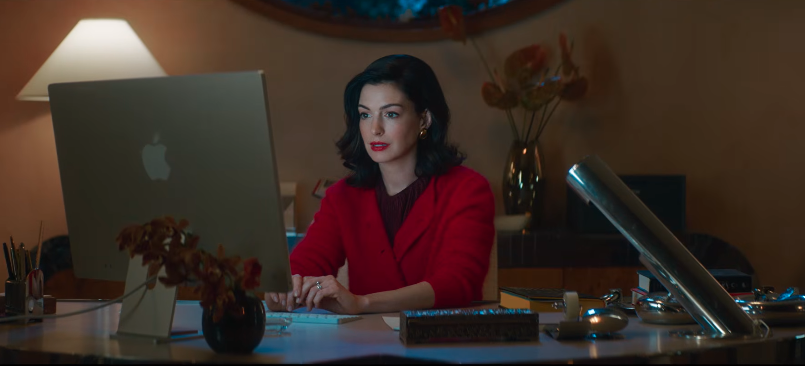
Hathaway is the actor who most fully exploits that uncertainty. Verity spends significant portions of the story physically limited, meaning the performance has to generate menace through looks, posture and the versions of Verity that exist inside Lowen’s imagination. The film smartly visualizes material that existed largely on the page in Hoover’s novel, allowing Hathaway to play several shades of the same woman rather than simply sit silently at the center of the mystery.
Hathaway has explained that she approached certain moments from Lowen’s perception of Verity, allowing herself to “play into the villainy” because that is how Lowen sees her.
That is exactly where the performance gets interesting.
Hathaway does not seem particularly worried about making Verity subtle. She alternates between intimidating, seductive, grotesque and knowingly excessive, occasionally pushing expressions or gestures just far enough that the movie begins flirting with camp. Other early reviews have similarly singled out that heightened quality, even when their overall assessments of the film have been negative.
It works because Verity needs someone willing to acknowledge its ridiculousness without turning the entire thing into parody.
Dakota Johnson is well cast as someone who cannot stop looking
Johnson takes the opposite approach.
Lowen is reactive by design. She spends much of the movie observing Verity, reading about Verity, imagining Verity and becoming increasingly entangled with Verity’s husband. Johnson’s natural screen reserve suits a protagonist who is constantly processing information without fully revealing what she intends to do with it.
The problem is that the screenplay occasionally confuses opacity with depth.
Lowen should gradually become unsettling herself. Her fascination with Verity is not simply fear; it is mixed with ambition, attraction, jealousy and the possibility that assuming another writer’s professional identity could expand into occupying other parts of her life as well.
That idea is more interesting than the straightforward question of whether Verity is secretly evil.
The movie recognizes this, particularly when Lowen and Jeremy’s attraction becomes harder to separate from Lowen’s fixation on Verity. Dakota Johnson has described the romance in the film as something that is “not really healthy,” which is almost comically understated but also a useful description of why the dynamic works.
Hartnett understands his function, too. Jeremy has to appear reassuring enough that Lowen’s attraction makes sense while remaining just uncertain enough that viewers never feel entirely comfortable around him. The movie would lose much of its tension if Jeremy could simply be categorized as loving husband, victim or manipulator.
The movie is sometimes better when it leaves the book behind
This is where adapting Verity creates an unusual challenge.
Hoover’s novel is built around reading. Lowen encounters Verity through written pages, and the distance between what was written, what actually happened and why someone might have written it is central to the book’s biggest ambiguity.
Film cannot reproduce that experience by simply photographing Johnson reading for two hours.
Showalter and screenwriter Nick Antosca instead dramatize material from Verity’s manuscript and use Lowen’s perspective to create different versions of events. That makes Hathaway a much more active presence than the source material’s basic setup might suggest and lets the audience experience Lowen’s interpretation rather than merely hear about it afterward.
It is one of the adaptation’s better decisions.
The filmmakers also take liberties elsewhere. Showalter has discussed removing one of the book’s child characters because the material was difficult to balance tonally on screen, while an intimate moment between Hathaway and Johnson reportedly developed through improvisation and was not taken directly from Hoover’s novel.
Those changes point toward the movie’s biggest improvement over the book: it has the opportunity to make Verity herself more than an object Lowen investigates.
Hoover has even said watching the adaptation complicated her own thinking about which character is actually the more morally troubling figure. The film, according to Showalter, was structured to expose multiple versions of the same story rather than simply settle into one unquestioned interpretation.
That approach suits Verity better than strict fidelity would have.
Where ‘Verity’ starts to lose control
Unfortunately, making the characters more visually dynamic does not solve the story’s fundamental problem: almost every twist requires another twist to explain it.
For a while, that is fun.
There are glances that may mean nothing, discoveries that could be traps and moments where Lowen — and therefore the viewer — is never certain whether Verity is helpless, performing helplessness or being reimagined by an increasingly unreliable observer.
But psychological ambiguity works only while the possible explanations remain roughly as interesting as one another.
By its final act, Verity begins spending too much energy servicing revelations rather than escalating character tension. Several critics have similarly pointed to the third act as the place where the movie’s internal logic becomes most strained. The Guardian described a promising setup that loses coherence near the end, while Variety’s review was considerably less persuaded by the film’s overall handling of the erotic-thriller material.
This is also where readers who disliked the book are unlikely to experience a complete transformation.
The film can reorganize the material, give Hathaway more room to perform and make Lowen’s obsession physically visible, but it cannot entirely escape a plot designed around increasingly outrageous information being revealed at precisely the moment another revelation is needed.
The ending still wants uncertainty to function as profundity.
Sometimes it does. Sometimes it simply feels like the movie is withholding a straight answer because a straight answer would expose how shaky the construction underneath it really is.
‘Verity’ works best as expensive trash — and that is not an insult
The most effective way to watch Verity may be to stop demanding that it become Rebecca.
There are clear gothic ingredients here: the outsider entering an intimidating home, the overpowering presence of another woman, a husband whose version of events cannot automatically be trusted, and a house that seems to preserve secrets better than the people living inside it. Showalter has openly cited Hitchcock-era and gothic influences, while the film’s setup naturally invites comparisons with Daphne du Maurier.
But Verity is far more comfortable when it embraces something trashier.
It has sex, manipulation, voyeurism, absurd behavior, suspicious manuscripts, beautiful people making catastrophically poor decisions and Anne Hathaway staring at Dakota Johnson as though she might murder her, seduce her or both.
That is enough.
The mistake comes whenever the film seems embarrassed by those ingredients and reaches for psychological seriousness it has not fully earned.
Hathaway never appears embarrassed.
Her performance gives Verity permission to be heightened, and Johnson’s cooler presence creates the contrast necessary for that performance to land. Even when the plot is collapsing under the weight of its own twists, there is pleasure in watching these characters circle one another while each quietly attempts to rewrite the story in her favor.
The result is not an especially elegant psychological thriller, and viewers expecting every mystery to lock neatly into place may leave frustrated. But as a glossy piece of adult melodrama with gothic trappings, Verity is considerably easier to enjoy.
And occasionally, by turning Hoover’s interior storytelling into something stranger, sexier and more theatrical, the movie finds ways to improve upon the page.