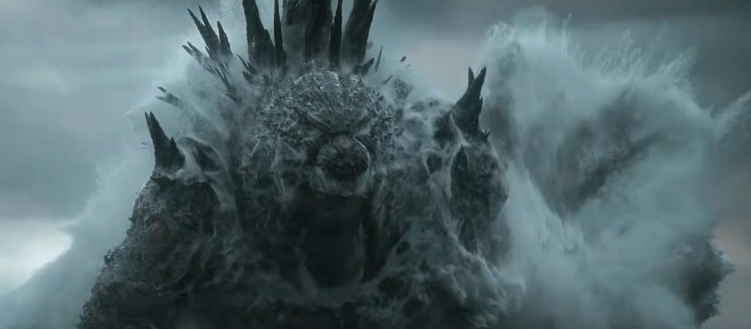
Takashi Yamazaki faced an unusually difficult sequel problem with Godzilla Minus Zero.
Godzilla Minus One was not simply another successful monster movie. Its small-budget visual effects won an Oscar, its postwar drama gave audiences characters worth caring about, and its international success transformed a relatively modest Japanese production into a global phenomenon. Simply making everything bigger risked losing exactly what made it work.
Minus Zero does go bigger. It is louder, more violent and considerably more ambitious. But the encouraging part is that Yamazaki has not forgotten that Godzilla is most frightening when we care about the people standing underneath him.
The result is a muscular, emotionally sincere sequel that does not have the unexpected freshness of Minus One, but finds enough new terror—and enough human damage—to justify returning to this version of postwar Japan. Early reviews following its New York Film Festival world premiere have been overwhelmingly positive, with particular praise for its monster action and visual effects.
The Shikishima family matters as much as Godzilla
The sequel moves forward to 1949, two years after the events of Minus One. Koichi Shikishima, played again by Ryunosuke Kamiki, is attempting to build something resembling an ordinary life with Noriko and their family after surviving war, guilt and Godzilla. Toho describes Japan itself as similarly fragile: the country has finally begun reclaiming some normality when another catastrophe destroys that sense of security.
That continuity is one of Minus Zero’s smartest decisions.
Yamazaki could easily have treated the first movie as finished business and surrounded Godzilla with an entirely new cast. Instead, the sequel asks what happens to people after they survive something impossible.
Kamiki remains central because Shikishima’s trauma did not disappear when the credits rolled. Minami Hamabe’s Noriko also has more than ceremonial importance, while the returning ensemble gives the destruction an emotional history that anonymous blockbuster crowds rarely possess.
There is a new major figure as well: Min Tanaka plays biologist Kanji Murakami, another man carrying psychological scars from the war.
That focus keeps Minus Zero from becoming a two-hour effects reel.
The monster action is significantly more brutal
That said, nobody should worry that Yamazaki has become shy about destroying cities.
The scale has expanded considerably.
Minus Zero was Filmed for IMAX, which Toho and GKIDS describe as a first for a Japanese production, and the larger canvas is immediately apparent in the way Yamazaki stages destruction.
Where Minus One built some of its greatest tension around Godzilla pursuing small boats across open water, the sequel introduces more elaborate aerial and urban set pieces. RogerEbert.com’s review specifically highlights a mid-film aerial battle while noting that the movie is substantially gorier than its predecessor.
There is a reason for that change.
Godzilla Minus Zero carries an R rating in the United States, with bloody imagery and violent content cited by the rating information. Yamazaki has said at NYFF that toning down the action simply was not the direction he wanted to take.
The violence consequently feels less clean than in many giant-monster movies. Buildings do not merely collapse beautifully in the distance. People are caught inside the disaster.
That difference matters.
Godzilla once again feels less like a superhero-sized attraction and more like an event people should be terrified to witness.
Bigger does not always mean better
Where Minus Zero struggles slightly is in escaping the shadow of the movie before it.
The first film’s combination of survivor guilt, rebuilding and Godzilla felt unusually fresh because audiences were not expecting such an intimate drama from the franchise. This time, we already understand Yamazaki’s approach.
Some of the thematic territory therefore feels familiar.
The sequel again examines war trauma, institutional failure, sacrifice and the question of whether ordinary people should be expected to die for decisions made by governments and military leaders. RogerEbert.com’s review argues that parts of Minus Zero effectively repeat material from Minus One, even while praising its spectacle and emotional concerns.
That is the sequel’s main weakness.
Yamazaki can make Godzilla larger. He can create more elaborate destruction. He can introduce a new threat.
What he cannot reproduce is the shock of discovering that Minus One was far more emotionally involving than audiences expected.
Fortunately, Minus Zero does not spend all 135 minutes trying to imitate its predecessor.
The sequel broadens its political concerns and places greater emphasis on a Japan navigating the complicated realities of the postwar world. The monster itself remains a metaphor, but Yamazaki’s interest is increasingly in the systems that fail people before individual courage is forced to take over.
The effects still embarrass much bigger blockbusters
The biggest technical achievement may be that Minus Zero looks like a movie made after an Oscar win without suddenly losing the physical texture of its predecessor.
Yamazaki again serves as writer, director and VFX supervisor, and critics at the NYFF premiere have repeatedly highlighted how naturally the monsters exist within the environments rather than feeling pasted over them. The Hollywood Reporter praised the significantly expanded effects work and the sense of physical weight given to the creatures, while IndieWire called the sequel an improvement over Minus One in almost every respect.
The spectacle is bigger, but it still has geography.
You understand where people are standing, where the monster is moving and what is about to be destroyed. That sounds basic, yet it is something far more expensive blockbusters regularly lose beneath layers of digital debris.
Yamazaki knows that Godzilla’s size only matters if the humans around him still look small.
Godzilla Minus Zero does not need to beat Minus One
Comparisons are unavoidable, but they may also be slightly unfair.
Minus One had the advantage of surprise. Minus Zero has expectations.
What the sequel needed to prove was that this particular version of Godzilla could support another story without becoming just another franchise machine. Based on the film’s NYFF premiere and early critical response, Yamazaki has largely succeeded. Variety described the film as an even grander follow-up, while Film at Lincoln Center called it a “supremely satisfying sequel” whose effects choreography exceeds the first movie.
The human drama remains important. The destruction becomes nastier. The visual effects scale up without becoming anonymous.
It may not carry the same lightning-in-a-bottle quality as Godzilla Minus One, but that does not make Minus Zero a lesser reason to return.
PopcornRealm verdict: Godzilla Minus Zero is a bigger, harsher sequel that understands why Minus One worked in the first place. Its themes occasionally repeat familiar ground, but the stronger monster action, outstanding effects and continued investment in Shikishima’s family make this a worthy second chapter rather than an oversized victory lap.
Godzilla Minus Zero runs 135 minutes. It opens in Japan on November 3, 2026, followed by a wide North American release through GKIDS on November 6.