The U.K.’s advertising watchdog has ruled against part of the marketing campaign for Lee Cronin’s The Mummy, deciding that the film’s outdoor posters breached advertising rules because of imagery that could be particularly distressing for young children. However, the regulator stopped short of taking action against the movie’s television and streaming advertisements, concluding that those commercials complied with existing broadcast standards.
The decision follows dozens of complaints from members of the public who argued that the horror film’s promotional material was disturbing. While the watchdog acknowledged concerns surrounding the outdoor campaign, it determined that the TV and Prime Video advertisements were appropriately scheduled and unlikely to cause widespread distress.
Outdoor posters ruled unsuitable for children
The Advertising Standards Authority (ASA) investigated four complaints relating to the promotional campaign after receiving 30 complaints from the public. According to the regulator, many complainants believed the advertisements were upsetting not only for children but also for adults who encountered them in public places.
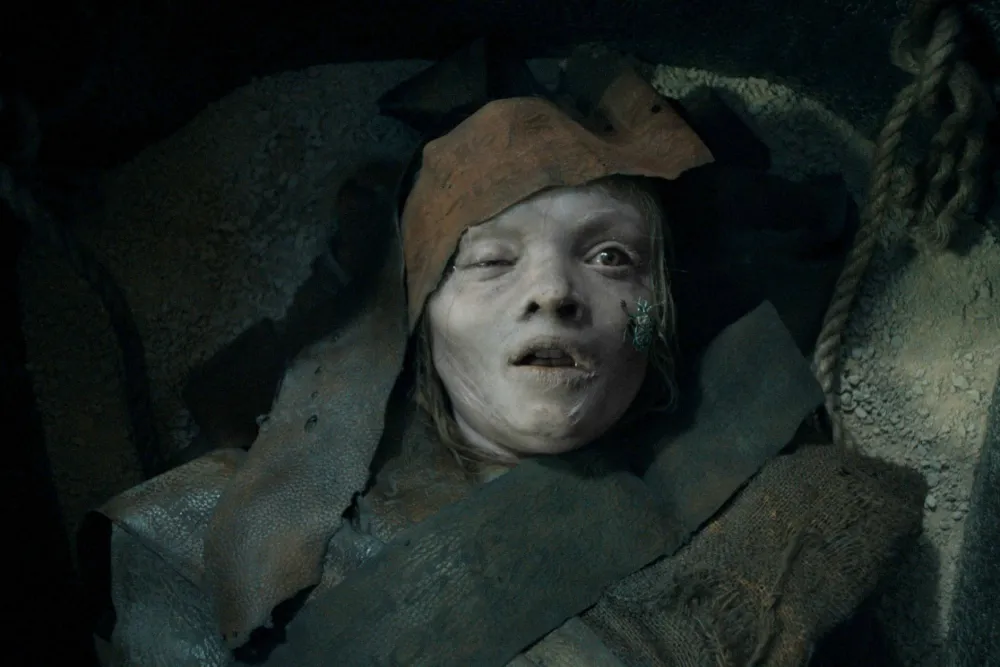
The disputed posters appeared across the London Underground and other outdoor advertising locations. They featured a close-up image of a mummified female figure with grey skin, cracked lips, one swollen eye and fabric resembling a burial shroud decorated with hieroglyphic-style markings. After reviewing the artwork, the ASA concluded that the character’s appearance created “a realistic impression of a dead child,” particularly because of the facial features and the way the figure was wrapped.
The regulator noted that the advertisements appeared in untargeted public spaces, including one location visible from a children’s nursery. Because young children could reasonably be expected to see the posters, the ASA determined they were likely to cause unnecessary distress. As a result, it ruled that the campaign breached the CAP Code and ordered that the posters “must not appear in the form complained of.” The watchdog also instructed Warner Bros. to ensure future horror advertising likely to frighten children is kept away from locations where young audiences are likely to encounter it.
Warner Bros. defended the campaign
During the investigation, Warner Bros. argued that several creative choices had been made specifically to reduce the impact of the image. The studio said the character’s neutral facial expression, open eye and the absence of a traditional sarcophagus or physical restraints were intended to make the artwork less disturbing for viewers.
The company also pointed to its internal advertising policy, explaining that outdoor horror campaigns are generally placed at least 100 metres away from schools. However, the studio acknowledged that the policy does not currently extend to nurseries, an issue that became relevant in this particular case because one of the posters was visible from such a location.
The ASA rejected a separate complaint alleging that the poster trivialised child loss or ongoing global conflicts. The regulator concluded that the promotional text clearly identified the image as part of a horror film campaign, providing sufficient context for viewers even if some considered the artwork to be in poor taste.
TV and Prime Video ads cleared
Unlike the outdoor campaign, the film’s television commercial and matching Prime Video advertisement were found to comply with advertising regulations. The commercials revolve around a family receiving a call informing them that their daughter, who disappeared eight years earlier, has been discovered inside a 3,000-year-old sarcophagus. The campaign concludes with the on-screen message, “Some Things Are Meant to Stay Buried.”
The ASA found that the television and streaming advertisements were unlikely to cause serious distress because they were subject to scheduling restrictions approved by Clearcast. Both commercials were only permitted to air after 7:30 p.m., reducing the likelihood that younger children would be exposed to the content.
The regulator also considered audience data provided by Clearcast, which showed that the average children’s viewing index for the television placements was 31, well below the industry benchmark of 100 that represents typical child viewership. Based on that evidence, the ASA concluded that the child audience reached by the campaign was relatively low and decided that no further action was necessary against the TV or streaming advertisements.
Lee Cronin’s The Mummy was released in the United Kingdom on April 17 and has earned approximately $2.9 million at the domestic box office. Warner Bros. Discovery had not publicly commented on the ruling at the time of publication.