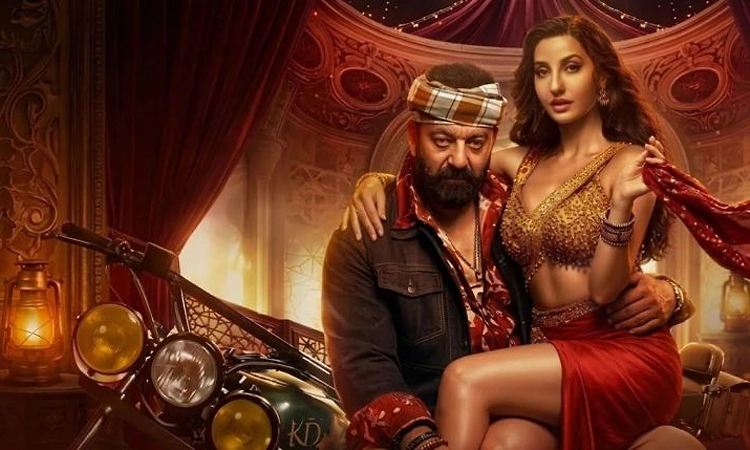
The controversy around a song from KD: The Devil has now taken a serious turn, moving beyond social media outrage into official action. Sanjay Dutt appeared before the National Commission for Women (NCW) on April 27 after being summoned over objections raised against the song Sarke Chunar Teri Sarke. The issue, which started as online backlash, has now become a wider conversation about content boundaries in mainstream cinema.
The song, featuring Nora Fatehi alongside Sanjay Dutt, has been criticised for its suggestive lyrics and choreography. According to reports, Sanjay attended the hearing with his legal team and offered an apology, stating that he was not fully aware of the lyrical context when the song was recorded. His lawyer also mentioned that the actor, as a gesture of goodwill, has voluntarily offered to support the education of 50 children from tribal communities.
The NCW had earlier taken suo motu cognisance of the issue, stating that the content appeared “sexually suggestive and objectionable,” and could potentially violate provisions under laws like the Bharatiya Nyaya Sanhita, the IT Act, and even the POCSO Act. That kind of language from a statutory body indicates the seriousness with which the matter is being viewed.
At the centre of the controversy is the song’s structure itself. The opening lines reportedly use double entendre in a way that many viewers found uncomfortable, with imagery that initially suggests explicit meaning before shifting context later in the verse. While the makers may have intended it as wordplay, the execution didn’t sit well with audiences, especially when combined with choreography that was also labelled as overly suggestive.
The backlash wasn’t limited to viewers alone. Politicians and public figures also weighed in, amplifying the debate around how far mainstream films can push boundaries under the label of entertainment. In response to the growing criticism, the lyrical video of the song has already been taken down from YouTube across multiple languages, including Hindi, Tamil, Telugu, Malayalam, and Kannada.
Interestingly, Nora Fatehi had earlier distanced herself from the content, stating that she did not endorse the final version of the song. She even acknowledged that the backlash played a role in the video being removed, which shows how quickly public pressure can influence decisions in the industry today.
The film itself, KD: The Devil, directed by Prem, is a pan-India project that has been generating buzz for its scale and cast. However, this controversy has somewhat overshadowed its promotional momentum, shifting focus from the film to the debate around its content.
What this situation highlights is a larger shift in audience sensitivity and accountability. Content that might have been brushed off earlier is now being questioned more actively, both by viewers and regulatory bodies. For filmmakers, this creates a tricky balance — between creative expression and social responsibility.
At this point, the issue may not be fully closed, but Sanjay Dutt’s appearance and apology mark a significant step in how such controversies are being addressed. Whether this leads to stricter scrutiny for similar content in the future remains to be seen, but it has definitely sparked a conversation that the industry can’t ignore anymore.