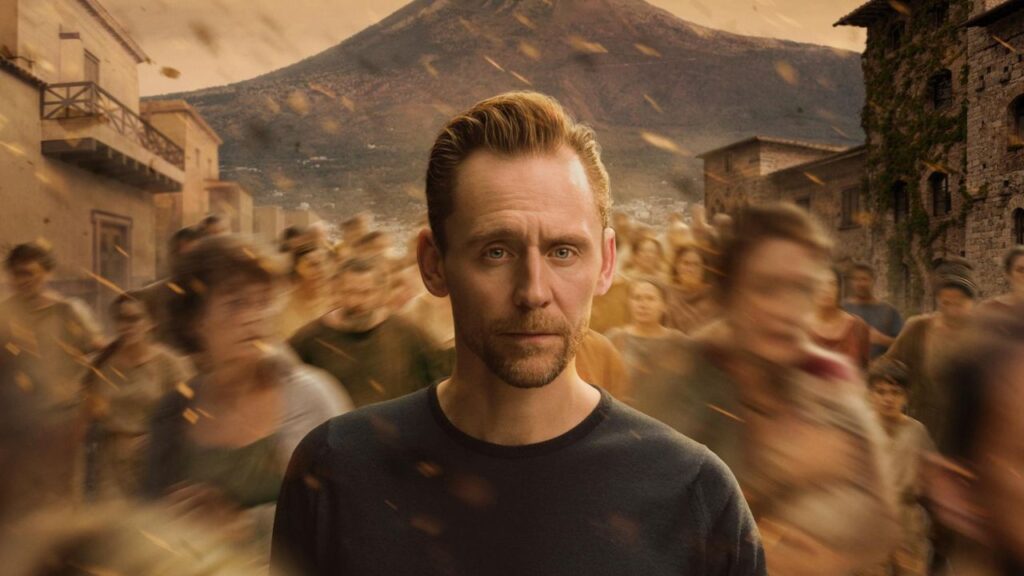
Tom Hiddleston is taking audiences back nearly 2,000 years for a very different kind of time-travel story. The Loki star is leading Pompeii: Out of Time, a three-part National Geographic docudrama that revisits the final hours of Pompeii before and during the eruption of Mount Vesuvius. Rather than treating the ancient city purely as a frozen image of disaster, the series investigates the people who lived there, the choices they faced and the possibility that some victims had a genuine opportunity to escape.
The project also reunites Hiddleston with Kevin R. Wright, the executive producer of Loki. Produced by Plimsoll Productions, the series combines scripted sequences with investigative documentary storytelling, bringing together archaeologists, historians, geologists and disaster experts to reconstruct what may have happened as the catastrophe unfolded. National Geographic describes Hiddleston as a “time detective,” with the actor following evidence to piece together the stories of real people caught in the shadow of Vesuvius.
The approach gives Pompeii: Out of Time a more personal focus than a conventional historical documentary. Instead of simply asking how the city was destroyed, the series asks who recognized the warning signs, who decided to stay, who attempted to flee and what ultimately determined whether someone survived.
Tom Hiddleston Brings His Love Of History
Hiddleston’s connection with the subject goes beyond simply hosting the series. The actor has spoken openly about his lifelong fascination with the ancient world, making Pompeii a particularly personal project for him. In the statement supplied with the original report, Hiddleston described his attraction to classical history and explained why visiting Pompeii can make the enormous distance between the modern world and ancient Rome feel surprisingly small.
“The ancient world has compelled my imagination and curiosity for as long as I can remember: I’ve been fascinated by it all my life. Classical Antiquity is the foundation and cornerstone of Western and European culture. To visit Pompeii is to feel the distance of the 2,000 years between now and then compress. The past becomes the present; the past feels so close. Tangible, honest and real. Our relationship with the past is alive – studying who we were in order to understand who we are. Pompeii is a gateway for that conversation.”
That interest is also reflected in the way the series approaches the historical evidence. National Geographic’s own interview with Hiddleston revealed that one of the actor’s biggest surprises during production was discovering how much more time some Pompeii residents may have had to react to the eruption than he had previously assumed. Evidence also points toward survivors fleeing the disaster and becoming refugees in the aftermath, adding another dimension to a story that is often remembered primarily through the people who died.
Hiddleston has also described hosting the project as a privilege, particularly because it allows the series to focus on ordinary people rather than reducing Pompeii’s final hours to a single catastrophic moment.
“It’s a privilege to host this visually immersive and dynamic series. Pompeii is often remembered for how its story ended. But by looking closer, we can uncover the details of people’s lives, the choices they made, and the moments that came before the city was buried. To revisit the final hours of those ordinary people, caught in an extraordinary moment, and to help bring these remarkable human stories back into the light, is a genuine honor.”
Pompeii Becomes A Race Against Time
The central idea behind the series is simple but surprisingly powerful: could more people have survived Pompeii? The National Geographic investigation follows several reconstructed human stories while using archaeological evidence to examine how people responded as the danger became impossible to ignore. The official episode descriptions identify individuals including a teenager, a businesswoman and a soldier, each facing different decisions as the eruption develops.
The first episode, “Tremors,” examines the warning signs before the disaster reaches its most destructive phase. The second, “Eruption,” moves into the chaos of the volcanic event and asks who chooses to flee and who stays behind. The final episode, “Survival,” looks at the aftermath and what the evidence reveals about the fate of those who lived through the catastrophe.
That structure allows the series to build tension almost like a thriller while remaining rooted in archaeological investigation. Hiddleston effectively becomes the audience’s guide, moving between reconstructed scenes and conversations with specialists who can explain what the physical evidence tells us. The result is designed to make Pompeii feel less like a distant historical event and more like a human emergency unfolding in real time.
There is also a modern relevance to the story. National Geographic’s reporting around the series highlights how the experience of Pompeii can be viewed through the lens of modern natural disasters, particularly the way communities respond to sudden danger and how survivors cope after losing homes and livelihoods. That connection gives the project a contemporary emotional layer without changing its focus on ancient Rome.
When And Where To Watch Pompeii: Out Of Time
Pompeii: Out of Time premiered on National Geographic on July 22, 2026, before becoming available for streaming on Disney+ and Hulu on July 23 in markets where those services are offered. The three-part project was produced by Plimsoll Productions, with Tom Barbor-Might serving as showrunner and director. Kevin R. Wright is among the executive producers, alongside Grant Mansfield, Helen Flint and Alan Eyres.
The series is also notable because it reunites Hiddleston and Wright after their work together on Loki. However, this project is far removed from the Marvel Cinematic Universe, even though its storytelling approach borrows an idea that Hiddleston is naturally associated with: moving through time to understand events from another perspective.
For viewers who know Pompeii mainly through the iconic images of bodies preserved by volcanic material and buildings buried under ash, the series offers a different entry point. Its focus is not simply the moment Vesuvius erupted, but the hours surrounding it and the human decisions that may have shaped who escaped and who did not.
Pompeii: Out Of Time FAQs
What is Pompeii: Out of Time about?
Pompeii: Out of Time is a three-part National Geographic docudrama investigating the final hours of Pompeii before and during the eruption of Mount Vesuvius. It combines scripted storytelling with archaeological and scientific investigation.
Who hosts Pompeii: Out of Time?
Tom Hiddleston hosts the series and serves as its central guide, working with archaeologists, historians, geologists and disaster experts.
Is Pompeii: Out of Time connected to Loki?
Not as a story, but the project reunites Tom Hiddleston with Loki executive producer Kevin R. Wright. The two collaborate again on this historical documentary project.
What does the series reveal about Pompeii’s survivors?
The investigation explores evidence suggesting that not everyone caught in the disaster was immediately doomed. Some residents had time to make choices, while others escaped and became refugees after the eruption.
How many episodes does Pompeii: Out of Time have?
The National Geographic project consists of three episodes titled “Tremors,” “Eruption” and “Survival.”
Where can viewers watch Pompeii: Out of Time?
The series premiered on National Geographic and is available for streaming on Disney+ and Hulu, depending on regional availability.
Tom Hiddleston’s Pompeii project ultimately works because it asks a more compelling question than simply what destroyed the ancient city. It asks what people did when they realized something was terribly wrong, and whether different decisions could have changed their fate. By putting those choices at the centre of the story, Pompeii: Out of Time turns one of history’s most famous disasters into a much more intimate story about survival, fear and human behaviour.