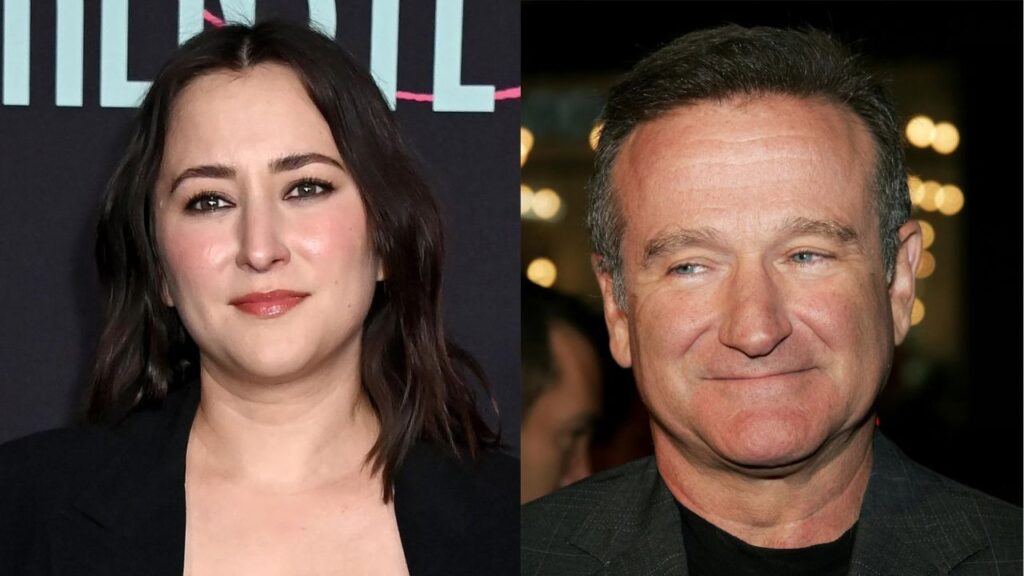
Robin Williams has been gone for more than a decade, yet his voice, expressions and unmistakable screen presence continue to circulate across social media in ways his family never authorised. That problem has become increasingly personal for his daughter Zelda Williams, who has once again spoken out after an AI-generated video falsely presented her father discussing conspiracy theories. Zelda said the clip was obviously artificial and criticised both the quality of the imitation and the decision to use a deceased person’s likeness to strengthen an argument online. Her latest response continues a campaign that has grown alongside advances in generative AI, with the Williams family increasingly focused on separating authentic memories of Robin from manufactured versions of him.
The video reportedly circulated as though it were a private recording featuring the late actor. Rather than simply dismissing it as another poor deepfake, Zelda questioned why anyone claiming to admire her father would participate in spreading content that puts words into his mouth. Robin Williams died in August 2014 at age 63, but the continued popularity of films such as Mrs. Doubtfire, Jumanji, Good Will Hunting, Dead Poets Society and Aladdin means his image remains instantly recognisable to multiple generations. That enduring familiarity also makes him particularly vulnerable to artificial recreations capable of reaching audiences who may not immediately recognise what is genuine.
Zelda says the viral Robin Williams clip is fake
Zelda addressed the latest video directly in a social media post on September 21, saying there should have been little doubt that the recording was manufactured. She wrote, “That supposedly ‘private video’ of dad that I’ve been shown talking about conspiracies is clearly AI, and not even particularly convincing AI. Anyone who claims to be a fan who believes it clearly listened to his movies on mute because that voice is robotic and terrible. That said, a human made a robot create it, and to you I say: leave him out of your delusional bullshit and let him rest.” Her criticism was aimed not only at the technology but also at the person who deliberately instructed a system to make Robin appear to say something he never said.
That distinction sits at the heart of Zelda’s argument. An AI system may produce the finished video, but a person still decides to generate it, distribute it and present it in a way that may persuade others. She questioned the contradiction of using fabricated media to make claims about manipulation, effectively arguing that the creator was relying on the very practice they were supposedly trying to expose. For Zelda, the issue therefore extends beyond whether the voice sounds convincing enough to fool viewers; it concerns the ability to assign opinions, emotions and statements to someone who can no longer approve, challenge or reject them.
Her reaction also highlights how quickly modern deepfake technology has moved beyond novelty impersonations. Artificially generated voices and faces can now be attached to political arguments, advertisements, scams, fabricated interviews and conspiracy content, making celebrity likenesses valuable raw material for people seeking attention or credibility. Robin Williams’ case is particularly sensitive because a fabricated clip can exploit both the emotional connection fans have with him and his reputation as an unusually expressive performer. Zelda has repeatedly argued that technological capability does not automatically make this kind of recreation respectful or acceptable.
This is not Zelda Williams’ first warning about AI
The latest controversy follows an even broader statement Zelda made in October 2025, when she asked people to stop sending her AI-generated videos of her father. At the time, she made clear that she did not consider the clips touching tributes simply because they recreated someone fans missed. “Please, just stop sending me AI videos of Dad,” she wrote, before saying she neither wanted nor appreciated receiving them. She also criticised the broader trend of reducing real performers to digital approximations that merely resemble their faces and voices.
Her concerns stretch back even further. During the Hollywood labour disputes of 2023, Zelda publicly described the use of AI to recreate performers such as her father as personally disturbing, particularly because deceased artists cannot consent to new performances being generated in their names. Her position has remained remarkably consistent as the technology has improved: she does not see a synthetic Robin Williams performance as a continuation of his art. Instead, she views it as something assembled from a body of work and a human identity that already existed.
That argument has become increasingly relevant across the entertainment industry. Generative AI can reproduce facial movements, vocal qualities and styles with increasing realism, but those capabilities raise questions that cannot be solved simply by making the output more technically convincing. Families and estates must consider who controls a deceased performer’s image, while audiences have to decide whether seeing a familiar star apparently “perform” again is a tribute, imitation or exploitation. Zelda’s objection is unusually direct because she is confronting that debate not as an abstract technology issue but as someone watching algorithms reconstruct her own father.
Robin Williams’ children are protecting his real legacy
The Williams family has responded to the problem with more than criticism. On August 17, 2026, Zelda and her brothers Zak and Cody Williams revived Robin’s official Instagram account after it had remained largely dormant since his death. The siblings said they wanted the account to become a “safe, trusted place” where fans could find genuine photographs, stories, videos and memories that represent Robin with “authenticity, warmth, and care.”
Zelda later explained that giving fans access to authentic material was one way the family could counter what she described as “rampant AI abuse” of Robin’s voice and likeness. Instead of attempting to recreate him digitally, the account gives new audiences access to material that actually came from his life and career. It is a notable approach because it treats authenticity itself as a defence against deepfakes: the more clearly genuine material is identified and preserved, the easier it may become for audiences to question suspicious clips circulating elsewhere.
The timing was also symbolic. Robin would have turned 75 in July 2026, and his children said they were grateful that younger generations were continuing to discover his work while longtime admirers still celebrated the joy he brought to audiences. That legacy includes not only his rapid-fire comic improvisation but performances ranging from the tenderness of Good Will Hunting to the inspirational energy of Dead Poets Society and the family comedy of Mrs. Doubtfire. Preserving those performances may ultimately matter more to his family than generating new material that merely imitates how he looked or sounded.
Zelda’s latest statement makes clear that this is unlikely to be the last time the Williams family has to confront synthetic versions of Robin online. As AI-generated video becomes easier to create, the challenge is shifting from whether convincing deepfakes can be produced to whether audiences can reliably recognise when they are watching one. For Robin’s children, the answer is not to digitally extend his career after death but to keep pointing people back toward the enormous body of authentic work he already left behind. Their message is becoming increasingly simple: remembering Robin Williams does not require making him say things he never said.
Q&A
What AI video of Robin Williams did Zelda Williams criticise?
Zelda said she had been shown a supposedly private video in which her father appeared to discuss conspiracy theories. She stated that the footage was AI-generated and criticised its artificial-sounding voice. She also objected to the broader idea of using Robin’s likeness to give credibility to a message he never delivered. No evidence indicates that the video represented an authentic recording of Robin Williams.
Why does Zelda Williams oppose AI recreations of her father?
Zelda has repeatedly argued that her father cannot consent to being digitally recreated or made to perform new material. She believes AI videos reduce the lives and artistic work of real people to synthetic imitations that only approximate their appearance and voice. Her criticism is therefore about both personal respect and the wider treatment of artists’ identities. She has been publicly raising these concerns since at least 2023.
Has Zelda Williams spoken about Robin Williams AI videos before?
Yes. In October 2025, she specifically asked fans to stop sending her AI-generated videos featuring her father. She said she did not want to see them and rejected the idea that she would appreciate them as tributes. Her September 2026 comments continue the same position rather than representing a sudden objection.
Why was Robin Williams’ Instagram account reactivated?
His children Zak, Zelda and Cody revived the account in August 2026 to create an official place for authentic material connected with Robin’s life and career. They said they wanted photographs, memories, videos and stories shared there to reflect his legacy with care and authenticity. Zelda also connected the decision directly to the rise of AI-generated misuse of his likeness and voice. The account had previously been largely inactive since 2014.
When did Robin Williams die?
Robin Williams died on August 11, 2014, at the age of 63. His death came after a career spanning stand-up comedy, television, animation and films that made him one of Hollywood’s most recognisable performers. His work continues to attract younger viewers more than a decade later. That continuing popularity is one reason his family remains actively involved in protecting how his image is used.
What does the Robin Williams AI controversy mean for Hollywood?
The controversy reflects a larger debate over whether deceased performers should be digitally recreated without their prior consent or family approval. AI makes it increasingly easy to imitate famous voices and faces, but technical realism does not resolve questions of ownership, ethics or authenticity. Families and estates may therefore have to become more active in identifying authorised material as synthetic content becomes more widespread. Zelda Williams’ repeated objections provide a very personal example of that broader industry problem.