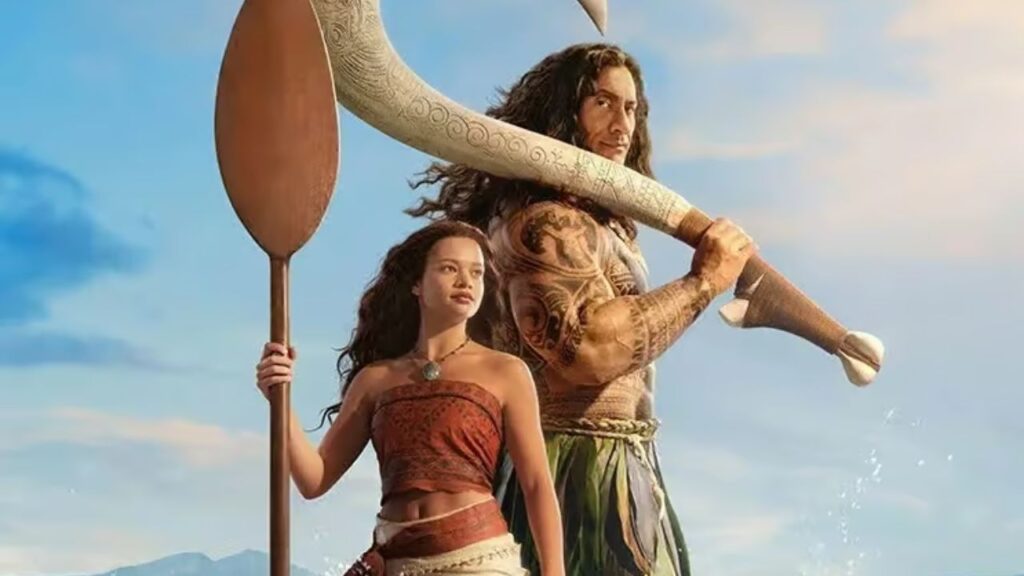
Dwayne Johnson is not ready to let the disappointing theatrical response to Disney’s live-action Moana define the movie. The actor, who returns as the demigod Maui, has acknowledged the criticism surrounding the remake while making it clear that he remains proud of what the film represents. For Johnson, the conversation goes beyond opening-weekend numbers and critics’ scores, particularly because of the movie’s connection to Polynesian culture and representation.
The response to Moana has certainly been complicated. Critics have been largely unimpressed, while audiences have been considerably more receptive, creating a noticeable gap between professional reviews and general moviegoers. Rotten Tomatoes currently lists the film at 31% from critics but 89% from verified audience ratings, while Metacritic has it at 42 from critics.
Dwayne Johnson Says the Reaction Changed
Johnson discussed the film’s reception in a new interview with People, recalling that the first reviews gave him reason to feel optimistic before the critical response shifted. He said he and his wife, Lauren Hashian, also spent time talking about the reaction privately after the film arrived in cinemas.
“Our first two reviews came out. I’ll never forget it. They were amazing. I was like, ‘Wow.’ [Then] it went another way, as sometimes happens. That’s just the way it goes because we’re in this business. My wife and I had a lot of these conversations at home, at the kitchen island late at night when the babies are asleep,” Johnson said.
Rather than allowing the initial critical response to become the entire story, Johnson said he was trying to look further ahead. “The challenge was, ‘OK, let’s remember, though, what’s going to be beyond this opening weekend. Let’s remember what’s happening right now and the noise that’s happening right now. If you love it, great. If you don’t, no problem,” the actor said.
That attitude is significant because Moana arrived with enormous expectations. The original 2016 animated movie became one of Disney’s most recognizable modern properties, while Moana 2 crossed the $1 billion mark worldwide in 2024. The live-action remake therefore had to compete not only with the affection audiences have for the first movie, but also with a story that remains relatively fresh in popular culture.
Critics Rejected It, Audiences Were Kinder
The critical response has been the biggest problem for the remake. Rotten Tomatoes currently gives the film a 31% Tomatometer score from 190 reviews, with the site’s consensus arguing that the new version ultimately reinforces the strengths of the animated original rather than replacing it. At the same time, its audience score is much healthier at 89%, showing that viewers who actually watched the film have responded considerably more positively than critics.
Metacritic paints a similar picture from the critics’ side, with a 42 score based on 40 reviews. That places the film in the site’s “Mixed or Average” category, although audience reactions have been less severe. The difference between the two groups is important because it suggests the remake has found some value with families and fans even though professional reviewers have largely questioned the need for another version of the same story.
Some critics have also been more sympathetic to the film. The source material quotes Owen Gleiberman as saying, “The remake of ‘Moana’ can’t, and shouldn’t, replace the original. But it earns a place alongside it.” That perspective captures the central challenge facing the movie: it does not necessarily have to erase the 2016 version, but audiences still need a compelling reason to experience a story they already know.
That problem has become increasingly common with Disney’s live-action strategy. Unlike older animated classics that had decades to build nostalgia before being remade, Moana is still a comparatively recent property. The animated original remains highly visible on Disney+, and its sequel arrived only two years before the live-action version. Variety’s box-office analysis noted that Disney’s remake strategy depends heavily on whether audiences perceive a new adaptation as an event or simply as a duplicate of something they already have access to.
The Box Office Has Become the Bigger Problem
The theatrical numbers make the situation harder for Disney to ignore. Moana opened to approximately $43 million in North America and $95 million worldwide, a disappointing start for a production with a reported $250 million budget and around $120 million in marketing costs. Variety’s analysis estimated that the movie would need roughly $600 million at the global box office just to reach theatrical break-even, because cinemas keep a significant share of ticket revenue.
The film has since reached roughly $263 million worldwide, according to People, but that remains a long way from what would normally be expected from a major Disney franchise with such a large production and marketing investment. The comparison with the 2016 animated Moana is even more revealing, because that original finished its theatrical run with approximately $687 million worldwide.
Disney CEO Josh D’Amaro has also acknowledged that the theatrical results for the live-action Moana were below expectations. According to Variety, he pointed out that even when franchise movies such as the live-action Moana and The Mandalorian and Grogu do not reach the studio’s box-office expectations, they can still generate value elsewhere across Disney’s business.
That broader perspective matters for a company like Disney. A franchise is not judged only by cinema ticket sales because its characters can support merchandise, streaming, music, theme-park attractions and future productions. Variety noted that Moana has generated more than 22 million toy sales since 2016, while its music has accumulated billions of streams, giving the property commercial value that extends far beyond a single theatrical release.
Why Johnson Still Takes Pride in Moana
For Johnson, there is another reason the live-action film matters. The actor has a personal connection to Polynesian heritage through his Samoan background, and the remake gave him another opportunity to bring Maui to a new generation while working alongside Catherine Laga’aia, who plays Moana.
Johnson and Laga’aia have previously spoken about the importance of representation in the film. Laga’aia has described growing up with the 2016 movie and understanding what it meant for audiences who had not often seen Polynesian culture represented this prominently in a major Hollywood production.
Johnson’s wife, Lauren Hashian, has also spoken about the cultural side of the project, while Johnson has emphasized that the film allowed Polynesian culture to be placed at the centre of a major Disney production. That perspective helps explain why the actor’s reaction to the box-office disappointment is different from simply defending a commercial result.
There is also a growing sense that the live-action Moana’s theatrical performance should be viewed separately from the long-term value of the franchise. Disney’s own strategy increasingly treats major properties as ecosystems rather than single movies, and Moana remains one of the studio’s most valuable modern animated brands. The disappointing remake may therefore be a setback for the live-action experiment without necessarily damaging the larger franchise.
The bigger lesson for Disney may instead be about timing. The original Moana remains popular, Moana 2 arrived recently and the live-action remake closely follows both films. Variety’s analysis suggested that the studio may need to create more distance between versions of the same property, particularly when audiences already have easy access to the original.
For Johnson, though, the response does not appear to erase what he believes the movie accomplished. The film may have fallen short of Disney’s theatrical expectations, and critics may have preferred the animated original, but its stronger audience response and cultural significance give the actor reasons to remain proud of it. In an industry where box-office numbers can quickly become the entire conversation, Johnson is choosing to measure Moana by something beyond its opening weekend.
Moana Live-Action Q&A
Why is Dwayne Johnson defending Moana?
Dwayne Johnson has defended the film because he remains proud of what it represents, particularly its connection to Polynesian culture and representation. He has acknowledged that the critical response changed after the first reviews but said that this is part of working in the film industry.
How did critics review the live-action Moana?
The film has received a largely negative critical response. Rotten Tomatoes currently gives it a 31% Tomatometer score, while Metacritic lists a score of 42.
Did audiences like the live-action Moana?
Audience reactions have been considerably more positive than critics’ reviews. Rotten Tomatoes currently lists an 89% verified audience score, creating a large gap between professional reviews and viewer response.
How much has the live-action Moana made worldwide?
People reports that the movie has earned around $263 million worldwide. That remains well below the level needed to justify its large production and marketing costs theatrically.
How much did the original Moana make?
The 2016 animated Moana earned approximately $687 million worldwide during its original theatrical run. The live-action remake has therefore performed substantially below its predecessor at the box office.
Who plays Moana and Maui in the live-action remake?
Catherine Laga’aia plays Moana, while Dwayne Johnson reprises the role of Maui. Thomas Kail directed the live-action adaptation.