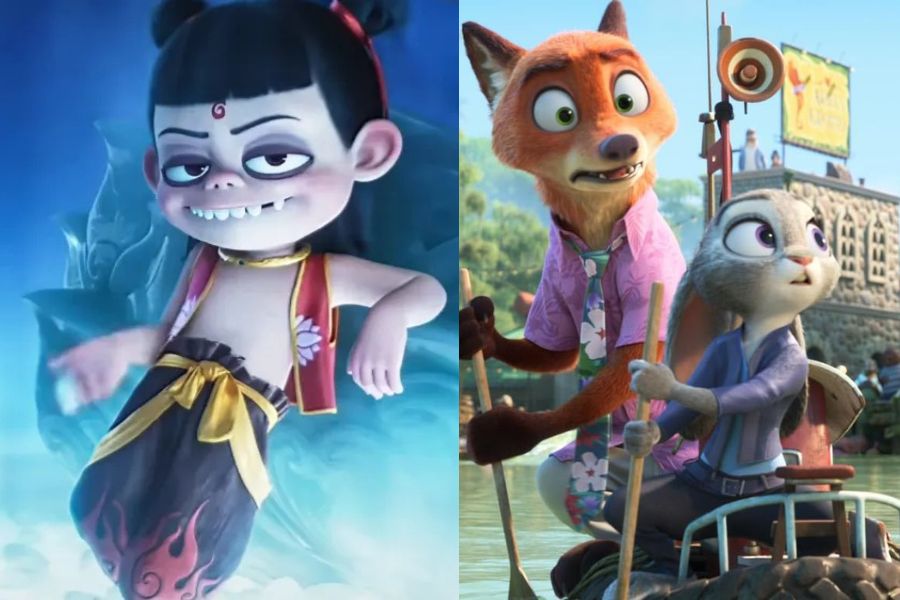
China’s theatrical market staged a strong comeback in 2025 — and animation did most of the heavy lifting. After a bruising 2024, the country’s box office rebounded sharply, with annual ticket revenue climbing 20% year-on-year to $7.41 billion (¥51.83 billion), signalling renewed audience confidence and a shifting taste in what drives crowds back to cinemas.
Animation dominates the recovery
The standout story of the year was the overwhelming impact of animated films. According to industry data, 57 animated titles generated $3.57 billion, accounting for nearly half of China’s total box office — an extraordinary share for a single genre.
Two animated juggernauts defined the year. Domestic sequel Ne Zha 2 shattered records during the Lunar New Year window, pulling in a staggering $2.13 billion, while Disney’s Zootopia 2 closed the year on a high note with $558.3 million. Both films benefited from unusually high repeat viewership, a sign of deep fan engagement rather than one-off curiosity.
Other animated successes included Chinese hit Nobody, which earned roughly $245 million, and Japanese anime release Demon Slayer: Infinity Castle, which crossed $95 million before exiting theatres early amid rising geopolitical tensions between China and Japan.
Local films tighten their grip
Domestic productions continued to strengthen their hold on the market, accounting for nearly 80% of total box office revenue, a slight increase over 2024. Hollywood films and Japanese anime together made up most of the remaining share, though their performance was increasingly selective rather than broad-based.
Attendance figures mirrored the revenue rebound. Total admissions climbed to 1.24 billion, up more than 20% year-on-year. Growth was particularly strong in third- and fourth-tier cities, where suburban and regional markets have now posted three consecutive years of expanding box office share. An influx of first-time and occasional moviegoers helped widen the audience base, allowing major releases to outperform projections during key holiday corridors.
A top-heavy market raises concerns
While blockbusters thrived, the overall market structure grew more uneven. Only four films crossed the ¥3 billion mark, and eight titles topped ¥1 billion, but the middle tier continued to erode. Films earning between ¥100 million and ¥500 million — traditionally a crucial space for emerging filmmakers and sleeper hits — declined yet again, raising questions about long-term creative diversity.
Hollywood: hits and misses
Hollywood’s performance in China remained mixed. Zootopia 2 delivered a clear win, while Avatar: Fire and Ash posted a respectable $136 million. Beyond that, results were uneven.
Superhero franchises struggled noticeably. Several MCU titles posted modest numbers, and even DC’s marquee release Superman underperformed. Analysts suggest that legacy comic-book brands may need reinvention to reconnect with Chinese audiences.
Among studios, Universal’s Jurassic World: Rebirth led with around $79 million, Paramount’s Mission: Impossible — The Final Reckoning followed at $64.5 million, and Warner Bros.’ F1: The Movie emerged as its top performer at approximately $59 million.
Domestic storytelling shifts tone
On the local front, Chinese filmmakers leaned away from grand spectacle and toward grounded, human-scale storytelling. War dramas like Dead to Rights and Evil Unbound, which earned $431 million and $270 million respectively, resonated by focusing on personal stakes and emotional realism rather than mythic heroism.
China’s place in the global picture
Globally, China contributed just under 24% of worldwide box office revenue in 2025, second only to North America at around 29%. The figures reaffirm China’s importance — but also underline how much of its recovery now hinges on a small number of cultural mega-events.
Final words
China’s 2025 box office rebound proves that audiences are still willing to show up — when the right films arrive. Animation has emerged as the most reliable engine of growth, while domestic cinema continues to dominate in share and cultural relevance. The challenge ahead lies in rebuilding the middle of the market, ensuring that the comeback isn’t just powered by a few giants, but by a healthier, more balanced film ecosystem.