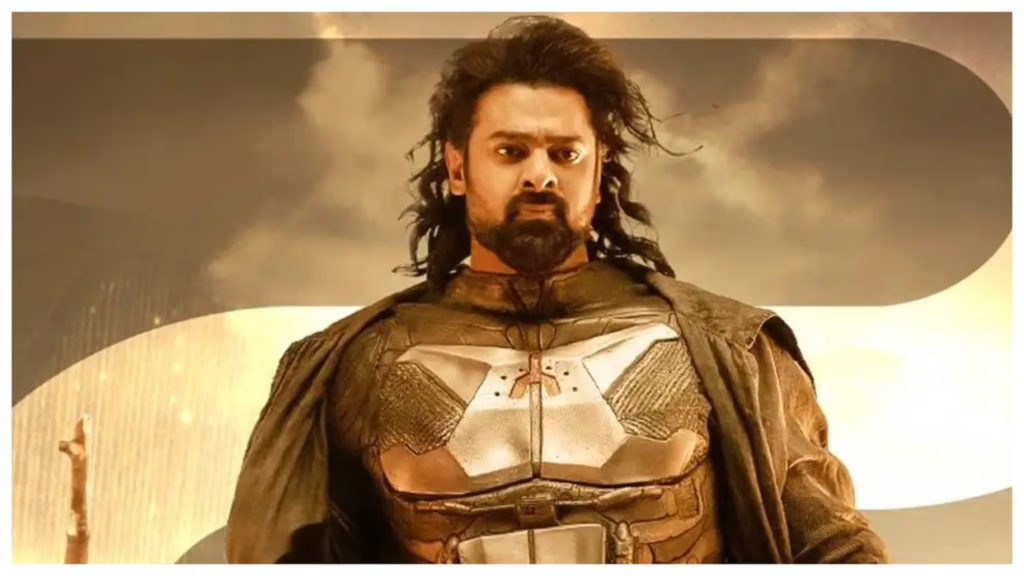
The wait for Kalki 2898 AD Part 2 is becoming clearer—and longer.
Director Nag Ashwin has confirmed that the sequel will move into regular production in October 2026, with the team hoping to finish principal photography by the middle of 2027. More importantly, Ashwin has now indicated that a theatrical release in 2028 is looking increasingly likely, although Vyjayanthi Movies has not formally announced a date.
When asked about a possible 2028 arrival, Ashwin replied, “Looks like 2028, certainly.”
That short answer significantly updates the sequel’s timeline. Rather than rushing Kalki 2 into late 2027, the filmmakers appear prepared to leave substantial room for the effects-heavy post-production that helped define the first movie.
Kalki 2 finally enters its main shooting phase
Although Kalki 2 has technically already started filming, production has so far been limited.
Earlier in September, Ashwin revealed that only around 10 days of shooting had been completed, with the larger schedule waiting on Prabhas’ availability. The director said the production would move into a much longer stretch once the actor’s dates were available.
That hurdle now appears to have been cleared.
Ashwin told India Today, “We’re starting the shoot regularly from next month and, hopefully, it should be done with the shoot by mid next year.”
Current reporting says call sheets for the principal actors are ready and the larger schedule is expected to begin around mid-October. Amitabh Bachchan had already filmed some material earlier while the production waited for Prabhas to become available.
Prabhas, Amitabh Bachchan and Kamal Haasan are expected to return as the sequel continues the conflict established in Kalki 2898 AD.
Why a 2028 release makes more sense now
A mid-2027 filming wrap makes a 2027 theatrical release possible only on an extremely compressed schedule.
Kalki is not the type of production that simply finishes shooting and reaches cinemas a few months later. Its world depends heavily on visual effects, futuristic environments, digital creatures and large-scale action—a technical ambition recognized when the first movie recently won National Film Awards for Best Popular Film Providing Wholesome Entertainment and Best Special Effects.
Ashwin has indicated that extensive post-production will begin after filming wraps, with the final release date to be discussed once production is further along.
That makes 2028 more than a random delay.
If the sequel completes shooting around June or July 2027, even an early-to-mid 2028 release would give the team several additional months for VFX, editing, sound design and finishing work rather than forcing one of India’s biggest science-fiction productions through an unusually short post-production window.
The filmmakers have not announced a specific month or day, so 2028 should still be treated as the current expectation rather than an official release date.
Part 2 has much more story to resolve
The sequel also has considerably more narrative weight after the first film’s final act.
Kalki 2898 AD ended by revealing a deeper connection between Prabhas’ character and Karna, while Kamal Haasan’s Supreme Yaskin emerged in a far more powerful form. Amitabh Bachchan’s Ashwatthama remains central to the mythology surrounding the arrival of Kalki.
That means Part 2 does not need to spend as much time introducing the world of Kasi, the Complex and Shambhala. It can move directly into conflicts that the first film spent nearly three hours setting up.
Ashwin has also spoken about the continuing enthusiasm around the sequel, saying children still approach him two years after the original release asking when Part 2 will arrive. He described the recent National Awards as an additional “energy boost” for the team.
Fans will apparently need to hold onto that enthusiasm a little longer.
The important change is that Kalki 2 now has something it lacked for much of the past two years: a defined production window. Regular filming begins in October, Ashwin wants cameras down by mid-2027, and 2028 is now the clearest release indication the director himself has given.