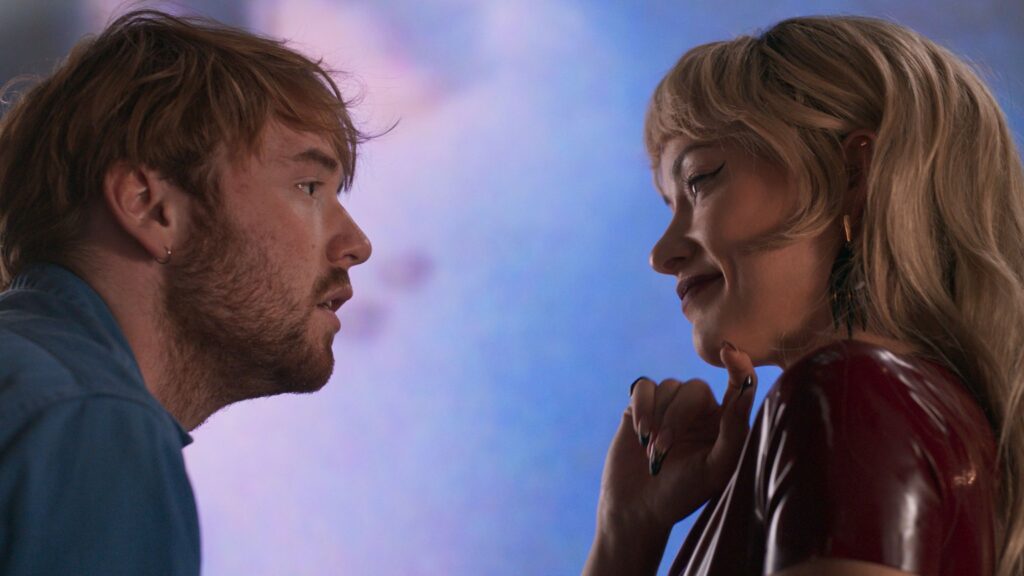
At first glance, I Want Your Sex sounds like it’s ready to push every possible boundary — and to be fair, it does, at least visually. Directed by queer indie provocateur Gregg Araki, the film arrives at the Sundance Film Festival with a provocative title, hyper-sexual energy, and a workplace power dynamic that immediately recalls cult classics like Secretary.
Starring Olivia Wilde and Cooper Hoffman, I Want Your Sex is unapologetically raunchy, deliberately camp, and aggressively sex-positive — but beneath the latex, stilettos, and fluorescent pinks, it turns out to be far more conventional than it wants you to believe.
The Setup: Sex, Power, and an Unusual Boss
Wilde plays Erika Tracy, a domineering contemporary artist whose idea of office attire includes sheer dresses and razor-sharp heels. She’s easily Araki’s most ferocious boss character to date — a Miranda Priestly filtered through BDSM aesthetics.
Enter Elliot, played by Hoffman, her eager, soft-spoken subordinate who quickly discovers that his job description comes with far more than administrative duties. Their relationship is defined by dominance, submission, and consent — but also by an oddly traditional emotional imbalance that sneaks in as the film progresses.
Despite how liberated the film appears about nudity and kink, its emotional dynamics feel surprisingly old-fashioned: she controls everything, he relinquishes agency, and the thrill lies in that surrender — until it doesn’t.
A Murder Tease, Then a Flashback Spiral
The film opens with a darkly comic hook. Elliot stumbles out of Erika’s lavish mansion wearing blood-splattered lingerie, only to discover her floating face-down in a pool. Smash cut to a police interrogation, where Margaret Cho and Johnny Knoxville question him.
Then comes the rewind: “9½ weeks earlier,” splashed in neon pink — a cheeky nod to erotic thrillers of the ’80s and directors like Adrian Lyne. From there, Araki dives headfirst into a candy-coloured, sex-soaked rewind of how Elliot and Erika got here.
Sex as Comedy, Not Threat
Unlike erotic cinema that leans into danger or psychological decay — think David Cronenberg — Araki refuses to make sex ominous. Even when the film features pig masks, ball gags, handcuffs, or humiliation play, it’s played for absurdist comedy rather than dread.
Araki’s philosophy is clear: sex should be joyful, ridiculous, and freeing — not a descent into darkness. It’s a deliberate rejection of the cold, clinical fetish aesthetics seen in mainstream erotic thrillers.
The Art World Satire
Much of the film unfolds inside Erika’s art studio, where assistants churn out grotesque, brightly coloured installations — papier-mâché phalluses, labia-shaped canvases, gum-stuck sculptures. It’s here that Araki slips in his sharpest satire.
“Contemporary art is a scam,” Erika declares. “The real art is convincing people it means something.”
It’s one of the film’s funniest and most self-aware moments — and arguably Araki poking fun at the very art-world elitism that keeps rewarding provocation over substance.
Performances: Camp Carries the Film
Olivia Wilde fully commits to the bit. Her Erika is pure camp — icy, theatrical, predatory, and deliberately exaggerated. She’s not playing realism; she’s playing a persona, daring the audience to laugh with her or recoil.
Hoffman, meanwhile, brings vulnerability and awkward charm. He’s less confident than his breakout role in Licorice Pizza, but that insecurity works here. Elliot’s wide-eyed enthusiasm gradually gives way to emotional confusion — especially when he starts fantasising not about domination, but marriage and stability.
Their chemistry is undeniable, even if the script doesn’t always justify how deeply their desires align.
Supporting Cast and Sexual Fluidity
The film surrounds Elliot with a sexually fluid friend group: a voyeuristic roommate played by Chase Sui Wonders, an unapologetically horny coworker portrayed by Mason Gooding, and a distracted girlfriend played by Charli xcx.
Araki treats sexuality as spectrum and chaos — no labels, no explanations — which aligns with his long-standing filmography and makes Elliot’s “awakening” feel less shocking than inevitable.
What Works / What Doesn’t
What works:
- Araki’s colour-drenched visual style
- Olivia Wilde’s fearless, camp-heavy performance
- A sex-positive tone that avoids moral panic
- Satirical jabs at art-world pretensions
What doesn’t:
- A plot that collapses once the shock wears off
- Emotional dynamics that feel dated beneath the provocation
- A murder mystery framing device that never truly matters
Final Verdict
I Want Your Sex isn’t profound, and it doesn’t pretend to be. Its greatest success lies not in storytelling, but in permission — permission to laugh at sex, to explore it without shame, and to treat kink as play rather than pathology.
Once the novelty fades, the narrative thins out. But that’s beside the point. Gregg Araki isn’t trying to deliver insight — he’s trying to loosen a generation raised on porn yet terrified of intimacy.
As guilt-free escapism? It works.
As social commentary? It’s shallow.
As a campy, unapologetic Sundance oddity? Mission accomplished.
Sometimes, pushing boundaries is the entire point — and Araki pushes them with a grin.