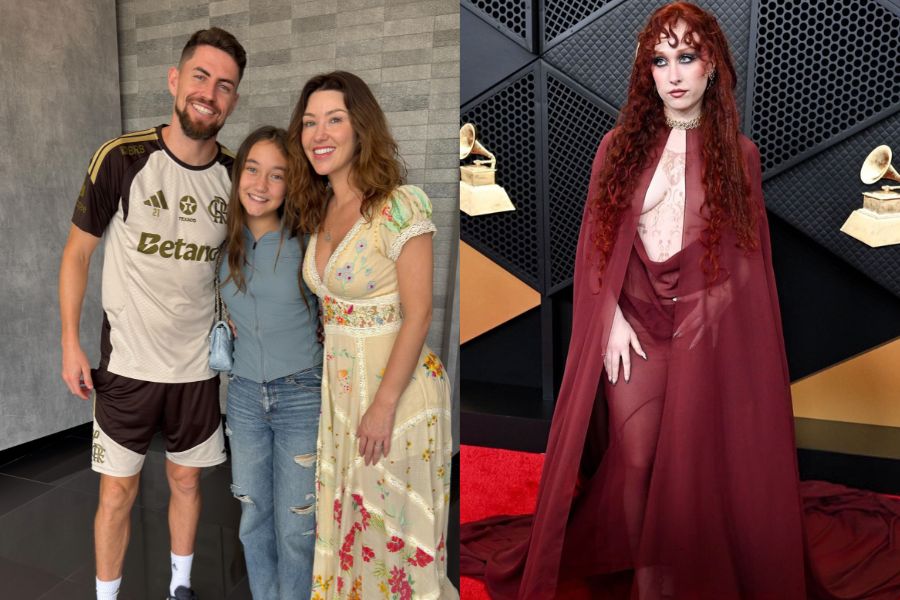
A fresh wave of controversy is surrounding Chappell Roan after a viral video from the mother of a young fan added a new layer to an already heated situation. What initially appeared to be a minor misunderstanding has now turned into a widely discussed debate online, raising questions about celebrity boundaries, fan interactions, and accountability.
At the center of the issue is Catherine Harding, partner of Jorginho Frello, who has now come forward with her own detailed account of an incident that reportedly took place during a breakfast outing at a hotel in São Paulo. Her version of events challenges earlier clarifications from Roan and has sparked a broader conversation across social media.
The controversy first gained traction when Jorginho publicly expressed his disappointment, claiming that his 11-year-old stepdaughter was left in tears after being confronted by a security guard near the singer’s table. His statement quickly went viral, with fans and critics weighing in on what many initially assumed was an overreaction by security.
However, Harding’s recent video has shifted the narrative.
According to her, the incident began in a relatively ordinary way. She and her daughter were having breakfast at the hotel when they noticed someone who looked like Roan seated in a nearby garden area. Like many young fans, her daughter was curious and excited, briefly stepping outside to get a closer look.
Harding insists that the child maintained distance, did not attempt to approach the singer, and made no effort to take photos or interrupt her. After a quick glance, the girl reportedly returned to the table without any interaction.
But what followed, Harding claims, was unexpected and deeply unsettling.
She described how a man—whom she characterized as physically imposing and visibly authoritative—approached their table and began reprimanding them in what she alleges was an aggressive tone. According to Harding, the man accused her daughter of being intrusive and disrespectful, and even suggested that a complaint could be filed with the hotel.
What appeared to upset Harding the most, however, was the personal nature of the remarks.
She claims the man went beyond addressing the situation and criticized her parenting, telling her she should “teach her daughter to be better.” For Harding, this crossed a line from professional security behavior into something far more personal and inappropriate.
In her account, she emphasized that they were paying guests in a public space and that her daughter’s behavior did not amount to harassment. She also noted that her child is familiar with public figures and understands boundaries, suggesting that the situation may have been unnecessarily escalated.
The aftermath of the incident, she revealed, had a lasting emotional impact.
The experience reportedly left her daughter shaken and upset, ultimately leading the family to skip Roan’s concert—an event that had been planned as a birthday celebration. What was meant to be a joyful experience for a young fan instead turned into a disappointing memory.
Harding, however, stopped short of directly accusing Roan herself.
In her statement, she acknowledged that she cannot definitively confirm whether the individual involved was officially part of the singer’s security team. At the same time, she maintained that the man appeared to be associated with Roan, noting that he was “with her” and seemed to be managing the surrounding environment.
This detail is particularly significant because it directly contradicts Roan’s earlier response.
The singer had previously addressed the situation on social media, stating that the individual in question was not part of her personal security team. She also clarified that she was unaware of the interaction at the time and did not instruct anyone to approach the mother and child.
Importantly, Roan did issue an apology, acknowledging that the situation should not have made them feel uncomfortable—even if she was not directly involved.
But with Harding’s video now circulating widely, the conversation has shifted from “what happened” to “who is responsible.”
This kind of situation isn’t new in the entertainment world, but it does highlight an ongoing tension between celebrities and fans in public spaces. On one hand, artists—especially those with rapidly growing global fame like Chappell Roan—require a level of security to maintain safety and privacy. On the other hand, fans often expect a certain degree of accessibility, especially in casual, public settings.
When those expectations clash, even small interactions can quickly escalate.
In this case, the presence of a child adds another emotional dimension. Public reactions have been particularly strong because the incident involves an 11-year-old fan—someone many feel should have been treated with more sensitivity, regardless of the circumstances.
At the same time, others have pointed out that security teams are often tasked with preventing situations from escalating in the first place, sometimes leading to overly cautious or firm responses. Without full clarity on the guard’s role or instructions, it becomes difficult to determine whether the reaction was a misunderstanding, an overstep, or a necessary precaution taken too far.
The controversy has also had ripple effects beyond just online discussions.
Reports suggest that local sentiment in Brazil has been impacted, with conversations emerging around how international artists engage with fans during visits. While no official action has been confirmed, the incident has undeniably influenced public perception—something that can carry long-term implications in an artist’s global journey.
For now, Harding has indicated that she does not wish to escalate the matter further. Her closing remarks in the video suggest a desire for accountability rather than conflict, expressing hope that if Roan was not directly responsible, she would ensure that people around her handle such situations more thoughtfully in the future.
As for Chappell Roan, the situation places her in a delicate position.
Even without direct involvement, public figures are often held accountable for the actions of those perceived to represent them. How she chooses to respond—or whether she addresses the issue again—could play a key role in shaping how this controversy settles.
In the end, what began as a brief encounter at a hotel breakfast has turned into a broader conversation about celebrity culture, fan expectations, and the responsibilities that come with global fame.
And as the story continues to unfold, it’s clear that this isn’t just about one moment—it’s about how those moments are handled, remembered, and understood.