Lee Child has finally explained just how directly he ended Tom Cruise’s run as Jack Reacher. After two theatrical films, the author had a contractual right to stop the series from continuing — and he used it, eventually helping move the character toward the Prime Video format he now describes as a “fabulous luxury.”
Speaking to Collider while promoting his new Reacher novel Chain Reaction, Child revealed that the movie agreement he signed years before the first film included an unusual provision giving him control after two installments.
“I had a clause in that movie contract that after two movies I had a veto whether we would do any more. I exercised that veto,” Child said.
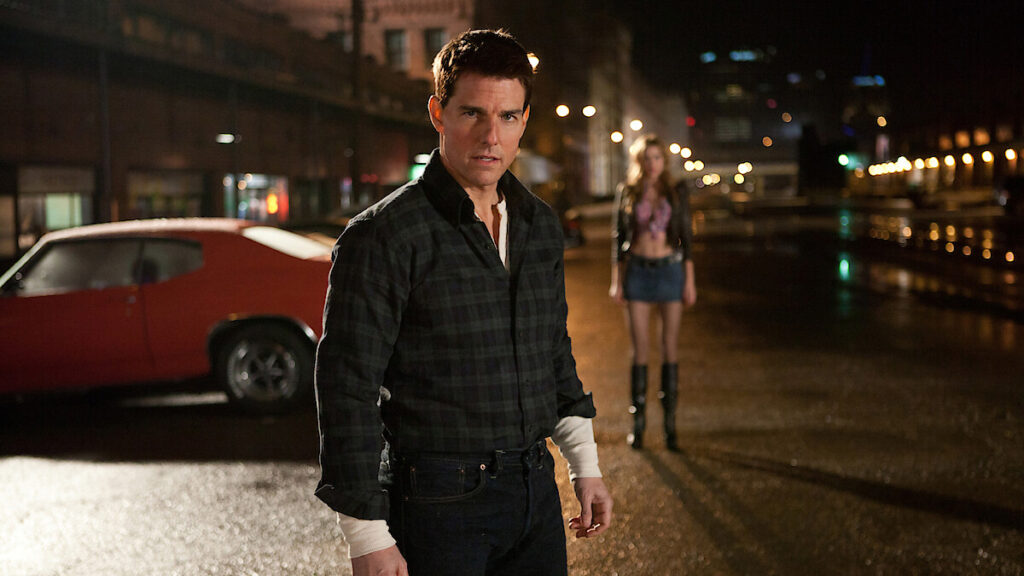
Cruise had played the former military policeman in Christopher McQuarrie’s Jack Reacher in 2012 and Edward Zwick’s Jack Reacher: Never Go Back in 2016. But Child’s decision was more complicated than simply rejecting Cruise or declaring the movies failures.
The Tom Cruise movies were hugely valuable to Lee Child
Child remains remarkably positive about what the Cruise era did for his books.
He recalled that after the first Jack Reacher arrived in December 2012, eight older Reacher paperbacks entered the Top 10 by the following reporting cycle. In Child’s words, that kind of exposure was something an author simply could not buy.
The problem was the disconnect between the films and a section of the readership.
Jack Reacher is famously enormous in Child’s novels — roughly 6-foot-5, broad and physically intimidating. Cruise, despite successfully capturing other parts of the character, was always a dramatically different physical presence. Readers had objected to that casting from the beginning, and Child has since acknowledged that their concerns mattered more to him than he initially expected.
Child said he had originally viewed the movies simply as another interpretation of his books. Readers did not separate the two so easily; in his telling, some felt the films had failed to mirror the character they knew closely enough.
That backlash helped make continuing with a third movie less attractive. But another major change was happening at exactly the same time.
Streaming solved two problems the movies could not
By the time Cruise’s second film had run its course, the television landscape looked very different from when Child’s original film deal was made in 2005.
Broadband had become commonplace, binge-watching had transformed television, and streaming services could devote an entire season rather than two hours to adapting a single novel.
For Child, that changed the mathematics of adaptation.
“The running time—it’s fabulous luxury,” he said, explaining that eight, 10 or even 12 hours allow an adaptation to preserve the quieter moments, humor and details that would otherwise need to be compressed into a feature film.
That may be the clearest explanation for why Prime Video’s Reacher feels different from the Cruise films. Season 1 was able to spend eight episodes adapting Killing Floor, giving the investigation, supporting characters and Reacher himself considerably more breathing room than a theatrical runtime permits.
Child also pointed to a second advantage: casting.
A major feature film often needs a bankable star capable of supporting a large theatrical investment. Child argued that streaming changes that financial equation because the platform itself carries more of the commercial weight, giving producers greater freedom to choose the performer who best fits the character rather than the biggest movie star available.
That opened the door for Alan Ritchson.
Alan Ritchson’s Reacher proved the TV gamble worked
Ritchson debuted as Reacher on Prime Video in 2022 and immediately offered something Cruise physically could not: a version of the character whose sheer size is part of how other people react to him.
Child has since said Ritchson was “born to play Reacher,” while still speaking warmly about his experience working with Cruise and praising the first film as an effective thriller.
Commercially, the decision has also aged extremely well.
Prime Video says Reacher Season 4 attracted 66 million viewers worldwide during its first 28 days, surpassing Season 3 and placing among the service’s five most-viewed seasons of an original series. The franchise has surpassed 200 million viewers globally, and Prime Video has already renewed the show through Season 6.
The universe is growing beyond Reacher himself, too. The Maria Sten-led spinoff Neagley recently earned a second-season renewal after Prime Video says its first season reached 40 million viewers in only 13 days.
So Child’s veto did something unusual: it ended a franchise starring one of the world’s biggest movie stars without ending the franchise itself.
Instead, the decision allowed Reacher to become something larger in another medium. Cruise helped introduce millions of moviegoers to Jack Reacher and dramatically boosted Child’s books. Ritchson’s series then gave the author the thing he felt the movies could never fully provide — enough time and casting freedom to make the character resemble the one already living on the page.