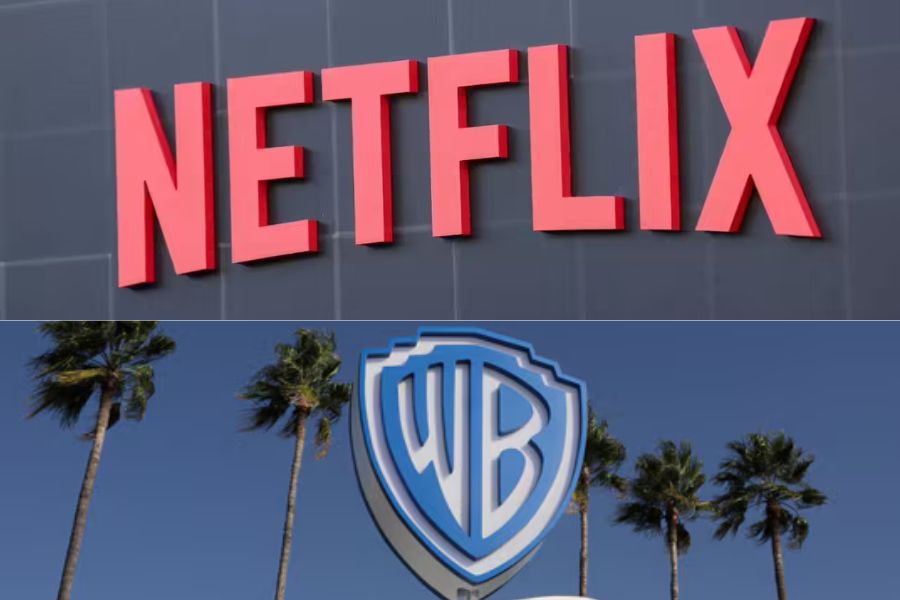
Hollywood woke up to a seismic shift on Friday. Netflix — the company that once mailed DVDs in red envelopes — has now struck an agreement to acquire Warner Bros. in a deal valued at a massive $82.7 billion. The announcement instantly rewired the conversation across studios, Wall Street, and creative circles, marking what many analysts are calling the most disruptive entertainment merger of the decade.
The acquisition, internally codenamed Project Noble, is backed by more than $59 billion in financing secured by Netflix from a consortium of global banks. For a company long known for building its own ecosystem rather than buying others’, the move is nothing short of historic.
A Deal Built on Scale, IP Power, and a New Streaming Strategy
Netflix says the acquisition is meant to “create more choice” for consumers, give the company a chance to optimize its plans, and expand its studio footprint across film and television.
The company expects to achieve $2–3 billion in cost savings annually, improve value for talent and shareholders, and accelerate its global entertainment push.
Importantly, Netflix insists that Warner Bros.’ existing operations — including theatrical releases — would continue. But specifics remain thin, and this is exactly where much of the industry’s anxiety is focused.
The deal includes a $5.8 billion breakup fee, meaning that even if regulators halt the acquisition, Warner Bros. Discovery (WBD) still walks away with billions in cash.
A Pitch to Creators: “More Stories, Bigger Worlds, Wider Reach”
Netflix framed the merger not just as a business move but as an invitation to filmmakers.
In its statement, the company highlighted the potential of pairing Netflix’s global subscriber base with Warner Bros.’ iconic libraries — from DC Comics to Harry Potter, Lord of the Rings, HBO originals, and legacy classics.
The goal, Netflix says, is to create “greater value for talent,” opening doors to work with beloved IP while reaching audiences far beyond traditional borders.
For WBD shareholders, the payout includes $23.25 in cash and $4.50 in Netflix stock per share. Meanwhile, the company’s linear networks — including CNN, TNT, HGTV, and Discovery+ — are still on track to be spun off by Q3 2026.
Sarandos & Peters Explain Why Netflix Is Becoming a Buyer
Netflix co-CEO Ted Sarandos, acknowledging widespread surprise, told analysts that this moment is an evolution of everything the company has built.
“We started as a DVD-by-mail company, then streaming, then originals, then global expansion,” he said. “To keep entertaining the world, we cannot stand still.”
Co-CEO Greg Peters echoed the ambition, saying Warner Bros.’ century-old legacy and creative infrastructure would accelerate Netflix’s growth “for decades to come.”
What Warner Bros. Gains: Cash, Stability, and a Lifeline
WBD CEO David Zaslav positioned the move as a continuation of Warner Bros.’ storytelling legacy. He emphasized that combining the two studios ensures “audiences everywhere will continue to enjoy the world’s most resonant stories.”
Analysts say WBD gets much-needed stability. The company’s heavy debt load, volatile streaming revenue, and the rapidly shrinking cable ecosystem have kept pressure high. This deal provides billions in liquidity — enough to fund “more than 20 Superman-scale blockbusters,” as Bernstein analyst Laurent Yoon noted.
Why Analysts Think This Deal Was Inevitable
Industry watchers have been forecasting a major studio collapse for years. Netflix’s offer simply arrived first — and highest.
Analysts point out:
- Mid-sized traditional studios can no longer match Netflix’s global economics.
- Streaming requires nonstop content flow; Netflix releases far more new titles than any competitor.
- Warner Bros.’ biggest assets — DC, LOTR, Harry Potter, HBO — are priceless to Netflix’s long-term growth.
- If Netflix didn’t step in, other tech giants or studio groups would have.
Bank of America’s Jessica Reif Ehrlich argued that Netflix acquiring WBD effectively knocks Paramount Skydance and NBCUniversal out of long-term viability.
Fears Inside Hollywood: Theatrical Future, Competition, Regulation
Not everyone is celebrating.
The theater owners’ group Cinema United issued a sharp warning, calling the acquisition “an unprecedented threat” to movie exhibition. They argue Netflix’s model has historically minimized theatrical windows and could weaken cinemas worldwide.
The Directors Guild also voiced “significant concerns,” particularly around consolidation, bargaining power, and long-term creative freedom.
Regulatory scrutiny is expected to be intense. The merger would make Netflix not just the dominant global streamer, but one of the most powerful content owners in Hollywood history.
A New Era Begins — Even If the Road Is Rough
Whether the merger sails through or becomes a battleground in Washington and Brussels, one thing is clear: the entertainment industry has entered a new chapter.
Netflix, long crowned the winner of the “streaming wars,” now prepares to become a full-fledged studio titan — inheriting Warner Bros.’ franchises, creative engines, production capabilities, and cultural legacy.
If the deal is approved, Hollywood could be reshaped in ways more dramatic than the Disney–Fox merger. And for audiences, it could spark a new era of global storytelling — one where the biggest narratives, universes, and franchises live under one unprecedented umbrella.
Whatever happens next, the ripple effects of this megadeal will be felt for years.