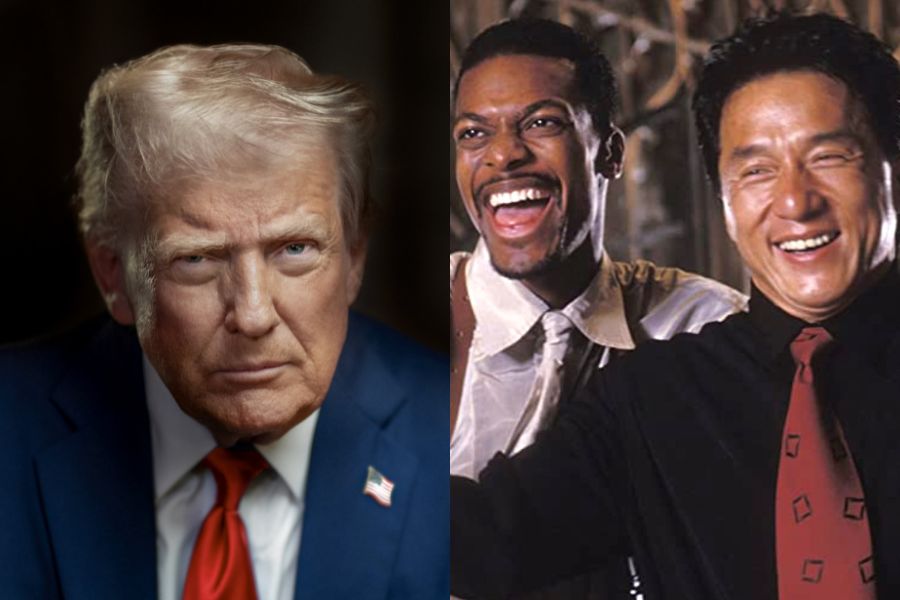
In a twist straight out of a Hollywood pitch meeting, former U.S. President Donald Trump is reportedly pushing for a revival of the Rush Hour franchise — nearly three decades after Jackie Chan and Chris Tucker first teamed up as one of cinema’s most iconic buddy-cop duos. According to American outlet Semafor, Trump has been personally urging his friend and Paramount owner Larry Ellison to get the long-dormant project off the ground.
Why Trump Suddenly Wants ‘Rush Hour’ Back
The original Rush Hour (1998) was a worldwide hit, blending Jackie Chan’s martial-arts genius with Chris Tucker’s high-energy comedy. But after Rush Hour 3 received lukewarm reception in 2007, the franchise quietly faded into the background.
So why revisit it now?
Political analysts believe Trump’s interest goes deeper than nostalgia. According to Semafor’s report, Trump has been offering creative input to Ellison — suggesting an effort to revive the loud, action-heavy, “pre-woke” Hollywood of the late ’80s and ’90s, the era he often praises. Films from that time, especially those with bold humour and swaggering masculinity, align strongly with Trump’s cultural taste and political messaging.
A Cultural Play, Not Just a Movie Pitch
Insiders say Trump’s push appears to be part of a broader cultural strategy. The Rush Hour franchise, built on high-voltage action and racial humour, predates today’s conversations about representation and sensitivity in mainstream media. To his critics, Trump’s push signals an attempt to re-center the kind of reckless, stereotype-driven comedy that defined an earlier Hollywood — and to position himself as a champion of “anti-woke” entertainment.
The franchise’s decline was partly attributed to its outdated racial jokes failing to land with 2007 audiences. Now, reviving that same brand of humour raises the question: would it resonate — or clash — with 2025 viewers?
The Brett Ratner Roadblock
One of the biggest challenges facing Rush Hour 4 is its original director Brett Ratner, who became persona non grata in Hollywood after facing multiple sexual-misconduct allegations in 2017. Warner Bros. severed ties soon after, causing the sequel — which reportedly had a completed script — to stall indefinitely.
But Ratner’s recent closeness to Trump has quietly put him back in the conversation. Semafor reports Ratner has spent months working on an Amazon documentary about Melania Trump, while original producer Arthur Sarkissian also made a pro-Trump documentary that premiered at Mar-a-Lago.
Whether Paramount or any major studio would be willing to re-engage with Ratner, however, remains far from certain.
Where Jackie Chan and Chris Tucker Stand
Over the years, both actors have remained more neutral than most Hollywood figures when it comes to Trump. Jackie Chan once suggested giving Trump “a chance” after the 2016 election, calling him a businessman with negotiating instincts. Chris Tucker has been more cautious but hasn’t adopted the openly critical tone many celebrities have.
In a landscape where most A-listers vocally oppose Trump, even this mild friendliness could factor into why Trump is comfortable championing the revival.
The Larry Ellison Influence
Oracle founder Larry Ellison — one of Trump’s most loyal Silicon Valley allies — now holds significant influence in Hollywood after taking control of Paramount. His potential acquisition of Warner Bros. Discovery further expands that power.
Reports have suggested Ellison and Trump associates have discussed future media plans, including personnel changes at CNN if a Warner takeover materialises. With that level of influence, getting a Rush Hour reboot onto a development slate is certainly within reach.
Is Hollywood Ready for a 90s-Style Buddy-Cop Comeback?
Even if the political machinery aligns, the real question is whether audiences want a return to old-school, stereotype-heavy comedy. Studios will be wary of greenlighting a film that could ignite backlash or feel out of touch with modern sensibilities.
Yet nostalgia remains one of Hollywood’s biggest currencies — and the Rush Hour brand, with its martial-arts spectacle and iconic chemistry, still holds appeal.
Final Words
As conversations swirl around Trump’s behind-the-scenes influence in Hollywood, Rush Hour 4 has unexpectedly become a cultural lightning rod. Whether the film gets made or not, the push to revive it highlights the deepening relationship between politics, entertainment, and power — and raises a bigger question: will Hollywood return to its pre-2000s formulas, or is the industry too changed to go back?
If a reboot does move ahead, it won’t just be another sequel — it’ll be a test of whether 1990s humour can survive in 2025.