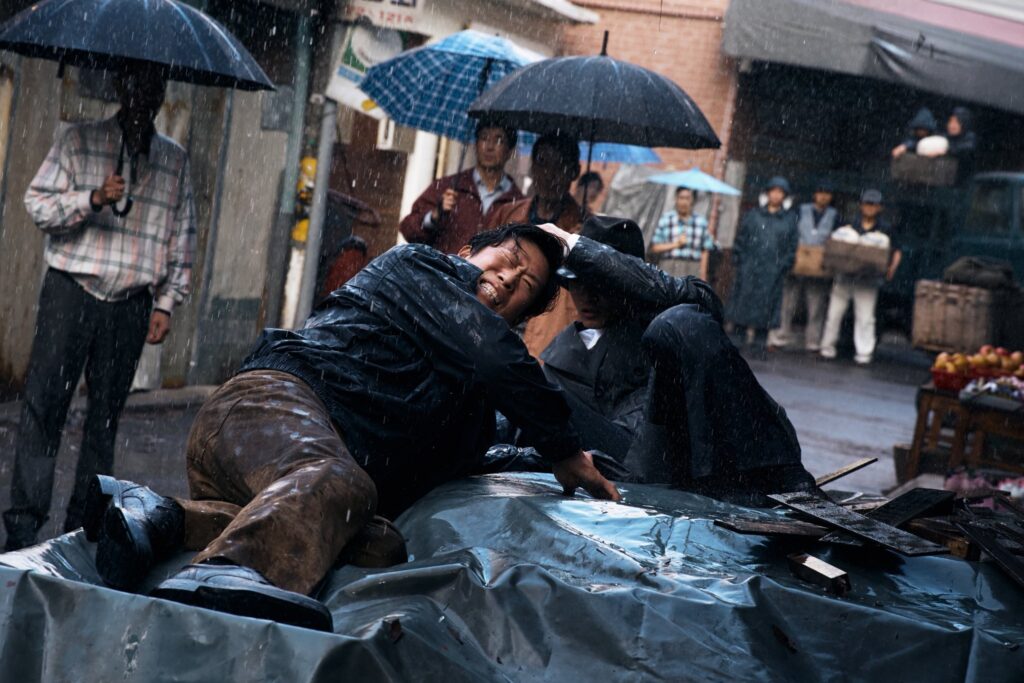
South Korean historical thriller The Assassin(s) has become something much bigger than a box-office story. Director Hur Jin-ho’s film has crossed 2.2 million admissions, but its fictional treatment of the 1974 assassination attempt on President Park Chung-hee — which instead killed First Lady Yuk Young-soo — has triggered accusations of historical distortion, a police complaint, boycott calls and protests outside lead actor Yoo Hae-jin’s home.
At the center of the dispute is not whether the 1974 shooting happened, but how much freedom a fictional movie should have when dramatizing unresolved questions around a politically sensitive historical event.
The Assassin(s) does not simply recreate the official account. It builds a thriller around questions about the investigation and introduces the possibility that there may have been forces within South Korea’s political or intelligence establishment connected to what happened. Critics from conservative political groups argue that this framing could leave audiences with the impression that Park himself or government officials were behind his wife’s death.
The filmmakers strongly reject that interpretation.
Why is The Assassin(s) being accused of distorting history?
The real incident took place on August 15, 1974, during a Liberation Day ceremony. Gunman Mun Se-gwang attempted to assassinate Park Chung-hee, but Yuk Young-soo was fatally shot. The investigation at the time concluded that Mun, an ethnic Korean living in Japan with pro-North Korean connections, had acted under North Korean direction.
Hur Jin-ho’s movie uses that event as the foundation for a fictional investigation. Among the questions raised by the film are discrepancies surrounding gunshots and evidence from the scene, material that becomes the basis for a political conspiracy thriller rather than a straightforward historical reconstruction. One line highlighted in Korean coverage asks: “On the day of the incident, six gunshots rang out at the ceremony hall. Whose gun fired the remaining two?”
That is where the political argument begins.
Members of the conservative People Power Party and organizations associated with Park Chung-hee’s legacy have accused the movie of reviving conspiracy theories and damaging the reputation of Park and his family. PPP lawmaker Yoo Young-ha, a close associate of Park’s daughter and former President Park Geun-hye, called the film an “immoral act that hurts the bereaved and betrays history.”
A former conservative city councilor subsequently filed a police complaint against Hur and the producers, turning what began as a cultural argument into a legal dispute as well.
The filmmakers say the movie does not identify a mastermind
The production team responded on September 28 with an unusually detailed statement explaining how it approached the historical material.
It said The Assassin(s) was reconstructed through “cinematic imagination” after researching public records, books, documentaries and other material related to the case. Most importantly, the filmmakers rejected the suggestion that their movie presents its theory as historical truth.
“At no point in the film is any individual identified as the mastermind behind the incident, nor does the film present its hypotheses or dramatic settings as historical facts,” the production team said.
It also insisted that the movie was not produced with a specific political agenda and asked audiences to regard it as a creative work rather than an attempt to replace the established historical record.
The company later had to address another politically charged allegation — claims that Chinese money had financed the project. Hive Media Corp. denied those reports, saying the film was independently developed and produced with South Korean capital and that there was “absolutely no truth” to claims of Chinese investment.
The controversy has now moved beyond criticism of the film
What makes the Assassin(s) situation particularly significant is how quickly the dispute moved from debating a movie to targeting the people connected with it.
Actors Lee Young-ae and Kim Go-eun faced hostile online reactions after praising the film following a VIP screening. Lee had called it “thrilling” and “deeply moving,” while Kim wrote about feeling gratitude for the present after watching it.
More seriously, conservative groups staged a protest near Yoo Hae-jin’s Seoul home on October 4, demanding that screenings stop and that the filmmakers and actors apologize. Around 50 people attended according to an unofficial police estimate cited by Korean media. Yoo’s agency, VAST Entertainment, responded the following day by saying it would take a firm stance against activity that threatened his privacy, safety or reputation.
Safety concerns have also reached the film’s promotional campaign. Hive Media Corp. withdrew Hur, Yoo Hae-jin, Park Hae-il and Lee Min-ho from planned events at the Busan International Film Festival, saying the decision was made after considering the safety of audiences and attendees. Soompi
Korean film organizations have since argued that legitimate criticism of historical interpretation should not become personal intimidation. The Producers Guild of Korea warned that the argument had expanded beyond criticism of the work into direct threats against those who made it.
The controversy has not stopped audiences from showing up
There is one particularly interesting contradiction in the story: the political backlash has not killed the movie commercially.
According to Korean Film Council data, The Assassin(s) had reached 2,233,963 admissions by October 4, less than two weeks after its September 23 release. It was also back at No. 1 at the Korean box office that day with 188,468 admissions.
The online battle has become messy enough that Naver said it detected automated abnormal activity involving reactions to reviews of The Assassin(s) and referred the matter to police. Importantly, Naver did not identify who was responsible or establish that the activity was politically motivated.
That distinction matters because the Assassin(s) debate now contains several separate issues that can easily become blurred together: whether the film’s historical speculation is responsible, whether fictional filmmakers have the right to explore disputed interpretations, and whether political criticism justifies targeting performers who did not write the screenplay.
The first two are legitimate subjects for debate. The third has increasingly become a question of safety and artistic freedom.
And that may ultimately be why The Assassin(s) controversy has grown so rapidly. The movie began by asking uncomfortable questions about a traumatic moment in South Korean history. Now the reaction to those questions has itself become part of the story.
Q&A
What historical event is The Assassin(s) based on?
The film takes inspiration from the August 15, 1974 assassination attempt on South Korean President Park Chung-hee, during which First Lady Yuk Young-soo was killed.
Does the film say Park Chung-hee ordered his wife’s killing?
The production team says no. It explicitly states that the film does not identify any particular person as the mastermind and does not present its fictional hypotheses as established historical fact.
How successful is The Assassin(s) at the Korean box office?
Korean Film Council figures show the movie had reached more than 2.23 million admissions by October 4.