Harvey Weinstein’s new 15-year prison sentence has put the legal legacy of the #MeToo era back in focus. But there is an important distinction between the hundreds of famous people who faced allegations after 2017 and the much smaller group who were actually convicted in criminal court.
#MeToo itself is a social movement, not a criminal charge, and some cases below began before the movement became global. What connects them is that their prosecutions became part of the wider reckoning over sexual abuse, power and accountability in entertainment.
Here are five of the most significant examples—and where their cases stand.
1. Harvey Weinstein
Weinstein remains the figure most directly associated with the explosion of the #MeToo movement in Hollywood.
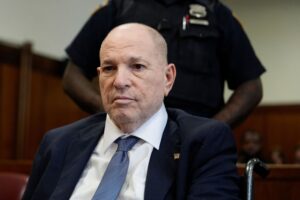
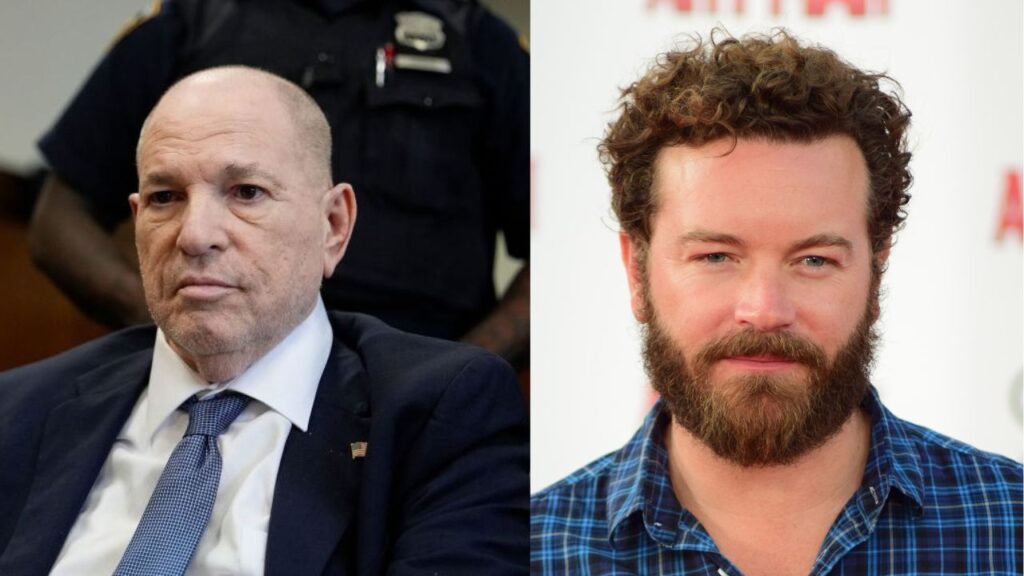
His original 2020 New York conviction was overturned in 2024 after the state’s highest court ruled that prejudicial testimony had been improperly admitted. That did not end the case. Prosecutors tried him again, and a new jury convicted Weinstein in June 2025 of a first-degree criminal sexual act against former production assistant Miriam Haley. On September 23, 2026, he was sentenced to 15 years in prison. Weinstein continues to maintain that he did not engage in non-consensual sex.
He also has a separate California conviction. A Los Angeles jury convicted him in 2022 of rape and sexual assault involving Evgeniya Chernyshova. A California appeals court upheld that conviction in 2026 but ordered Weinstein to be resentenced because his original 16-year term had improperly taken the since-overturned New York convictions into account.
So while one landmark Weinstein verdict was overturned, he now again has standing criminal convictions in both New York and California.
2. Danny Masterson
Former That ’70s Show star Danny Masterson received one of the longest sentences involving a prominent actor during the #MeToo era.
A Los Angeles jury convicted Masterson in May 2023 of raping two women at his Hollywood-area home in 2003. Jurors could not reach a verdict on a third rape charge. In September 2023, Judge Charlaine Olmedo sentenced him to 30 years to life in prison, the maximum sentence available.
Masterson has maintained his innocence. He was transferred to California state prison later that year and will have to serve more than 25 years before becoming eligible for parole under the sentence.
The case also had repercussions beyond Masterson. Ashton Kutcher and Mila Kunis faced criticism after character letters they wrote asking the judge for leniency became public; both later apologized, and Kutcher resigned as chairman of the anti-child-sex-abuse organization Thorn.
3. R. Kelly
R. Kelly’s case was broader than a conventional Hollywood sexual-assault prosecution.
The R&B singer was convicted in Brooklyn federal court in 2021 on charges including racketeering and sex trafficking, after prosecutors presented evidence that he had used his celebrity status and people around him to facilitate the abuse of girls and young women.
He was sentenced in 2022 to 30 years in federal prison.
Kelly challenged that conviction, but the U.S. Court of Appeals for the Second Circuit upheld both the convictions and his 30-year sentence in February 2025.
A separate Chicago prosecution resulted in convictions in 2022 for producing child sexual abuse material and enticing minors for sex. The 20-year sentence imposed there was structured largely concurrently with the New York sentence, effectively extending his imprisonment by one year.
Allegations against Kelly existed for decades, but public scrutiny intensified dramatically during the #MeToo period and following the 2019 documentary series Surviving R. Kelly.
4. Gérard Depardieu
France’s own #MeToo reckoning produced one of its biggest courtroom moments in May 2025.
A Paris court convicted actor Gérard Depardieu of sexually assaulting two women while working on the 2021 film Les Volets Verts. He received an 18-month suspended prison sentence. That means he was convicted but was not immediately sent to prison under that sentence. Depardieu denied wrongdoing and appealed.
The verdict carried particular significance in France because Depardieu had been one of the country’s most internationally recognizable actors and the case became a major test of how the French film industry was responding to #MeToo.
Depardieu has faced other separate allegations as well, but those should not be confused with the case in which he was convicted.
5. Christophe Ruggia
French filmmaker Christophe Ruggia’s case became another important milestone for #MeToo in French cinema.
Actor Adèle Haenel accused Ruggia of sexually abusing her when she was a child, after the two worked together on his film The Devils. She was 12 when they met; Ruggia was 36.
A Paris court convicted him in February 2025 of sexually abusing Haenel when she was underage. He initially received a four-year sentence, with two years suspended and two to be served at home under electronic monitoring.
The case then went through an appeal—and the result did not favor Ruggia. In April 2026, the Paris Court of Appeal increased the sentence to five years, including two years under electronic monitoring.
Haenel’s decision to speak publicly in 2019 had already become an important moment for France’s film industry, making the eventual conviction particularly significant to the country’s #MeToo movement.
Why Bill Cosby is a different case
Bill Cosby’s name frequently appears alongside Weinstein in discussions of #MeToo-era convictions, but his current legal status requires an important qualification.
Cosby was convicted in Pennsylvania in 2018 of aggravated indecent assault and sentenced to three to ten years in prison. But the Pennsylvania Supreme Court overturned that criminal conviction in 2021, and he was released after nearly three years behind bars.
That means it would be inaccurate today to list Cosby simply as someone with a standing criminal conviction from that case.
He has, however, subsequently lost civil cases. Most recently, a California civil jury in March 2026 found Cosby liable for sexually assaulting Donna Motsinger in 1972 and awarded her $59.25 million. A civil finding of liability is legally different from a criminal conviction.
Cuba Gooding Jr. presents another distinction. He initially pleaded guilty to a misdemeanor forcible-touching charge in New York but, after fulfilling the terms of a plea agreement, was allowed to replace it with a non-criminal harassment violation and received no jail sentence.
Those differences matter.
The #MeToo movement produced allegations, lawsuits, settlements, acquittals, overturned convictions and criminal sentences. Treating all of them as the same outcome obscures what actually happened in court.
Weinstein’s latest sentence is therefore significant not simply because another famous name faced accusations. Nearly nine years after the reporting that helped transform #MeToo into a global movement, a second New York jury convicted him—and that verdict has now produced another substantial prison term.